
Wheelchair Types: Manual, Electric or Commode — A Practical Guide for Pakistan
A wheelchair looks like a simple product until you have to buy one. Then the questions arrive fast — manual or electric? Foldable or fixed frame? With commode or without? Standard seat width or wider? Should it have a headrest? What about a reclining back? For a family in Lahore, Islamabad, or Rawalpindi arranging home care for an elderly parent, a post-stroke patient, or a spinal injury patient, choosing the right chair is a decision that shapes daily life for months or years — and getting it wrong is expensive.
This guide walks families through the types of wheelchairs Pakistan households actually use, when each type is the right choice, and the practical realities of using them at home. Nothing here replaces the physiotherapist's or occupational therapist's specific recommendation — but understanding the categories helps families ask the right questions and make sensible choices.
Who Decides Which Wheelchair Is Right
The decision belongs to the treating team, not the equipment supplier:
- Doctor / Neurologist / Orthopaedic Surgeon / Physiatrist: Sets the overall mobility plan based on the patient's condition and prognosis. Long-term wheelchair user vs temporary post-fracture user is a very different equipment question.
- Physiotherapist: Advises on posture, transfers, and safe use. Often the person best placed to say which specific features the patient needs.
- Occupational Therapist: Where available, matches the chair to the patient's home environment — doorway widths, ramps, bathroom access.
- Family / Caretaker: Knows the practical realities — who will push the chair, how many stairs are in the house, whether load-shedding affects charging plans for an electric chair.
- Equipment Supplier: Provides options, sizing, and demonstration. Not a clinical role.
Reputable home care agencies working in Pakistan usually coordinate the physiotherapist and the equipment supplier so the recommendation and the delivery arrive together, rather than the family being sent to a shop with a vague prescription.
The Main Categories at a Glance
- Standard manual wheelchair — the default choice for most short-to-medium-term needs. Someone pushes; the patient sits.
- Self-propelled manual wheelchair — larger rear wheels the patient turns themselves. For patients with functional arms who can move independently.
- Electric (power) wheelchair — battery-powered, joystick-controlled. For patients whose arms cannot self-propel but whose hands can operate a joystick.
- Commode wheelchair — has an opening or removable seat over a container, allowing use of the wheelchair as a bedside toilet.
- Reclining / tilt-in-space wheelchair — the seat and back tilt or recline for comfort and pressure relief.
- Paediatric wheelchairs — smaller frames for children.
- Bariatric wheelchairs — reinforced for heavier patients.
- Sport wheelchairs — lightweight, for active users. Uncommon at home care level.
Standard Manual Wheelchair
The most common wheelchair in Pakistani households. Basic frame, small front wheels, larger rear wheels with push handles for a caretaker or family member.
Typical Features
- Foldable X-frame for storage and transport
- Removable or swing-away armrests
- Removable or swing-away footrests
- Basic padded seat and back
- Rear wheels usually 22–24 inches
Who Typically Needs a Standard Manual Wheelchair
- Elderly patients who cannot walk long distances
- Post-fracture patients during rehabilitation
- Post-surgery patients who need transport during recovery
- Bedridden patients being moved to a doctor's appointment or for a change of scenery
- Stroke patients during the initial recovery period
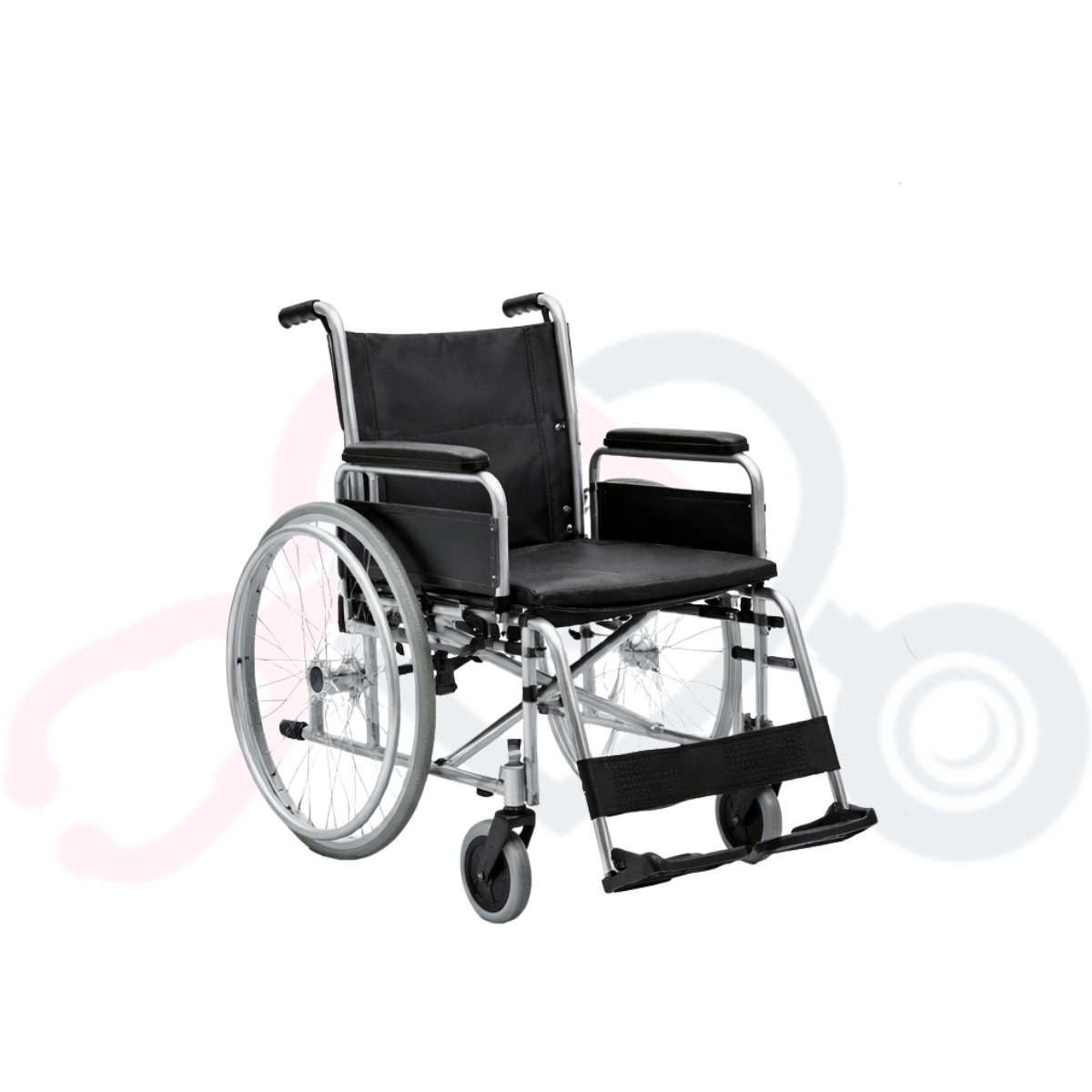
Standard Manual Wheelchair
Lightweight, foldable wheelchair with comfortable seat and durable tires for indoor and outdoor mobility. Easy to transport and store.
The strength of a standard manual wheelchair is affordability, simplicity, and portability — it folds into a car boot easily. The limitation is that it needs someone to push, which affects the patient's independence. Renting a wheelchair on rent for a defined recovery period is one of the most common medical equipment arrangements in Pakistan, precisely because most needs are temporary.
Self-Propelled Manual Wheelchair
Larger rear wheels the patient turns with their own hands. Physically similar to a standard chair but with the wheels sized and positioned for independent use.
Who Typically Needs a Self-Propelled Chair
- Paraplegic patients — normal upper body function
- Below-knee amputees with strong arms
- Patients with lower limb conditions but preserved upper body strength
- Long-term wheelchair users who value their independence
The strength is independence — the patient does not need help to move around the house. The limitation is arm fatigue over long distances or on uneven surfaces, and the need for adequate strength and coordination.
Electric (Power) Wheelchair
Battery-powered chair with a joystick controller, usually on the armrest. The patient moves by tilting the joystick.
Who Typically Needs an Electric Wheelchair
- Patients whose arms cannot generate enough power to self-propel
- Some progressive neurological conditions (motor neurone disease, advanced MS)
- High-level spinal cord injury patients with hand function preserved
- Long-term wheelchair users who cover long distances daily
Practical Realities in Pakistan
- Battery life needs planning around load-shedding — charging schedules matter
- Cost is significantly higher than manual chairs
- Weight makes them harder to transport (not easily fitted in most cars)
- Doorway and turning radius considerations matter more than for manual chairs
- Repair and servicing infrastructure is limited outside major cities
For most Pakistani households, electric wheelchairs are the right choice only when the specific benefits — independent movement for a patient who cannot self-propel — clearly justify the cost and complexity. For temporary use or for patients with adequate arm strength, a manual chair is usually the sensible choice.
Commode Wheelchair
A wheelchair with a hole in the seat, or a removable pan under the seat, that allows the patient to use it as a bedside or bathroom-side toilet.
Who Typically Needs a Commode Wheelchair
- Bedridden patients being moved from bed for toilet use
- Patients whose bathrooms are not wheelchair-accessible (very common in Pakistani homes with squat toilets)
- Elderly patients who cannot walk to the bathroom but can transfer to a chair
- Post-surgery patients during the first weeks of recovery
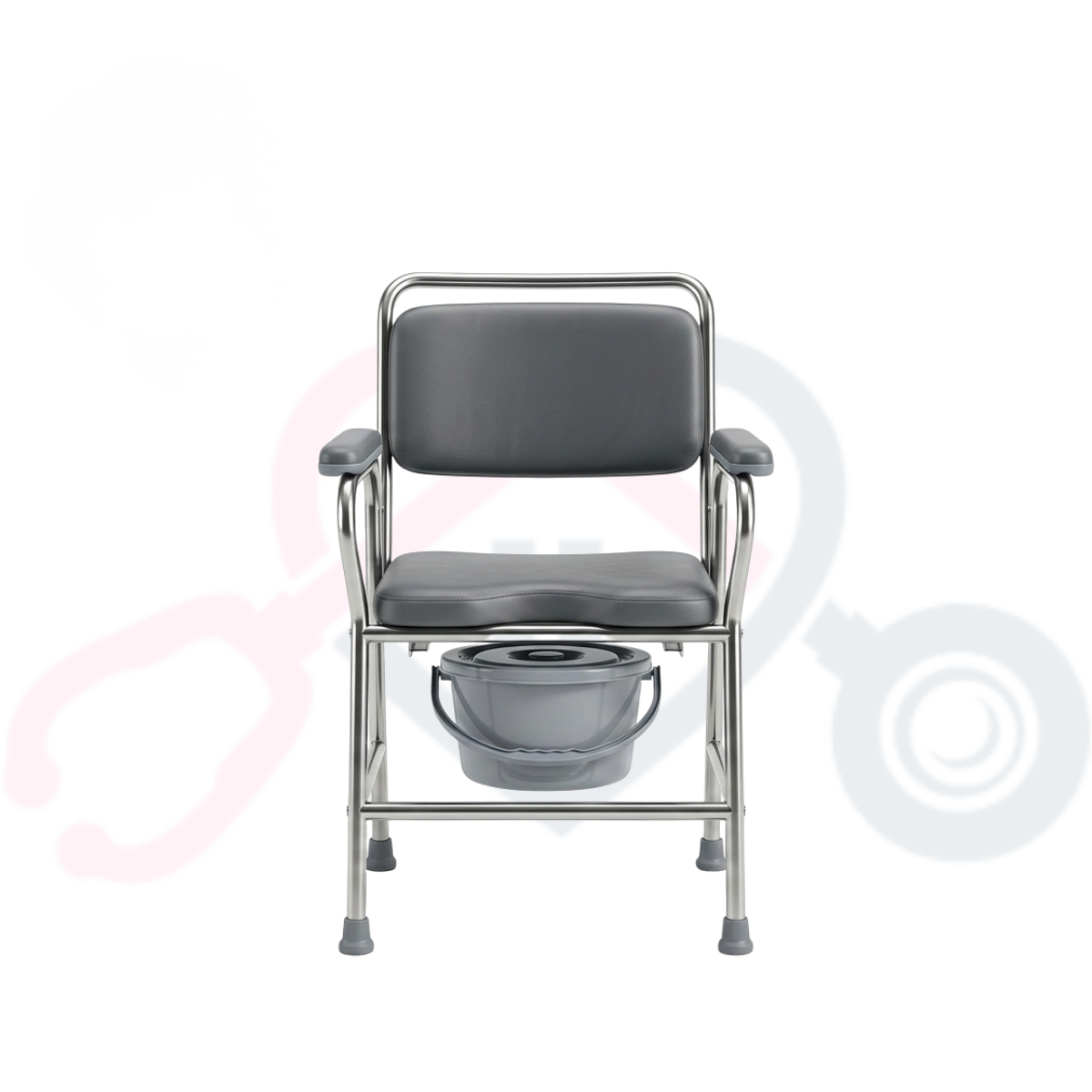
Commode Chair
2-in-1 mobility and bathroom assist chair. Designed with hygiene and patient dignity in mind.
Two Configurations
- Commode-only chair (not designed for long distance): Smaller wheels, used for the short journey from bed to bathroom or beside the bed for toileting
- Commode wheelchair (with larger wheels): Can also serve as a standard transport chair
The strength of a commode chair is dignity and practicality — for bedridden patients, being able to use a proper seated position for toileting rather than a bedpan is enormously better for both physical comfort and morale. Renting a dedicated commode chair on rent alongside a standard wheelchair is often the smoothest arrangement, using each for its actual purpose.
Reclining and Tilt-in-Space Wheelchairs
For patients who need to change position frequently for pressure relief, comfort, or medical reasons.
- Reclining wheelchairs: The backrest can be lowered like a beach chair while the seat stays flat
- Tilt-in-space wheelchairs: The entire seat-and-back unit tilts backward while maintaining the seated angle
Who Typically Needs These
- Patients with poor trunk control who cannot sit upright for long
- Patients at high pressure sore risk who need frequent position changes
- Post-operative patients who need periods of reclining
- Patients with severe respiratory conditions
Both types are more expensive and less portable than standard chairs. They are the right choice for specific medical needs; overkill for a temporary post-fracture recovery.
Paediatric and Bariatric Wheelchairs
Paediatric Wheelchairs: Smaller frames sized for children, with growth adjustability for long-term users. Choosing a paediatric chair requires the input of a paediatric physiotherapist — sizing and positioning matter enormously for a growing child.
Bariatric Wheelchairs: Reinforced frames and wider seats for heavier patients. Standard chairs have weight limits — usually around 100–110 kg. For patients above this, a bariatric chair is essential; using a standard chair beyond its weight limit is a safety hazard.
Head-to-Head: Which Wheelchair for Which Situation
| Situation | Usual Best Choice | Why |
|---|---|---|
| Elderly parent, cannot walk long distances but can walk short ones | Standard manual wheelchair | Family pushes; folds for car transport |
| Post-fracture recovery, 6–12 weeks | Standard manual wheelchair on rent | Temporary need; renting is more sensible than buying |
| Bedridden patient needing bedside toileting | Commode chair | Solves the specific problem of dignified toileting |
| Paraplegic patient with strong arms | Self-propelled manual wheelchair | Independence, control, no battery worries |
| High spinal injury, cannot self-propel | Electric wheelchair | Only way to give independent mobility |
| Frail patient with poor trunk control | Reclining or tilt-in-space wheelchair | Support and pressure relief |
| Overweight patient (over 110 kg) | Bariatric wheelchair | Standard chairs are not safe above their weight limit |
Home Setup Around the Wheelchair
Choosing the chair is only part of the arrangement. The house has to accommodate it:
Doorway Widths
Standard doorways in Pakistani homes are usually about 30 inches — enough for most standard wheelchairs but tight. Measure each doorway before deciding on a wider or bariatric chair.
Bathroom Access
The biggest challenge in most Pakistani homes. Squat toilets, small bathrooms, and step-in showers are not wheelchair-friendly. A commode chair often becomes the practical answer.
Bedroom Setup
Space around the bed for the chair to park. Ideally 30 inches of clear space on one side for safe transfers. An electric hospital bed at a height matched to the wheelchair makes transfers much safer.
Pressure Care
Long hours in a wheelchair, especially for immobile patients, cause pressure sores on the buttocks and thighs. A proper wheelchair cushion matters more than families realise. For patients who spend most of the day in bed with periodic chair time, an air mattress on rent for bed plus a wheelchair cushion together give proper protection.
Practical Considerations Before Renting or Buying
- Duration of Need: Short-term need (weeks to a few months) → rent. Long-term need (years) → buy, unless the patient's needs are likely to change.
- Storage: Foldable chairs store easily. Fixed-frame and electric chairs take significant space.
- Transport: If the patient needs to travel by car, weight and folding matter.
- Support Alongside: A wheelchair alone does not solve a home care problem. Sourcing the chair and human support (like home help) from providers who coordinate makes the whole arrangement smoother.
Common Mistakes Families Make
- Choosing Size by Guess: A chair that is too wide is unstable and hard to push through doorways. Too narrow, and the patient is uncomfortable and pressure sores develop faster. Sizing should be done properly.
- Buying Electric When Manual Would Do: For a post-fracture recovery of 8 weeks, electric chairs are almost always the wrong choice. Match the chair to the actual need.
- Skipping the Cushion: A wheelchair without a proper cushion is a pressure sore waiting to happen for any immobile patient. Cushion is not an optional accessory.
- Buying When Renting Makes More Sense: For temporary needs, renting is almost always more sensible. Reserve buying for confirmed long-term needs.
Red Flags: When Wheelchair Use Signals a Problem
For any of the following, contact the doctor or physiotherapist promptly. These are not "adjust and hope" situations — they usually mean the chair, the cushion, or the positioning needs review:
- New pressure sore or redness on the buttocks, tailbone, or thighs from wheelchair time
- Increasing pain or discomfort during sitting
- New swelling of the legs during long chair time
- Patient sliding forward and cannot stay in correct position
- Falls from or with the wheelchair
- New numbness, tingling, or weakness after chair use
- Brake failure or wheelchair becoming unstable
- Patient refusing to use the chair — often a sign it does not fit or is uncomfortable
For patient-friendly background on wheelchair selection and use, the NHS guide to getting a wheelchair or scooter is a reliable reference. For your patient's specific choice, always involve the treating physiotherapist or occupational therapist.
Frequently Asked Questions
This page is for general information regarding mobility equipment and does not constitute medical advice. Always consult with a physiotherapist or treating physician regarding the most appropriate mobility aid for a patient's specific condition.