
Infusion pump rental price
PKR 12,000 per month for an infusion pump on rent, delivered and installed at your home in Lahore.
That is the full monthly rate. Delivery is quoted upfront. Nothing is added later for setup, demonstration or servicing during the rental period. Documentation is a copy of the renter's CNIC plus the first month's advance — no heavy security deposit.
Purchase is also available if the need turns out to be long term. Message us for the current purchase price.
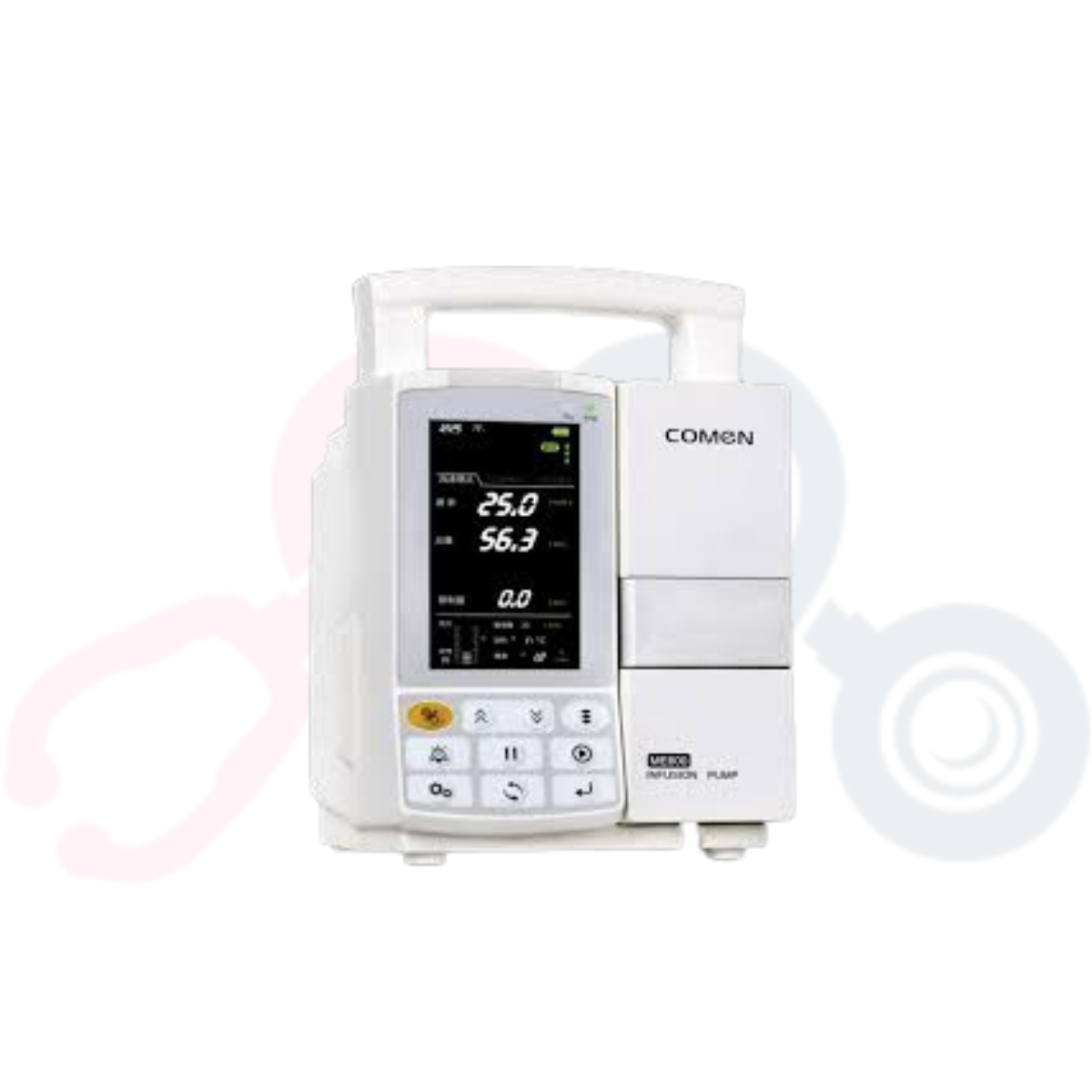
Volumetric Infusion Pump
Ensures highly accurate and continuous delivery of IV fluids and medications to patients safely at home.
What an infusion pump actually does
An infusion pump delivers fluids or medication into a vein at a controlled, measured rate over a set period. A gravity drip runs at whatever speed the roller clamp and gravity produce. A pump runs at exactly the rate the doctor prescribed, and keeps running at it.
That difference matters when the medicine is one where the rate itself is part of the treatment. Common reasons a patient comes home with one:
- Long courses of IV antibiotics after discharge
- Chemotherapy and supportive treatment between hospital cycles
- Pain management where a steady level has to be maintained
- IV fluids for patients who cannot maintain hydration by mouth
- Post-ICU patients still on measured infusions at home
Infusion pump, syringe pump or feeding pump?
These three get confused constantly, and renting the wrong one wastes a month.
| Device | What it delivers | Typical use | Monthly rent |
|---|---|---|---|
| Infusion Pump | Larger volumes of fluid or medication from a bag | IV antibiotics, fluids, chemotherapy support | PKR 12,000 |
| Syringe Pump | Very small, precise volumes from a syringe | Critical drugs given slowly in tiny doses | PKR 12,000 |
| Feeding Pump | Liquid feed into the stomach, not the vein | Patients on NG or PEG tube feeding | PKR 15,000 |
The simplest way to tell: if the prescription says the medicine goes into a vein and comes from a bag, it is an infusion pump. If it comes from a syringe in small measured amounts, it is a syringe pump. If it is food going into the stomach, it is a feeding pump.
If the discharge paper is unclear, send us a photo of it. We would rather tell you which one you need than deliver the wrong machine.
We supply equipment. We do not supply nursing staff, and we will say plainly that an infusion pump is not a device for a family to program.
The US Food and Drug Administration publishes guidance for patients using infusion pumps at home, and two of its points are worth repeating here: make sure whoever is responsible can actually read the pump's display and hear its alarms, and verify the settings whenever an infusion is started or a rate is changed.
The FDA is equally direct about why this matters. Infusion pumps frequently deliver critical fluids and high-risk medications, so a pump failure or a wrong setting has real consequences — over-infusion, under-infusion, or missed treatment.
In practice, for a home in Lahore, that means a trained nurse sets the rate, starts the infusion, responds to alarms, and checks the line. The family's job is to watch the patient, notice changes, and call when something is wrong. Rates are prescribed by the treating doctor and changed by nobody else.
What the alarms mean
Every pump alarms. New families panic at all of them, then start ignoring all of them — and the second habit is the dangerous one.
The most common causes are mechanical rather than medical:
- Occlusion / blockage — tubing kinked, clamped, trapped under the patient, or a blocked cannula
- Air in line — an air bubble detected in the tubing
- Infusion complete — the prescribed volume has finished
- Low battery — needs mains power
- Door or set error — the giving set is not loaded correctly
Whoever is caring for the patient should be able to identify which alarm is sounding and what to do about it. If nobody in the house can, that is the gap to fix before the equipment arrives — not after.
One rule: never silence an alarm without understanding why it sounded, and never adjust the rate to stop a pump complaining.
What is included, and what is not
Included in the monthly rent:
- Cleaning, inspection and full testing before delivery
- Delivery and setup at the patient's bedside
- A working demonstration for the attending nurse and family
- Servicing or replacement if the unit develops a fault during the rental
- Mains adapter and standard accessories
Not included: giving sets, IV lines, cannulas and the medication itself. These are consumables, replaced regularly, and usually prescribed or supplied through the treating team. Ask us what the ongoing monthly cost of consumables will be for your patient so there are no surprises in week three.
Important: pumps are not all compatible with every giving set. Confirm which sets work with the pump you are renting before buying a month's supply from a pharmacy.
Power backup — plan this before delivery
Infusion pumps have an internal battery, but it is a bridge, not a solution. For a patient on a continuous infusion in a city with scheduled load-shedding, this needs settling in advance.
- Ask us the battery run time on the specific unit, and test it once with the nurse present
- Keep the pump on mains power whenever possible so the battery stays charged for outages
- Give the pump its own socket — not shared with a heater, fridge or air conditioner
- Know what the nurse should do if power fails mid-infusion, before it happens
What usually comes with it
An infusion pump rarely arrives alone. Depending on the case, families in Lahore commonly add:
- IV stand — PKR 1,500 per month, to hold the pump and fluid bag at a stable height
- Patient monitor — PKR 10,000 per month, where the patient also needs vital signs tracked
- Electric hospital bed — PKR 22,000 per month, for patients spending most of the day in bed
- Syringe pump — PKR 12,000 per month, where a second, precisely measured drug is running alongside
Send us the discharge summary and we will tell you which of these the paperwork actually calls for — including the ones you can leave out.
Rent or buy?
Renting suits a course of treatment with an end date, which is what most infusion pump cases are — a few weeks of IV antibiotics, or support through a chemotherapy cycle.
Buying starts making sense when the requirement is genuinely long term and there is no expected end point. Two things sit outside the arithmetic:
Servicing. While the pump is rented, keeping it working is our responsibility. A pump is a precision device with a motor and a pressure sensor, and it is not equipment you want to be troubleshooting yourself.
What happens afterwards. Once the course finishes, a purchased pump has to be stored, maintained or sold. Families rarely factor that in at the point of buying.
If you are unsure, rent for the first month or two while the treatment plan settles, then decide with real information.
Delivery across Lahore
Same-day delivery is standard where the unit is in stock. Because most infusion pump orders follow a hospital discharge, tell us the discharge date and time when you first message so we can work backwards from it rather than react on the day.
We deliver across DHA (all phases), Gulberg, Johar Town, Model Town, Bahria Town, Askari, Wapda Town, Cantt, Garden Town, Faisal Town, Allama Iqbal Town, Valencia, and along Canal Road, Ferozepur Road, Raiwind Road and Multan Road. If your area is not listed, ask — it is usually covered. We also serve Islamabad and Rawalpindi.
Frequently asked questions
This page is general information about equipment rental and is not medical advice. Infusion therapy is prescribed by a doctor, and infusion rates are set and changed only by the treating medical team. A patient on a home infusion requires trained nursing care. For a suspected reaction, a pump failure during a critical infusion, or sudden deterioration, seek emergency medical care immediately.