
Here is the price first, and then everything that actually matters once the pump is in the room.
Feeding pump rental price in Lahore
PKR 15,000 per month for a feeding pump on rent, delivered and installed at your home in Lahore.
That is the full monthly rate. Delivery is quoted upfront, and nothing is added later for setup, demonstration or servicing during the rental. Documentation is a copy of the renter's CNIC plus the first month's advance — no heavy security deposit.
Purchase is available if the need turns out to be long term. Message us for the current purchase price.
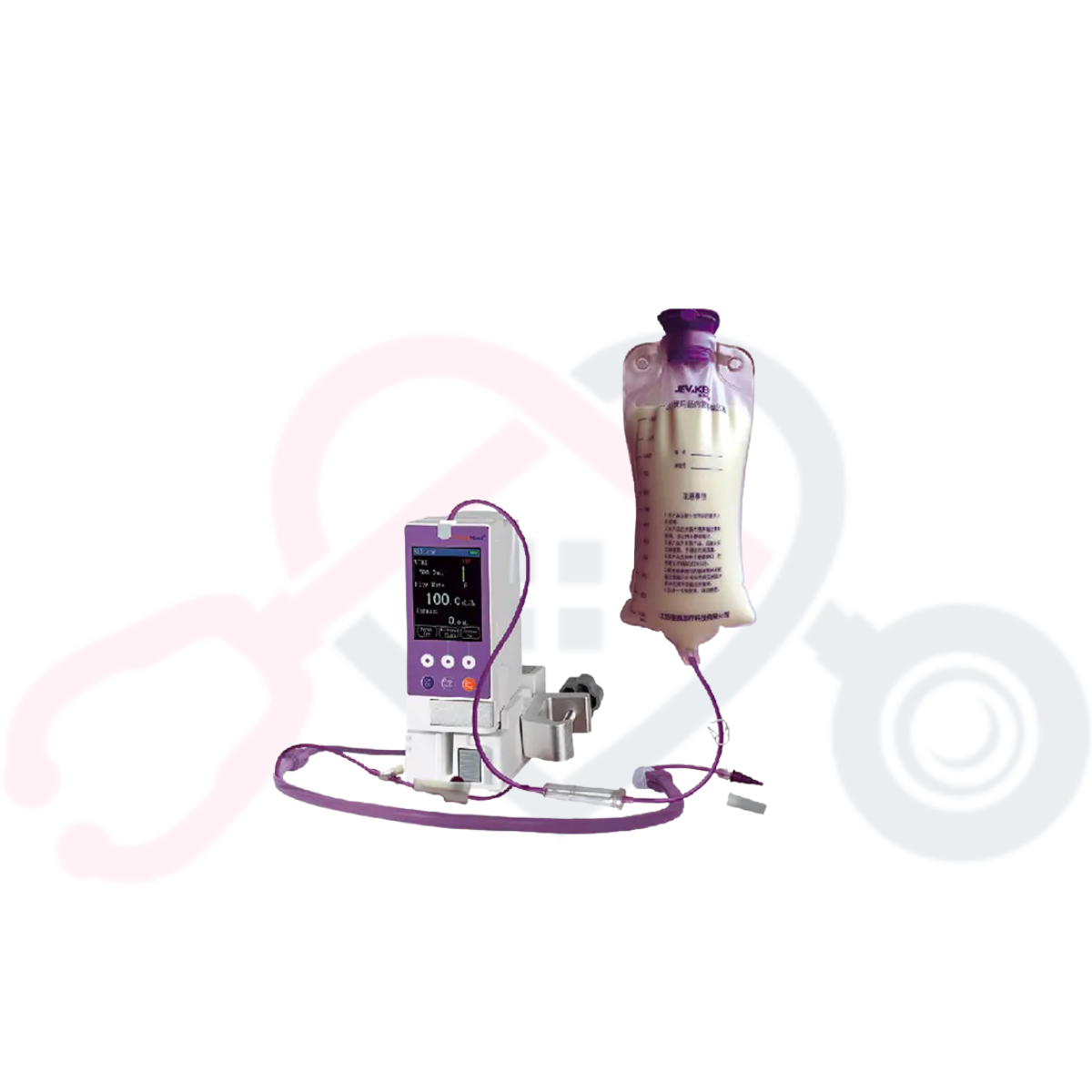
Enteral Feeding Pump
Reliable feeding pump for accurate enteral nutrition support, allowing controlled delivery of liquid feed directly to the stomach.
What a feeding pump actually does
It delivers liquid feed into the stomach at a controlled, measured rate over a set period, instead of the feed being pushed in by syringe or run in by gravity.
NHS guidance from Cambridge University Hospitals on tube feeding at home sets out the two approaches clearly. For patients with a nasogastric or gastrostomy tube into the stomach, feed can be given through an enteral feeding pump at a prescribed rate and duration, or as bolus feeding at set intervals using a syringe.
The same guidance adds a line worth taking seriously, because most home problems trace back to it: good hygiene and cleanliness when looking after the tube and setting up the feed is important.
Pump or syringe — who needs which
The doctor and dietitian decide this, but understanding why helps families follow the plan properly.
Bolus feeding by syringe suits patients whose stomach tolerates a reasonable volume at once — often more independent patients, or where the routine needs to fit around a normal day.
Pump feeding is prescribed when the feed has to go in slowly and steadily. Typically that means:
- Patients who vomit or feel bloated when fed quickly
- Patients being fed overnight while they sleep
- Patients at high risk of aspiration, where a slow controlled rate is safer
- Patients fed into the small bowel rather than the stomach — jejunal feeding almost always needs a pump
- Post-ICU patients whose gut is still adjusting after weeks of illness
- Patients needing a precise daily volume that cannot be estimated by syringe
In Lahore the most common cases we see are stroke patients with swallowing difficulty, head and neck cancer patients, patients discharged after long ICU stays, and advanced neurological conditions.
The pump is not the tube
Worth being clear about, because families sometimes expect both.
The feeding tube — a nasogastric tube through the nose, or a PEG placed through the abdominal wall into the stomach — is placed by a doctor or trained nurse in a hospital or clinical setting. We supply the pump that connects to it, not the tube.
Ask the discharging team which tube the patient has and write it down. When you call anybody for help at 2am, it is the first question you will be asked.
The rate is prescribed. It is not a setting to speed up because the feed is taking too long, or because the family wants the patient to finish before bedtime.
Running feed faster than prescribed causes vomiting, bloating, cramping and diarrhoea — and in a patient with swallowing difficulty, vomiting carries a real risk of feed entering the lungs. That is aspiration pneumonia, and it is the complication that most often sends a tube-fed patient back to hospital.
If the patient is not tolerating the feed, the answer is to tell the dietitian or doctor, who may reduce the rate. It is never to adjust the pump yourself.
Sit the patient up — every feed, every time
The head and shoulders should be elevated to roughly 30 to 45 degrees during the feed and for a period afterwards, unless the medical team has said otherwise.
This is gravity working for you, and it is the single most effective thing a household can do to prevent aspiration. It is also the step most often skipped, because the bed gets lowered for changing or washing and nobody raises it again before the next feed starts.
Pillows slide. A patient propped up on cushions at nine in the evening is often flat by midnight. An adjustable hospital bed holds the angle reliably, which is why most long-term tube-fed patients end up with one.
Feed hygiene — where things actually go wrong
Enteral feed is a nutrient-rich liquid at body temperature going directly into the stomach. It is an excellent growing medium for bacteria, and contaminated feed causes diarrhoea, vomiting and infection.
NHS guidance on home enteral tube feeding sets out the practical rules:
- Wash hands with soap and water before touching the tube, the feed or the syringe — every single time
- Handle the tube and giving sets as little as possible; every extra touch is an opportunity for contamination
- Use a new giving set every 24 hours
- Do not leave feed connected for more than 24 hours
- If feeding is stopped for more than 4 hours, the feed must go in the fridge and be used within 24 hours
- Store unopened feed at room temperature, out of direct sunlight and away from heat sources
- Try not to stop and start the feed repeatedly — it increases infection risk
One more rule that gets broken constantly: never top up a feed container that is already running. The full volume needed is put in at the start. Adding fresh feed to feed that has been hanging for hours contaminates the new feed with whatever has been growing in the old.
Hang time in a Lahore summer
This deserves its own section, because the international guidance assumes a room that is not 38 degrees.
"Hang time" is how long feed may safely stay connected at room temperature. Sterile ready-to-use feeds have a longer permitted hang time than powdered feeds mixed with water, which are far more vulnerable to bacterial growth.
In Lahore between May and September, particularly during load-shedding hours when the room is warm and still, ask the dietitian for the hang time for the specific feed being used — and treat it as a maximum rather than a target. Where there is any doubt, shorter is safer.
Practical measures through summer:
- Keep the patient's room as cool as you can manage during feeds
- Store unopened feed cartons away from windows, the kitchen and any warm wall
- Take refrigerated feed out about half an hour before use so it reaches room temperature — cold feed straight from the fridge causes cramping
- Discard anything left beyond its hang time rather than "just finishing the bag"
- Never leave a hanging feed in direct sunlight from a window
Giving sets: the compatibility trap
The feeding set — the disposable tubing that carries feed from the bag through the pump to the patient — is not included in the rental, and it is pump-specific.
A set designed for one pump will not load correctly into another. Before anybody buys a month's supply from a pharmacy, confirm with us which sets are compatible with the pump you are renting. These are not returnable, and buying the wrong ones is an expensive week.
Sets are changed every 24 hours. Budget for that in the monthly running cost alongside the feed itself.
Water, flushing and medicines
The tube is flushed with water before and after each feed, and before and after every medicine. Flushing is what keeps the tube open — a blocked tube usually means a trip to hospital to have it replaced.
The amount of water is prescribed, because it forms part of the patient's daily fluid intake. It is not something to increase because the patient looks dry, particularly in patients with heart or kidney conditions.
Medicines never go into the feed bag. They are given separately, one at a time, with a flush between each. Not every tablet can go down a tube — slow-release and enteric-coated tablets must not be crushed. Ask the doctor or pharmacist which of the patient's medicines are suitable and which need a liquid alternative.
What the alarms usually mean
Most feeding pump alarms at home are mechanical rather than medical:
- Occlusion or no flow — the tubing is kinked, clamped, trapped under the patient, or the feeding tube itself is blocked
- Feed complete — the prescribed volume has finished
- Air in line — the bag has emptied or the set is not primed
- Low battery — the pump needs mains power
- Set error — the giving set is not loaded correctly
Whoever is caring for the patient should be able to identify which alarm is sounding. Never silence one without knowing why it went off, and never increase the rate to make a pump stop complaining.
Power backup
Feeding pumps have an internal battery, which matters most for patients fed overnight.
- Ask us the battery run time on the specific unit and test it once
- Keep the pump on mains power when possible so the battery stays charged for outages
- Give it its own socket rather than sharing with a heater or air conditioner
- Know what the nurse or family should do if power fails mid-feed, before it happens
What usually goes with it
A tube-fed patient rarely needs the pump alone. Depending on the case, families in Lahore commonly add:
- Electric hospital bed — PKR 22,000 per month, to hold the feeding angle reliably
- IV stand — PKR 1,500 per month, to hang the feed bag and hold the pump
- Air mattress — PKR 4,000 per month, for patients spending most of the day in bed
- Suction machine — PKR 5,000 per month, where the patient has difficulty clearing secretions
- Patient monitor — PKR 10,000 per month, where vitals also need tracking
Send us the discharge summary and we will tell you which of these the paperwork actually calls for — including the ones you can leave out.
Rent or buy?
Renting suits feeding with an expected end point — a stroke patient who may recover swallowing, or a cancer patient during a treatment course.
Buying starts making sense where the requirement is clearly long term with no expected end. Two things sit outside the arithmetic. While the pump is rented, repairing or replacing it stays our responsibility, and a feeding pump is a precision device with a motor and sensors. And once the need ends, a purchased pump has to be stored, maintained or sold.
Most families are better served renting for the first two or three months while the clinical picture settles, then deciding.
Delivery across Lahore
Same-day delivery is standard where the unit is in stock. Because most feeding pump orders follow a hospital discharge, tell us the discharge date and hour when you first message so we can plan backwards rather than react on the day.
We deliver across DHA (all phases), Gulberg, Johar Town, Model Town, Bahria Town, Askari, Wapda Town, Cantt, Garden Town, Faisal Town, Allama Iqbal Town, Valencia, and along Canal Road, Ferozepur Road, Raiwind Road and Multan Road. If your area is not listed, ask — it is usually covered. We also serve Islamabad and Rawalpindi.
Frequently asked questions
This page is general information about equipment rental and is not medical advice. Tube feeding is prescribed by a doctor and dietitian, and feed type, volume, rate and flushing amounts are set for each individual patient — always follow the plan your medical team has provided. Never adjust the feeding rate or add medicines to the feed. For vomiting, coughing or breathlessness during or after a feed, sudden abdominal pain, or a blocked tube, seek medical advice immediately.