
Rental price
PKR 15,000 per month for a feeding pump on rent, delivered and installed at your home in Islamabad or Rawalpindi.
That is the full monthly rate — nothing added later for setup, demonstration or servicing during the rental. Delivery is quoted before you commit. Documentation is a copy of the renter's CNIC and the first month's advance, with no heavy security deposit. Purchase is available for long-term needs; message us for the current price.
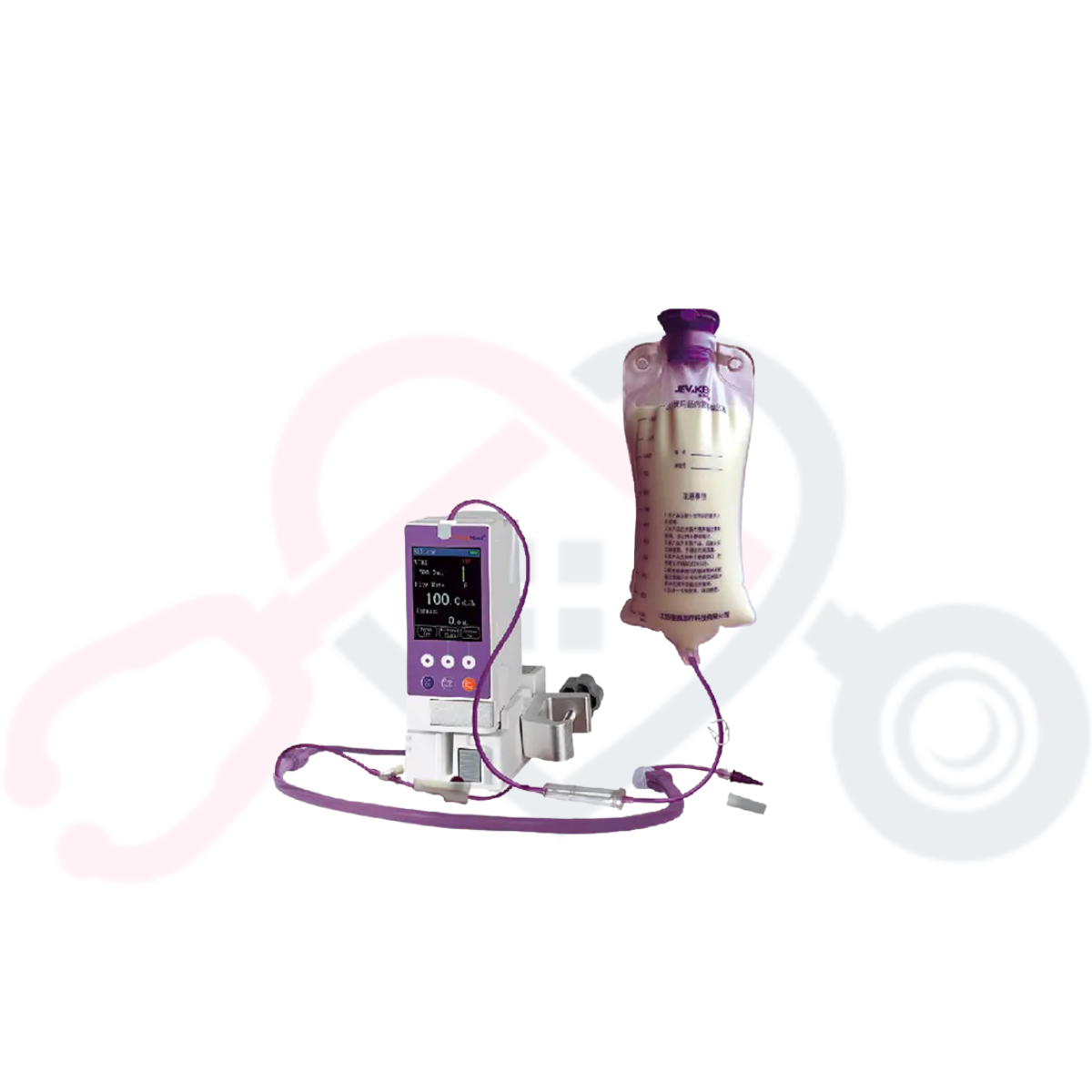
Enteral Feeding Pump
Reliable feeding pump for accurate enteral nutrition support, allowing controlled delivery of liquid feed directly to the stomach.
Who comes home tube-fed in the Twin Cities
Four situations account for most of the feeding pumps we deliver across Islamabad and Rawalpindi:
- Stroke patients whose swallowing has been affected, often the largest group
- Head and neck cancer patients, during or after treatment
- Patients discharged after long ICU stays, where the gut is still adjusting
- Advanced neurological conditions where swallowing has become unsafe
The pump is prescribed when feed has to go in slowly and steadily rather than by syringe — for patients who vomit or bloat when fed quickly, patients fed overnight, patients at high risk of aspiration, and anyone fed into the small bowel rather than the stomach.
This deserves a straight answer, because families ask it constantly and are usually given a vague one. Not through a pump.
Blending household food and giving it through a feeding tube — often called a blended or blenderised diet — is a real practice with genuine benefits for some patients, and dietitians increasingly support it where it is appropriate. NHS guidance from the Northern Care Alliance on blended diet for enteral feeds describes it plainly: everyday foods blended into a thin puree, about the consistency of single cream, given through a gastrostomy tube.
But the same guidance is equally clear that it is not suitable for everyone. It is unsuitable for patients who are immunocompromised or fed into the jejunum, and it is not recommended for patients fed through a nasogastric tube — NG tubes are thinner and longer than gastrostomy tubes, and splitting the tube could lead to aspiration.
And specifically on pumps, UK NHS guidance is blunt: pumps are not calibrated for that consistency of feed, and feeding pump manufacturers advise against using blended diet in a pump. Where blended diet is used, it is given by syringe with a slow, controlled technique — not run through a pump.
So what does that mean for a family in Islamabad who wants their father to have real food rather than cartons?
- The pump runs commercial feed. That is what it is designed and calibrated for
- Blended food, if used at all, goes by syringe — and only after a dietitian has assessed whether this patient is suitable
- Never through an NG tube without specialist advice
- Never mixed into the pump feed bag to "make it more nutritious." It will block the set, block the pump, and often block the tube itself
- Some patients use both — commercial feed via pump overnight, blended food by syringe during the day. That combination needs the dietitian's approval, not a family decision
A blocked tube usually means a trip back to hospital to have it replaced. A blocked pump means a service call. Neither is worth the shortcut.
Winter in Islamabad: feed temperature and storage
Cold matters here in a way it does not further south.
Feed straight from the fridge causes cramping, and sometimes diarrhoea. Take it out roughly half an hour before use so it reaches room temperature. In an unheated Islamabad room in January, "room temperature" may itself be cold — the fix is time out of the fridge, not warming it on a heater or in a microwave, which damages the feed.
Storage rules that hold all year:
- Store unopened feed at room temperature, away from direct sunlight and away from heaters or warm walls
- If feeding stops for more than four hours, refrigerate the feed and use it within 24 hours
- Never leave feed connected for more than 24 hours
- Use a new giving set every 24 hours
- Never top up a container that is already running — decant the full volume at the start
Overnight feeding and load-shedding
Many Twin Cities patients are fed overnight while they sleep, which is exactly when a power cut is least convenient.
- Ask us the battery run time on the specific unit and test it once with the nurse present
- Keep the pump on mains power whenever possible so the battery is charged when it is needed
- Give the pump its own socket, not shared with a heater or air conditioner
- Agree in advance what happens if a feed is interrupted mid-run — the nurse or dietitian decides whether it resumes or is abandoned, not the family
- In older Rawalpindi houses, have the circuit checked if several devices will run together
One more overnight point: the head of the bed must stay elevated through the feed and afterwards. A patient who slides flat at 2am while a feed is running is at real risk of aspiration. An adjustable hospital bed holds that angle reliably; pillows do not.
Giving sets: check compatibility first
The giving set is not included in the rental, and it is pump-specific. A set made for one pump will not load correctly into another.
Before anyone buys a month's supply from a pharmacy in Blue Area or Saddar, confirm with us which sets work with the pump you are renting. They are not returnable, and this catches families out regularly.
Planning around a hospital discharge
Most feeding pump orders in the Twin Cities follow a discharge — from PIMS, Shifa, Kulsum, Maroof or Ali Medical in Islamabad, or Holy Family, Benazir Bhutto Hospital, CMH or the Institute of Cardiology in Rawalpindi.
Three things worth settling before the patient leaves the ward:
- Which tube does the patient have — NG or PEG? Write it down. It changes what is possible at home, including the blended diet question above
- What feed, what volume, what rate, and who supplies the feed
- Who will run the pump. In the early weeks this is a nurse's job. Families are sometimes trained for long-term feeding, but that training comes from the medical team, formally
Message us as soon as discharge is mentioned rather than on the day. Arrangements made in the final few hours are the ones that go wrong.
What usually goes with it
- Electric hospital bed — PKR 22,000 per month, to hold the feeding angle
- IV stand — PKR 1,500 per month, for the feed bag and pump
- Air mattress — PKR 4,000 per month, for patients mostly in bed
- Suction machine — PKR 5,000 per month, where secretions are difficult to clear
- Oxygen concentrator — PKR 15,000 per month, where oxygen has been prescribed alongside
Send us the discharge summary and we will tell you which of these the paperwork actually calls for — including the ones you can leave out.
Delivery across Islamabad and Rawalpindi
Same-day delivery is standard where the unit is in stock.
Islamabad: the F, G, E, I and H sectors, DHA, Bahria Town, Gulberg Greens and Residencia, Park View City, B-17, PWD, Soan Garden, Bani Gala and Chak Shahzad.
Rawalpindi: Saddar, Satellite Town, Westridge, Chaklala, Lalazar, Morgah, Askari, Bahria Town, DHA, Gulraiz, Media Town, Adiala Road and Chakri Road.
A feeding pump is compact, so apartment blocks in G-11, I-8 and E-11 present no access problem — mention the floor only if a hospital bed is coming with it. Cantonment addresses in Rawalpindi need a gate pass arranged in advance, so tell us when booking rather than on the day.
Frequently asked questions
This page is general information about equipment rental and is not medical advice. Tube feeding is prescribed by a doctor and dietitian, and the feed type, volume, rate and route are decided for each individual patient. Blended diet should only be used where a dietitian has assessed the patient as suitable. Never adjust the feeding rate or add anything to the prescribed feed. For vomiting, coughing or breathlessness during or after a feed, sudden abdominal pain, or a blocked tube, seek medical advice immediately.