
Patient monitor rental price in Lahore
PKR 10,000 per month for a patient monitor on rent, delivered and installed at your home in Lahore.
That is the full monthly rate. Delivery is quoted upfront, and nothing is added later for setup, demonstration or servicing during the rental. Documentation is a copy of the renter's CNIC plus the first month's advance — no heavy security deposit. Purchase is available for long-term needs; message us for the current price.
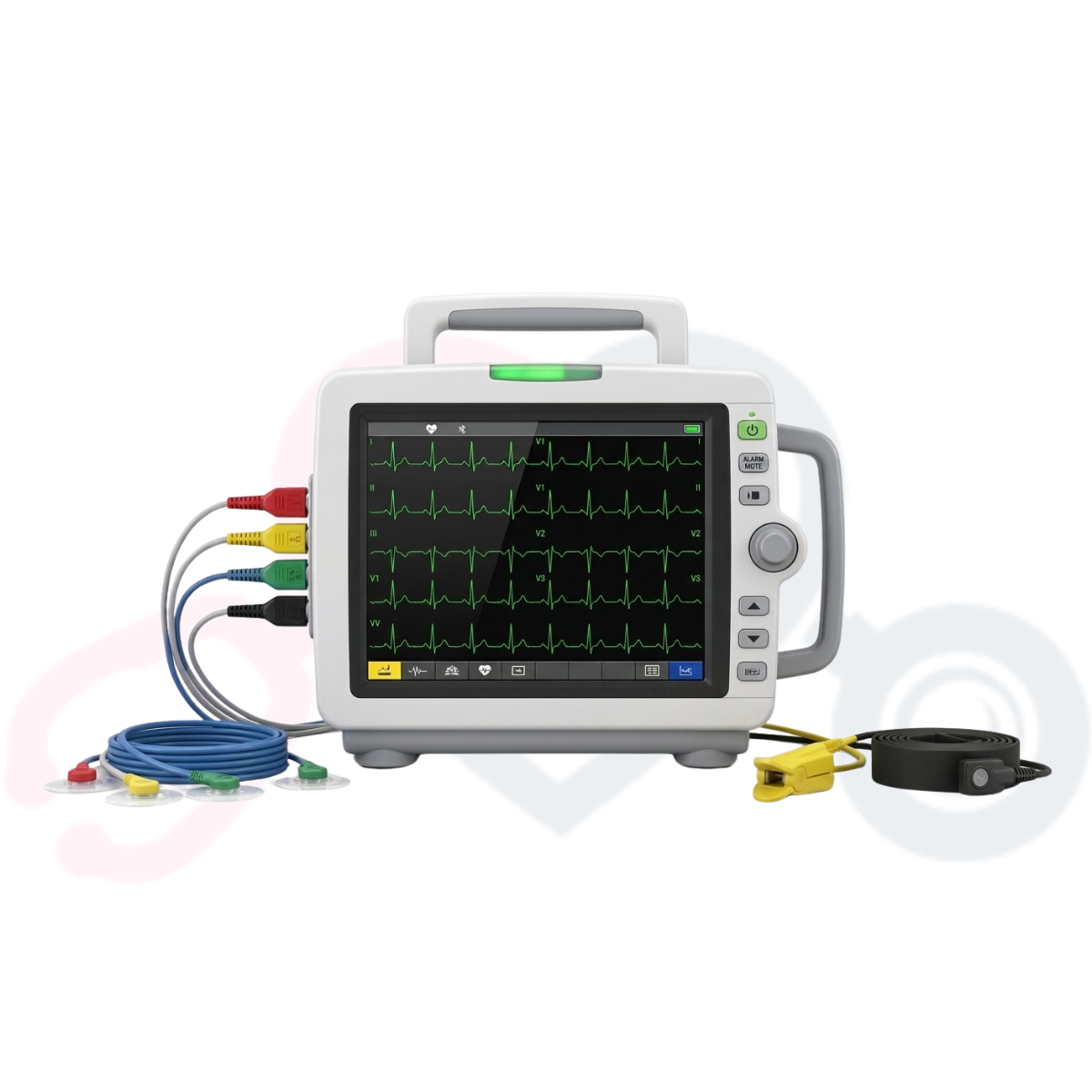
Multi-Parameter Patient Monitor
ICU-grade monitor tracking ECG, SpO2, NIBP, Respiration, and Temperature in real-time continuously.
What a patient monitor shows
An ICU-grade patient monitor tracks several things continuously and alarms when any of them moves outside a set range:
- ECG — the electrical activity of the heart, shown as a moving trace
- Heart rate — beats per minute
- SpO2 — oxygen saturation, through a finger or toe probe
- NIBP — blood pressure, taken automatically on a set schedule
- Respiration rate — breaths per minute
- Temperature — through a skin or probe sensor
The word that matters in that list is continuously. That is the entire difference between a monitor and a handheld device, and it is what you are paying for.
Patient monitor or cardiac monitor?
Families use these terms interchangeably and they are not the same thing, so it is worth being clear before renting either.
| Feature | Patient Monitor | Cardiac Monitor |
|---|---|---|
| Tracks | ECG, heart rate, SpO2, blood pressure, respiration, temperature | Focused on continuous heart activity |
| Best for | Post-ICU patients, ventilated patients, anyone needing a full picture | Patients discharged after a cardiac admission or procedure |
| Monthly rent | PKR 10,000 | PKR 12,000 |
If the discharge summary is unclear about which the patient needs, send us a photo of it. We would rather tell you than deliver the wrong machine. See the cardiac monitor page if the case is specifically cardiac.
Does your patient actually need one?
This section costs us rentals and we include it anyway, because the wrong answer here wastes money for months.
A patient monitor is genuinely needed when:
- The patient is on a ventilator or has a tracheostomy
- The patient has come home from an ICU and the doctor has asked for continuous observation
- Several supports are running together — oxygen, infusions, feeding — and the picture needs watching as a whole
- The patient is unstable enough that a change overnight would matter, and there is trained staff present to act on it
A handheld pulse oximeter is often enough when:
- The patient is stable and recovering
- The doctor has asked for oxygen levels to be checked a few times a day, not watched continuously
- There is nobody trained at home to interpret a monitor anyway
- The family wants reassurance rather than clinical monitoring
That last point deserves saying plainly. A monitor in a room with nobody who can read it is an expensive alarm clock. It will beep at three in the morning for a probe that slipped off a cold finger, and the family will spend the night frightened for no reason. If continuous monitoring is genuinely needed, so is somebody trained to interpret it. Arrange the nursing first, then the monitor.
Since many families choose a handheld oximeter instead, this matters. The US Food and Drug Administration has issued guidance on pulse oximeter accuracy across skin tones, noting that current scientific evidence suggests there are accuracy differences in pulse oximeter performance between individuals with lighter and darker skin pigmentation.
FDA's safety communication indicates this difference is typically small at saturations above 80 percent, and greater when saturations fall below 80 percent. Read that carefully: the discrepancy is largest exactly when the patient is sickest.
For a country where most patients have darker skin, that is not an academic point. It means a reassuring oximeter reading in a patient who looks unwell should not settle the question. FDA gives practical advice: remove nail polish, keep the finger warm and relaxed below the heart, wait for a steady number, and do not rely on the oximeter alone to assess the patient's condition.
Look at the patient before you look at the screen
A patient who is breathing comfortably, has normal colour and responds to you normally is a patient who is probably fine, whatever a number says.
A patient who is struggling to breathe, has grey or bluish lips, is confused or cannot be woken needs urgent help — even if every number on the monitor looks acceptable. Numbers support the picture. They do not replace it.
The alarms, and the trap that follows them
New families jump at every alarm. Two weeks later, nobody looks up. That second habit is the dangerous one. Most alarms on a home monitor are technical rather than clinical:
- The SpO2 probe has slipped, or the finger is cold
- An ECG electrode has lost contact — sweat, dry skin, or an old sticker
- The patient moved, coughed or was turned
- The blood pressure cuff shifted during a reading
- Alarm limits were left at factory defaults that do not suit this patient
Frequent false alarms are not something to tolerate. They exhaust the household and train everyone to ignore the sound — which is precisely when a real alarm goes unnoticed. If the monitor is alarming constantly, have the nurse review the probe placement and the alarm limits.
Two things nobody at home should do: change the alarm limits to stop the noise, or silence an alarm without knowing why it sounded. Limits are set for this patient, and widening them removes the entire point of the monitor.
What is included, and what is not
Included in the monthly rent:
- Cleaning, inspection and full testing before delivery
- Delivery and installation at the patient's bedside
- A working demonstration for the attending nurse and family
- Servicing or replacement if the unit develops a fault during the rental
- Mains adapter and standard cables
Not included: ECG electrodes, which are consumables replaced regularly. Cuffs and probes wear out with use and may need replacing on a long rental. Ask us the expected monthly cost of consumables for your patient so there are no surprises in week three. One practical note: electrodes are single-use. Peeling one off and re-sticking it is a common shortcut that produces exactly the loose-contact alarms families then complain about.
Power backup
A patient monitor has an internal battery, but it is a bridge rather than a plan.
- Ask us the battery run time on the specific unit and test it once with the nurse present
- Keep the monitor on mains power so the battery is charged when it is needed
- Give it its own socket, not shared with a heater or air conditioner
- After any power cut, check the settings. Medical devices often reset to default mode when power is interrupted, and alarm limits set for your patient may not survive an outage
That last point is the one families never think of, and it matters more than the battery.
Setting up the room
- Place the monitor where it can be seen from the door, not tucked behind the bed
- Run cables so nobody trips and nothing pulls on the patient
- Keep the screen out of direct sunlight — it is unreadable in glare
- Make sure alarms are audible from wherever the nurse or family will be
- Keep a notebook beside it. Readings written two or three times a day show the doctor a pattern; a screen shows only this moment
What usually goes with it
A patient monitor rarely arrives alone. Depending on the case, families in Lahore commonly add:
- Oxygen concentrator — 5L PKR 15,000 per month, where oxygen has been prescribed
- Suction machine — PKR 5,000 per month, for patients who cannot clear secretions
- Electric hospital bed — PKR 22,000 per month, for patients mostly in bed
- Infusion pump — PKR 12,000 per month, where IV medication is running
- Air mattress — PKR 4,000 per month, to protect the skin
Send us the discharge summary and we will tell you which of these the paperwork actually calls for — including the ones you can leave out.
Rent or buy?
Renting suits monitoring with an expected end point, which is what most cases are — a few weeks or months of observation after an ICU discharge while the patient stabilises.
Buying only makes sense where continuous monitoring will be needed indefinitely. Two things sit outside the arithmetic: while the unit is rented, repairing or replacing it stays our responsibility, and once monitoring ends a purchased machine has to be stored, maintained or sold.
Most families are better served renting for the first two or three months while the clinical picture settles, then deciding.
Delivery across Lahore
Same-day delivery is standard where the unit is in stock. Because most monitor orders follow a hospital discharge, tell us the discharge date and hour when you first message so we can plan backwards rather than react on the day.
We deliver across DHA (all phases), Gulberg, Johar Town, Model Town, Bahria Town, Askari, Wapda Town, Cantt, Garden Town, Faisal Town, Allama Iqbal Town, Valencia, and along Canal Road, Ferozepur Road, Raiwind Road and Multan Road. If your area is not listed, ask — it is usually covered. We also serve Islamabad and Rawalpindi.
Frequently asked questions
This page is general information about equipment rental and is not medical advice. Monitoring requirements, target ranges and alarm limits are decided individually by the treating doctor — never adjust them at home. A monitor does not replace clinical assessment. For breathing difficulty, blue or grey lips, chest pain, sudden confusion or unresponsiveness, seek emergency medical care immediately rather than relying on a reading.