
Air mattress rental price
PKR 4,000 per month for an air mattress on rent, delivered and installed at your home in Islamabad or Rawalpindi.
That is the full monthly rate — nothing added later for setup, demonstration or servicing during the rental. Delivery is quoted before you commit. Documentation is a copy of the renter's CNIC plus the first month's advance, with no heavy security deposit. Purchase is available for long-term needs; message us for the current price.
At this price it is the cheapest genuinely preventive item in home care, and the one that saves families the most.
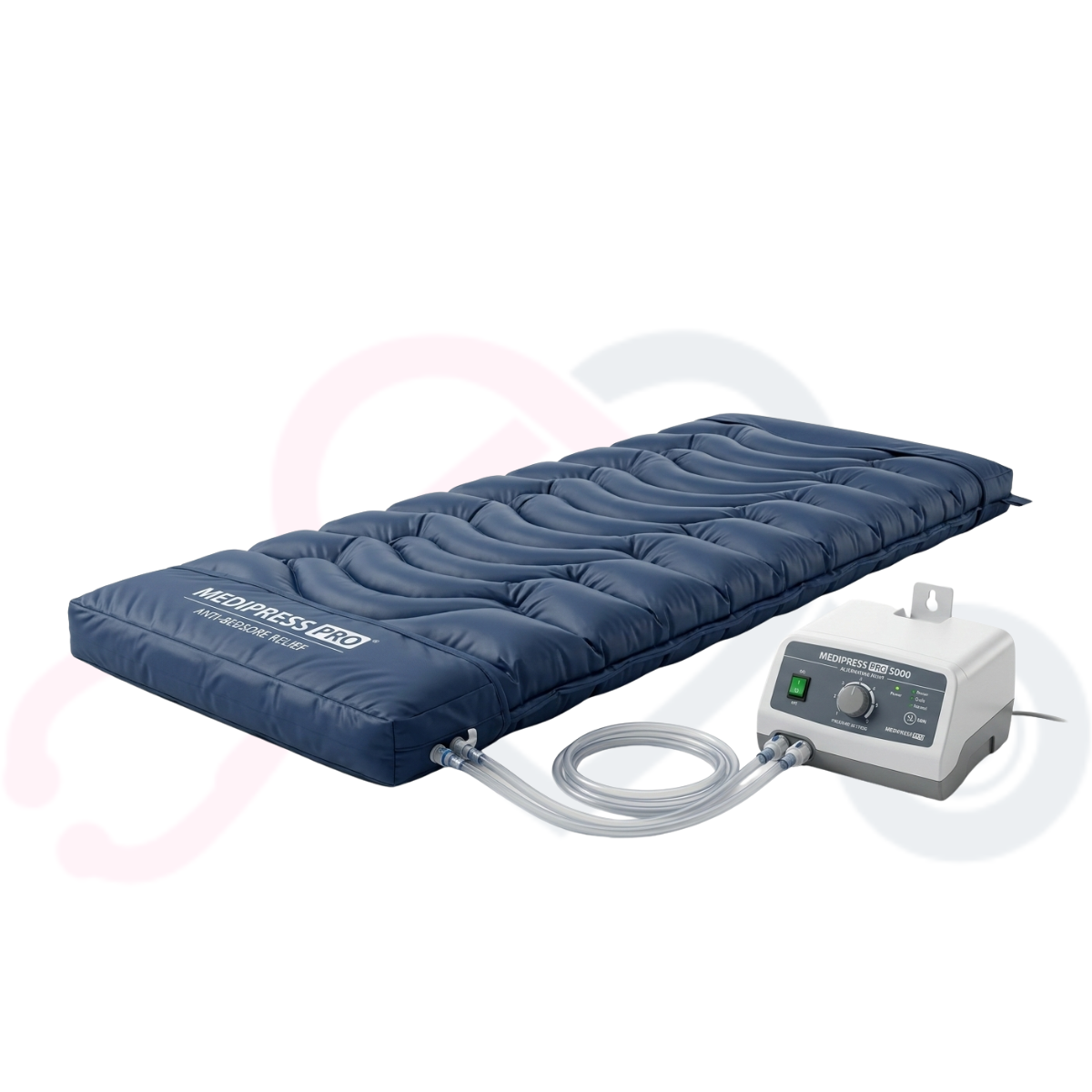
Medical Air Mattress (Anti-Bedsore)
Alternating pressure pad and pump system designed to prevent and treat bedsores for bedridden patients.
What an air mattress actually does
NICE clinical guidance describes pressure redistributing devices precisely: an alternating-pressure mattress is made of air-filled sacs that inflate and deflate in sequence, relieving pressure at different points on the body for short periods.
That is the whole mechanism. Cells under the hips inflate while cells under the shoulders deflate, then they swap. No single area of skin carries the patient's weight continuously.
A pressure sore forms when blood flow to an area of skin is cut off by unrelieved pressure. Relieve the pressure in cycles and you interrupt that process — which is why the mattress works.
An air mattress reduces the risk. It does not remove it, and it does not replace turning the patient.
This is not a cautious disclaimer. In a large NHS trial comparing alternating-pressure mattresses against a good foam mattress combined with repositioning every four hours, the rate of pressure ulcers was essentially the same in both groups — 15.3% against 15.6%.
Read that carefully. The mattress alone performed no better than turning alone. Which means the two are not alternatives — the protection comes from doing both.
The rule for any household with an air mattress: Keep repositioning on the schedule the doctor or nurse set. The mattress is in addition to that, not instead of it.
Who needs one
The more of these that apply, the more urgent it is:
- The patient cannot reposition themselves in bed
- They are spending most of the day and night in bed
- They are elderly, thin, or have lost weight — less padding over the bones
- They have diabetes or poor circulation, which slows healing
- They are incontinent, since moisture softens skin and makes it break down faster
- They are eating poorly — skin is rebuilt from protein
- They have had a pressure sore before, which is the strongest single predictor
- They are sedated, unconscious or paralysed, and cannot feel discomfort
Common cases in the Twin Cities: patients home after a long ICU stay, stroke patients, advanced neurological conditions, hip fracture patients, and elderly patients in the last phase of illness.
Order it before you need it
The most expensive mistake in this whole article is waiting.
Pressure damage can begin within hours in a vulnerable patient, and the first sign — a patch of redness that does not fade when you press it — is easy to miss under a blanket. Once skin breaks, healing takes weeks to months and often needs regular nursing.
If a patient is coming home bedbound, the mattress should be on the bed before they arrive, alongside the rest of the equipment. Renting it as a precaution for a month costs less than a single week of treating a wound that could have been avoided.
Setting it up properly
An air mattress installed badly protects considerably less than one installed well. These are the mistakes we see.
- Too many layers on top. One thin sheet only. A thick mattress cover, a folded blanket or a rubber sheet under the patient defeats the alternating action entirely
- Sheets tucked tight. Tight bedding creates a hammock effect and stops the cells rising and falling. Leave it loose
- Pump set wrong. Most pumps have a firmness dial set by patient weight. Ask us to set it, and check it if the patient's weight changes
- Pump placed on the floor or hidden. Hang it on the bed frame as designed, where air can circulate and you can hear it working
- Hoses kinked or trapped under the bed frame
- Nobody checks it. Put a hand under the patient's hip once a day — you should feel the cells rising and falling, and your hand should not touch the base of the mattress
Where sores actually form — and the part the mattress misses
Check these areas daily, in good light, when washing or changing the patient:
- The tailbone and lower back — the most common site by a wide margin
- Hips, on both sides
- Heels
- Shoulder blades and elbows
- The back of the head, particularly in very thin patients
- Ears, where oxygen tubing rests
- Under any tubing, strap or catheter line pressing on skin
Now the important exception: an air mattress protects heels poorly. The heel is a small bony point with almost no padding, and it does not sink into the mattress the way the hips do. Heels need their own protection — a pillow placed lengthwise under the calves to float the heels clear of the bed entirely. Ask the nurse to show you.
The check that matters: if you find redness, press it gently with a finger. Skin that turns white and then pink again is coping. Redness that stays red when pressed is early pressure damage, and needs reporting the same day.
Load-shedding: the question to ask before delivery
An air mattress runs on an electric pump. When the power goes, the pump stops.
Most mattresses have a static or CPR valve that holds air for a period so the patient is not lying on a deflating surface, but the alternating action stops. For a long outage in Islamabad or Rawalpindi that matters.
- Ask us how long the specific unit holds air without power
- Put the pump on a UPS if the patient is at high risk — it draws very little power, so a small UPS runs it for hours
- Reposition manually during any extended outage, whatever the schedule says
- Give the pump its own socket rather than sharing with a heater or air conditioner
- Check the pump is running again after power returns — it is quiet, and families do not always notice
Moisture, summer and hygiene
Moisture is the second half of the pressure sore problem, and in a Rawalpindi summer it becomes the bigger half.
- Change wet or soiled bedding immediately — skin left damp breaks down far faster than dry skin under the same pressure
- Keep the room cool where possible; sweat under a plastic mattress surface is its own problem
- Wipe the mattress cover with a damp cloth and mild detergent as instructed, and let it dry fully
- Do not use bleach or harsh chemicals on the cover — they damage the waterproof layer
- Never place a plastic sheet directly between the patient and the mattress
What usually goes with it
An air mattress is rarely the only item a bedbound patient needs. Families in the Twin Cities commonly add:
- Electric hospital bed — PKR 22,000 per month. Adjustable height and backrest make turning far easier and safer, and protect the carer's back
- Suction machine — PKR 5,000 per month, where the patient cannot clear secretions
- Oxygen concentrator — PKR 15,000 per month, where oxygen has been prescribed
- Feeding pump — PKR 15,000 per month, for tube-fed patients
- Patient monitor — PKR 10,000 per month, where vitals need tracking
Send us the discharge summary and we will tell you what the paperwork actually calls for — including the items you can leave out.
Delivery across Islamabad and Rawalpindi
Same-day delivery is standard where the unit is in stock. An air mattress is light and folds down, so access is rarely a problem — apartment blocks in G-11, I-8 and E-11 are fine.
Islamabad: the F, G, E, I and H sectors, DHA, Bahria Town, Gulberg Greens and Residencia, Park View City, B-17, PWD, Soan Garden, Bani Gala and Chak Shahzad.
Rawalpindi: Saddar, Satellite Town, Westridge, Chaklala, Lalazar, Morgah, Askari, Bahria Town, DHA, Gulraiz, Media Town, Adiala Road and Chakri Road.
Cantonment addresses in Rawalpindi need a gate pass arranged in advance — mention it when booking rather than on the day. If a hospital bed is coming too, tell us the floor and whether there is a lift.
Frequently asked questions
This page is general information about equipment rental and is not medical advice. An air mattress reduces pressure ulcer risk but does not replace repositioning, skin checks, good nutrition and proper nursing care. Repositioning schedules and wound treatment should be set by the patient's treating doctor or nurse. If you notice redness that does not fade when pressed, broken skin, discharge, or a foul smell from any pressure area, seek medical advice promptly.