This guide walks Twin City families through renting the right nebuliser, where delivery and support work well, how to use the machine safely at home, and what to confirm before signing a rental agreement. Nothing here replaces the treating doctor's prescription — the medicine, dose, and frequency are always set by the doctor.
Why a Nebuliser Makes a Difference at Home
A nebuliser turns liquid medicine into a fine mist that the patient breathes in through a mask or mouthpiece. The medicine reaches the airways directly — faster and often more effective than oral medications for acute wheeze, chest tightness, and breathing problems.
Common conditions where home nebulisation helps:
- Asthma — acute attacks and daily control
- COPD — exacerbations and maintenance therapy
- Chest infections (bronchitis, pneumonia recovery)
- Croup and viral wheeze in children
- Pre-surgery lung preparation
- Post-stroke patients with weak cough and chest congestion
- Smog-season flare-ups in Lahore and the dry pollen weeks in Islamabad
The medicine, timing, and length of treatment are prescribed by the doctor — not chosen by the family or supplier.
Nebuliser Types Available in Islamabad
| Type | How It Works | Best Use |
|---|---|---|
| Compressor (jet) nebuliser | Air compressor forces air through liquid medicine to create mist | Standard home use, all common medications |
| Ultrasonic nebuliser | High-frequency vibrations create mist | Quieter for sleeping children; limited to certain medications |
| Mesh nebuliser | Vibrating mesh pushes medicine through tiny holes | Portable and quiet; higher cost; good for travel |
For most Islamabad and Rawalpindi home rentals, a reliable compressor nebuliser is the standard and sensible choice. Ultrasonic and mesh models cost more and are usually chosen for specific needs — portability, overnight quiet operation, or specialised medications.
Coverage Across Islamabad and Rawalpindi
| Area | Typical Delivery Time | Notes |
|---|---|---|
| F-Series (F-6, F-7, F-8, F-10, F-11) | Same day | Central sectors — fastest service |
| G-Series and I-Series | Same day | Standard coverage |
| E-7, E-11 | Same day | Standard coverage |
| Bahria Town Islamabad, DHA Islamabad | Same day | Occasional travel supplement |
| Gulberg Greens, Park View, Bahria Enclave | Same or next day | Confirm supplier coverage |
| Bhara Kahu, Chak Shahzad, PWD | Next day | Fewer suppliers directly serve |
| Rawalpindi Cantt, Saddar, Westridge | Same day | Standard coverage |
| Bahria Town Rawalpindi, DHA Pindi | Same day | Standard |
| Adiala Road, Rawat | Next day | Fewer providers |
Most equipment suppliers serving Islamabad also cover Rawalpindi Cantt, Saddar, and DHA/Bahria Rawalpindi. Same-day delivery is usually possible for orders placed before mid-morning.
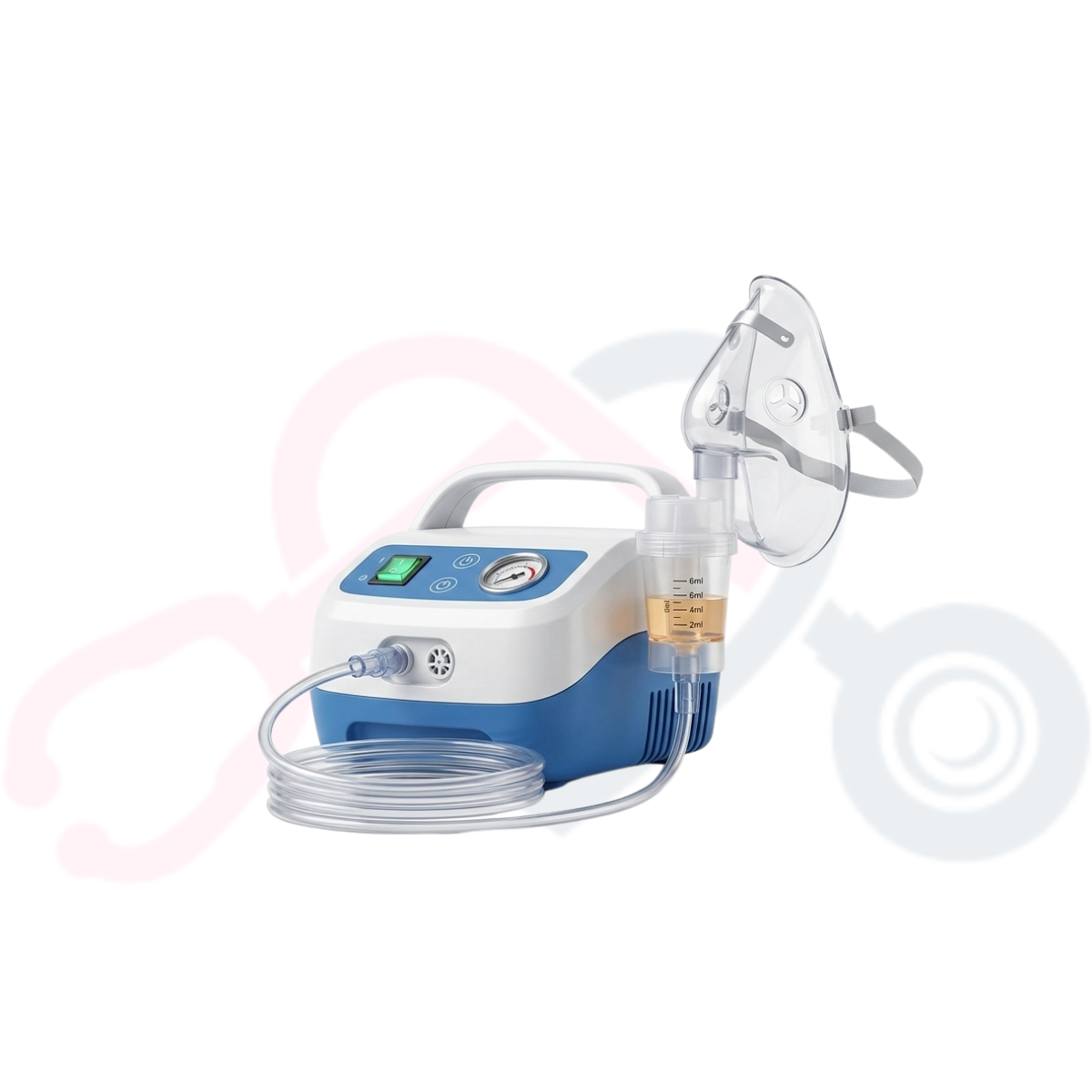
Nebulizer Machine
Compressor nebulizer machine designed to convert prescribed liquid medication into a breathable mist for fast respiratory relief.
Rent or Buy
| Situation | Rent | Buy |
|---|---|---|
| Short course for a chest infection (1–3 weeks) | Yes | No |
| Child with occasional wheeze (a few episodes a year) | Rent per episode or buy a basic model | Buy if episodes are frequent |
| Chronic asthma or COPD, regular use | Rent short-term | Buy for long-term daily use |
| Post-stroke patient with ongoing chest care | Rent long-term | Buy if use will exceed a year |
| Palliative patient needing symptom relief | Rent | No |
| Pollen or smog season flare-ups | Rent for the season | Buy if annual flares are predictable |
Nebulisers are not very expensive to buy, so for anything beyond 3 to 4 months of regular use, buying usually makes sense. Renting first lets the family confirm the model works for the patient before committing.
What a Rental Should Include
- The compressor unit with power cable
- Air tubing
- Nebuliser cup (medication chamber)
- Adult face mask
- Child face mask if the household might have one
- Mouthpiece (preferred over mask for cooperative adults)
- Spare filter if the model uses one
- Brief demonstration at delivery
Confirm at delivery that the machine switches on, is reasonably quiet, and the mist comes out of the mask or mouthpiece properly. A machine that struggles on day one usually fails within two weeks.
Using a Nebuliser Correctly at Home
- Wash hands thoroughly
- Measure the medication as prescribed — exact dose, no guessing
- Pour medication into the nebuliser cup
- Connect tubing between the cup and compressor
- Attach mask or mouthpiece to the cup
- Switch on the compressor — a steady mist should appear
- Patient sits upright and breathes normally through the mouth
- Continue until all medication is nebulised — usually 5 to 15 minutes
- Switch off the compressor
- Rinse cup, mask, and mouthpiece with warm water; air dry
Instruct the patient to breathe calmly through the mouth for maximum medication delivery. For children or anyone who cannot cooperate with the mouthpiece, a well-fitted mask is used instead.
Cleaning the Nebuliser
After Every Use
- Rinse the nebuliser cup, mask, and mouthpiece with warm water
- Shake out excess water and air dry on a clean towel
Daily (If Used Daily)
- Wash the cup, mask, and tubing with warm water and mild soap
- Allow to air dry fully before reassembly
Weekly
- Deep clean with mild disinfectant as advised by the supplier
- Rinse thoroughly with clean water
- Check the compressor filter — replace if dirty or discoloured
Every 2–3 Months
- Replace the nebuliser cup, mask, and tubing if used daily
- Replace the compressor filter
A dirty nebuliser is a bacteria-delivery system straight into the lungs. Cleaning is not optional.
Common Nebuliser Medicines Used in Pakistan
Prescribed by the doctor — never added or changed by the family:
- Salbutamol (Ventolin): Quick-acting bronchodilator for wheeze and acute attacks
- Budesonide (Pulmicort): Steroid for asthma and chest condition maintenance
- Ipratropium (Atrovent): Bronchodilator often used in COPD
- Combivent: Salbutamol + ipratropium combination
- Hypertonic saline: For thick mucus in some conditions
- Normal saline: Sometimes used alone for airway humidification
Mixing medications in one nebulisation is sometimes prescribed and sometimes dangerous. Always follow the doctor's exact instructions.
Setting Up Care in the Home Around a Nebuliser
- Clean side table or trolley for the compressor
- Comfortable upright chair for the patient
- Nearby plug point
- Clean cloth or towel for drying parts
- Storage area for medications (fridge for some, room temperature for others)
- Measuring syringe or dropper for accurate dosing
- Pulse oximeter in the house for acute episodes
- Written medication schedule on the wall
Simple, clean, accessible setup. Most "nebuliser not working" complaints trace back to one of these basics.
Safe Use for Specific Patients
Elderly Patient
Weaker lung function and sometimes poor compliance. A well-fitted mask is often easier than a mouthpiece. Family or caregiver should supervise. Watch for palpitations after salbutamol — common and usually settles.
Child Patient
Child mask size, not adult. Sitting on a parent's lap helps the child tolerate the mask. Keep the session calm — crying children do not breathe medication effectively.
Bedridden Patient
Head elevated to 45 degrees during the session. Mask fit matters — a leaking mask delivers much less medication. A suction machine may be needed afterwards for patients who cannot clear loosened secretions.
Post-Stroke Patient
Often has swallow problems, so a mask (not mouthpiece) is safer. Nebulisation helps loosen secretions; combine with chest physiotherapy.
Patient on Oxygen
Oxygen can usually be nebulised through — ask the treating doctor about the setup. For patients on continuous oxygen from an oxygen concentrator, pause only if specifically advised.
Combining the Nebuliser With Other Equipment
For patients needing broader respiratory support, the nebuliser is one piece of a larger setup:
- An oxygen concentrator if prescribed
- Backup oxygen cylinder for power cuts
- A BiPAP machine for severe respiratory failure or sleep apnoea
- A suction machine for tracheostomy patients or weak cough
- An electric hospital bed for comfortable head elevation during treatment
- The nebulizer machine itself as the core device
Ordering related equipment from one supplier simplifies delivery, replacement, and billing.
Rental Terms Worth Confirming
- Monthly or weekly rate
- Security deposit and refund timeline
- Delivery and pickup — included or extra
- Replacement nebuliser cup, mask, tubing — included or extra
- Spare filter included
- Response time if the compressor fails
- Swap or repair policy
- Notice period to end the rental
Written answers before signing prevent later disputes. A good supplier will send terms by WhatsApp or email on request.
Common Problems and Quick Fixes
| Problem | Likely Cause | Fix |
|---|---|---|
| No mist from the mask | Tubing loose, cup assembled wrong | Check connections; re-assemble |
| Very weak mist | Filter dirty, cup worn out | Change filter; call supplier for replacement cup |
| Compressor loud or rattling | Filter blocked, machine old | Change filter; ask supplier for swap |
| Mask uncomfortable | Wrong size or straps too tight | Ask supplier for correct size |
| Patient coughing more during use | Dose or medication issue | Check with doctor |
| Session taking very long (over 20 min) | Cup or tubing worn out | Replace parts |
Most issues are fixed by cleaning or replacing a part. Compressors themselves rarely fail outright.
When Nebulisation Is Not Enough
Call the doctor or go to the ER if during or after a nebulisation session:
- Oxygen level drops below 92% and does not recover
- Breathlessness continues or worsens
- Chest pain develops
- Patient cannot speak full sentences
- Blue tinge to lips or fingertips
- Confusion or drowsiness
- Rescue inhaler needed repeatedly in addition to the nebuliser
- Fever rising rapidly
Nebulisers help with many problems but not all. A worsening patient during treatment needs hospital assessment.
Roles Around Nebuliser Use
- Doctor: Prescribes the medicine, dose, frequency, duration
- Pharmacist: Supplies the correct medication strength
- Home nurse: Administers the first few sessions if the family is unsure; monitors response
- Caregiver or home care help: Daily cleaning, measuring doses, supervising sessions
- Family: Supervises the patient, orders supplies, calls for help when needed
- Equipment supplier: Delivers, services, replaces consumables
Clear role allocation keeps the arrangement simple and reliable.
Specific Scenarios for Islamabad and Rawalpindi
Elderly COPD Patient in F-10
Long-term rental, standard compressor nebuliser with mask. Daily twice-daily use, nurse visit weekly for review.
Child With Recurrent Wheeze in Bahria Pindi
Short-term rental during flare-ups. Paediatric mask. Parent supervises each session.
Post-Chest-Infection Recovery in Saddar
Two-week rental during the acute phase, return when breathing settles.
Bedridden Elderly Patient in DHA Islamabad
Monthly rental alongside a hospital bed, air mattress, and pulse oximeter. Nurse administers scheduled nebulisations.
Overseas Family Arranging for Parent
Rental booked remotely, delivered to the parent's home. Family coordinator or household help supervises the sessions, with photos and daily WhatsApp updates to the overseas family.
Frequently Asked Questions
The Simple Version
Rent a reliable compressor nebuliser from an established Twin City supplier. Confirm mask, tubing, and cup are included. Use only the medication the doctor prescribed, at the exact dose. Clean after each use, deep-clean weekly. Replace mask and tubing every 2 to 3 months with daily use. Call the doctor if the patient worsens during treatment. Do these things, and a rented nebuliser in Islamabad or Rawalpindi delivers what it should — safer breathing, at home.
For more information on asthma treatments, the NHS guide to asthma treatment is a reliable reference. Always follow your medical team's specific guidance.
Contact via WhatsApp