
An air mattress is not a luxury item. For any patient who will be bedridden for more than a few days, it is one of the two or three most important pieces of home care equipment — as important as the hospital bed itself. This guide walks Lahore families through renting the right air mattress: what type fits which patient, what to check at delivery, what a fair contract looks like, and how to use it correctly so it actually prevents the pressure sores it is meant to prevent.
Important Medical Note
Nothing here replaces the treating doctor's specific advice for your patient. If the patient already has pressure sores or complex skin issues, ask the doctor or wound nurse to review the mattress choice.
Why an Air Mattress Matters So Much
A bedridden patient cannot shift weight. The full weight of the body presses on the skin over the tailbone, hips, heels, and shoulder blades. On a normal mattress, blood flow to that skin stops after a couple of hours. Within days, the skin breaks down. A deep pressure sore that follows can take weeks or months to heal and often needs surgery.
An air mattress has cells (rows of air chambers) that inflate and deflate in cycles — usually every 5 to 10 minutes. This constantly moves the pressure point across the skin, so no single area stays compressed long enough to break down. It is basic mechanical protection that works.
An air mattress does not replace turning the patient every two hours. It reduces the risk; it does not eliminate it. Skilled nursing care and the mattress together are what prevent sores.
Types of Air Mattresses — Which One Fits Which Patient
| Type | How It Works | Best For |
|---|---|---|
| Bubble (alternating pressure) | Small bubble cells alternate inflation | Short-term or moderate-risk patients |
| Tubular (large-cell alternating) | Long horizontal tubes alternate | Medium- to long-term bedridden patients; better weight distribution |
| Low-air-loss | Cells release small amounts of air continuously to reduce skin moisture | Higher-risk patients — heavy sweating, incontinence, existing sores |
| Combination (alternating + low-air-loss) | Both mechanisms in one | High-risk patients, existing stage 2+ sores, heavy patients |
For most Pakistani families renting for the first time, a tubular alternating-pressure mattress is the standard choice — reliable, fits most patient care needs, and available at reasonable rental rates. For a patient who already has a wound or is heavy and sweaty, ask for a low-air-loss upgrade.
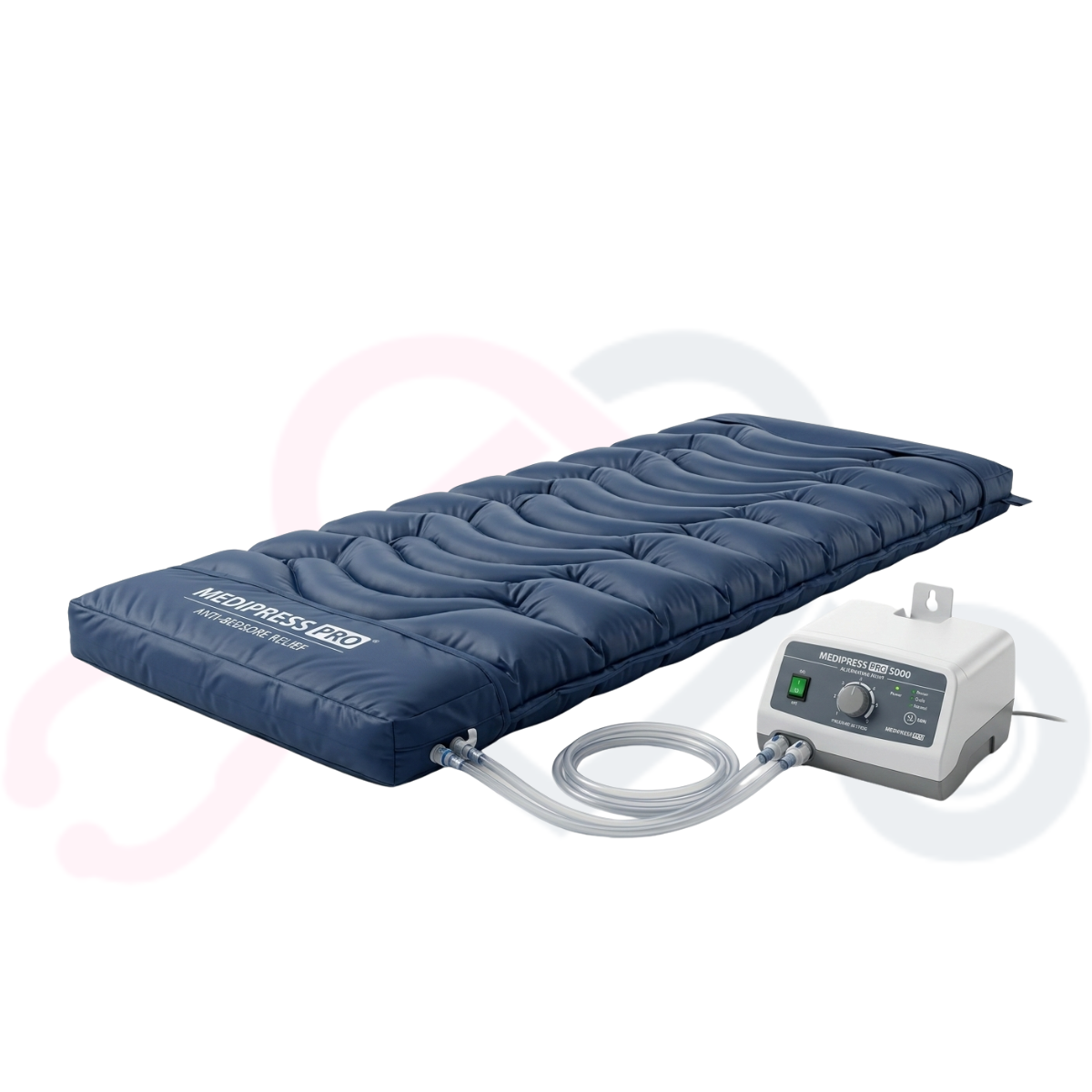
Medical Air Mattress
Tubular alternating pressure pad and pump system designed to prevent and treat bedsores for bedridden patients.
Standard Mattress Sizes
Most rental air mattresses are single-bed size (usually around 190 x 90 cm), designed to sit on top of the existing hospital bed mattress or a firm regular mattress. Weight capacity matters:
- Standard adult: up to about 100 kg
- Bariatric: 120 to 180 kg — ask specifically if the patient is heavier
Confirm size and weight capacity at booking. A mattress that is too small for the bed frame or too weak for the patient's weight does not work properly.
How the Rental Actually Works
Booking and Delivery
- Call the supplier with patient weight, bed size, and any existing skin concerns
- Same-day delivery is usually possible within Lahore central areas
- Delivery driver should show you how to inflate, check the pump, and set the pressure
- Ask for a demonstration — not just a drop-off
Setup on the Bed
- Place the air mattress directly on top of the existing bed mattress
- Secure the mattress with the elastic straps (usually four corners)
- Position the pump at the foot end where it is out of the way but reachable
- Plug the pump into a UPS or a plug point on the generator circuit
- Turn on and wait 10 to 15 minutes for full inflation before laying the patient on it
Pressure Setting
- Most pumps let you adjust firmness — set to the patient's weight (usually a dial or a soft/firm switch)
- Slide your hand under the patient's tailbone once they are on the mattress — you should just be able to slip your fingers in without much resistance
- Too firm and the pressure-relief benefit is lost; too soft and the patient sinks and bottoms out on the bed below
A nurse or the delivery technician should walk you through this the first time. Do not just plug in and hope.
Rent vs Buy — What Makes Sense
| Situation | Rent | Buy |
|---|---|---|
| Post-surgery, expected recovery in weeks | Yes | No |
| Post-stroke, uncertain recovery time | Rent first | Buy if beyond 6 months |
| Advanced dementia, long-term bedridden | Rent short-term | Buy if usage will exceed 8–10 months |
| Palliative / end-of-life care | Rent — family should not be left with equipment afterwards | No |
| Existing pressure sores requiring low-air-loss | Rent — usually more cost-effective for advanced mattresses | Rarely worth buying |
Renting for a few weeks costs a fraction of buying. If the situation extends beyond 6 to 8 months, buying often becomes cheaper. Renting also lets you swap types if the patient's needs change — from standard alternating to low-air-loss if a wound develops, for example.
What to Ask Before Signing the Rental
- What type of mattress is this (bubble, tubular, low-air-loss)?
- What is the weight capacity?
- What is the response time if the pump fails?
- Do you swap the mattress or repair it on failure?
- What is the security deposit and refund process?
- Is delivery and pickup included, or extra?
- Is the cover washable? Is a spare cover included?
- What is the monthly rate versus daily rate?
- Can I upgrade to a low-air-loss model mid-rental if needed?
Get answers in writing — WhatsApp confirmation is fine if you keep the screenshot. A supplier who will not put terms in writing is a supplier to avoid.
Using the Mattress Correctly
Renting the right mattress solves half the problem. Using it correctly is the other half.
Do
- Keep the pump running 24 hours a day — the mattress works only while cycling
- Check pressure daily; adjust as the patient's weight or position changes
- Keep the cover clean and dry — a soaked cover encourages bacteria and skin problems
- Continue turning the patient every 2 hours — the mattress reduces but does not eliminate the need
- Inspect skin daily — the mattress helps but is not magic
- Plug the pump into a UPS or generator-backed circuit for load shedding
Do Not
- Do not put heavy blankets or a second mattress on top — this defeats the pressure relief
- Do not switch off the pump at night to save electricity — the cells deflate within hours
- Do not puncture the mattress with pins, safety pins, or sharp objects
- Do not skip turning because "the mattress does it" — it does not
- Do not use for a very heavy patient beyond the mattress's capacity
When the Pump Fails — What to Do
- Turn the patient manually every hour until repair or swap
- Call the supplier immediately — ask for a same-day swap for critical patients
- Do not try to fix the pump yourself unless the supplier walks you through it on the phone
- If the supplier cannot respond within a few hours, call a backup supplier
- Note the failure time and duration for your records
For a fragile patient with existing skin issues, a pump failure of more than 12 hours is a real concern. Ask the supplier about their guaranteed response time before you sign.
Common Mistakes Families Make
- Renting a small mattress for a large bed — cells hang off the sides and lose pressure
- Not securing the mattress with straps — it slides off the bed frame
- Setting the pressure too firm to "feel supported" — this eliminates the benefit
- Placing a plastic sheet directly on the mattress cover — traps moisture and heat
- Stopping the pump during load shedding without switching to UPS backup
- Not turning the patient because "the mattress does it"
- Ignoring small red patches thinking the mattress will handle them
Combining the Air Mattress With Other Equipment
An air mattress on its own is not a complete setup. For most bedridden patients you also need:
- A proper electric hospital bed with side rails and adjustable head
- A commode chair beside the bed for bathroom access
- A wheelchair for moving around the house or trips to the doctor
- An oxygen concentrator and backup oxygen cylinder if prescribed
- A suction machine for patients with weak swallow or tracheostomy
A trained home nurse can walk through the setup on day one and set up the equipment layout correctly. Getting the room ready in one visit saves a lot of adjustment later.
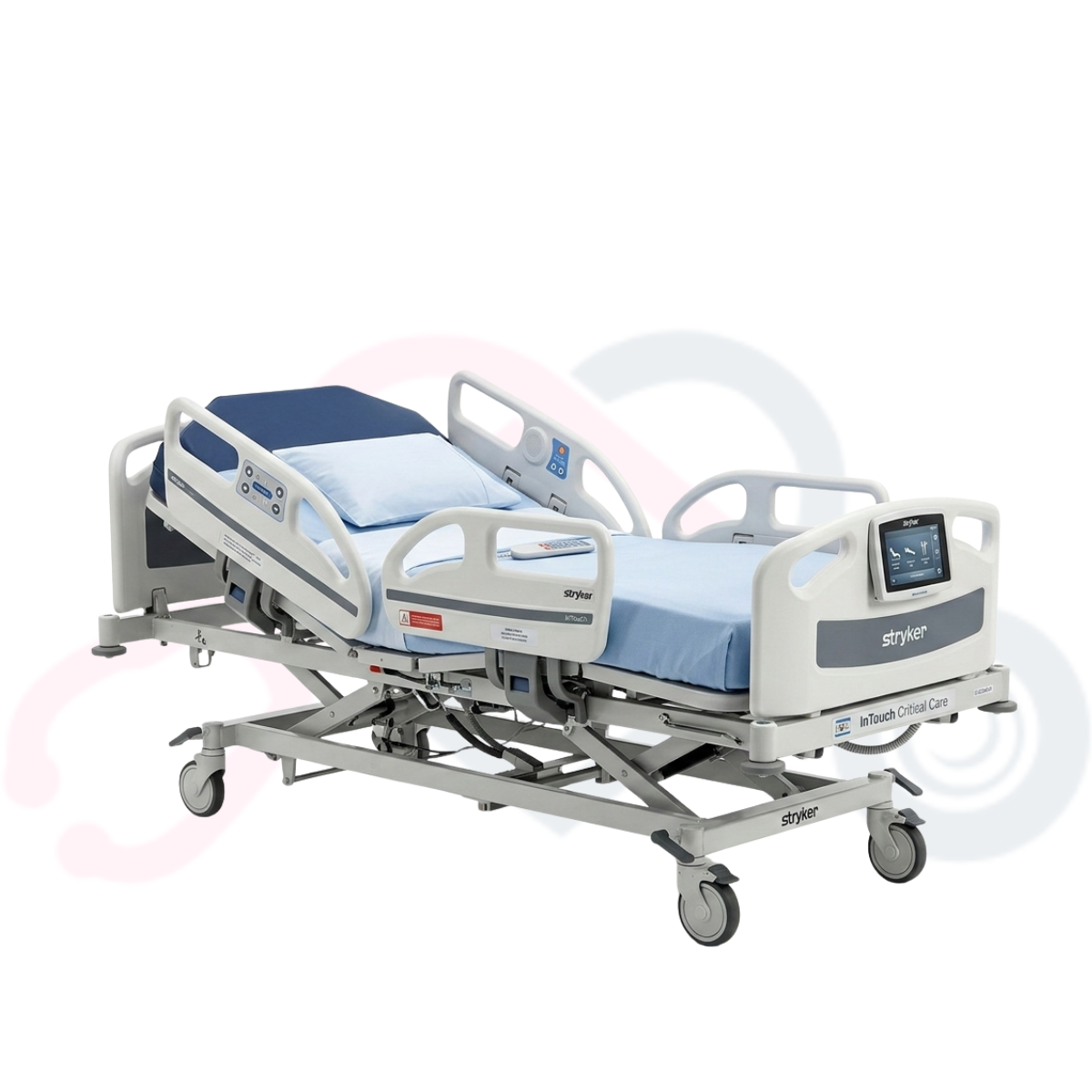
Electric Hospital Bed
Imported electric ICU bed providing automated positioning via remote control. The perfect base for your air mattress.
Special Patient Situations
Post-Stroke Bedridden Patient
Standard tubular air mattress usually works. Head elevation is important for feeding safety — make sure the mattress compresses evenly when the bed head is raised.
Post-Surgery Patient (Temporary Bedridden)
Basic alternating-pressure mattress. Rent for the recovery period, return when the patient is walking again.
Advanced Dementia or Bedridden Elderly Patient
Long-term case. Rent the appropriate mattress type; upgrade to low-air-loss if any pressure area develops. Continue turning even with the best mattress — this is patient care basics.
Roles Around the Air Mattress
- Doctor: Advises on type based on patient's skin and mobility status
- Home nurse: Checks skin daily, adjusts pressure, notes any developing areas, coordinates with the wound nurse if needed
- Caregiver or attendant: Turns the patient every 2 hours, keeps the cover clean and dry
- Family: Signs the rental, ensures pump has UPS backup, calls the supplier if anything fails
- Equipment supplier: Delivers, demonstrates, services, and swaps on failure
Red Flags: When to Get Help
- New red area developing on the tailbone, hip, heel, or shoulder — check pressure setting and turning schedule
- Red area that does not fade after 30 minutes off pressure — stage 1 sore forming
- Broken skin — stage 2 sore; call the nurse for wound care immediately
- Deep wound with visible fat, muscle, or bone — stage 3 or 4 — needs urgent wound specialist review
- Fever, foul smell from a wound, or spreading red streaks — possible infection, urgent doctor call
- Pump not cycling properly — call supplier for swap
Rent a tubular alternating-pressure mattress for most bedridden patients; low-air-loss for high-risk. Check size and weight capacity. Get the pressure setting right at delivery. Plug the pump into a UPS. Continue turning every 2 hours. Inspect skin daily. Call the supplier immediately for any pump failure. Do these seven things and an air mattress does exactly what it is meant to — prevents pressure sores, weeks and months at a time.
Frequently Asked Questions
For more information on preventing pressure ulcers, the NHS guide to pressure sores is a reliable reference. Always follow your medical team's specific guidance.