
Rental price
PKR 12,000 per month for an infusion pump on rent, delivered and installed at your home in Islamabad or Rawalpindi.
That is the full monthly rate — no separate charge for setup, demonstration or servicing during the rental. Delivery is quoted before you commit. Documentation is a copy of the renter's CNIC plus the first month's advance, with no heavy security deposit. Purchase is available if the need turns out to be long term; message us for the current price.
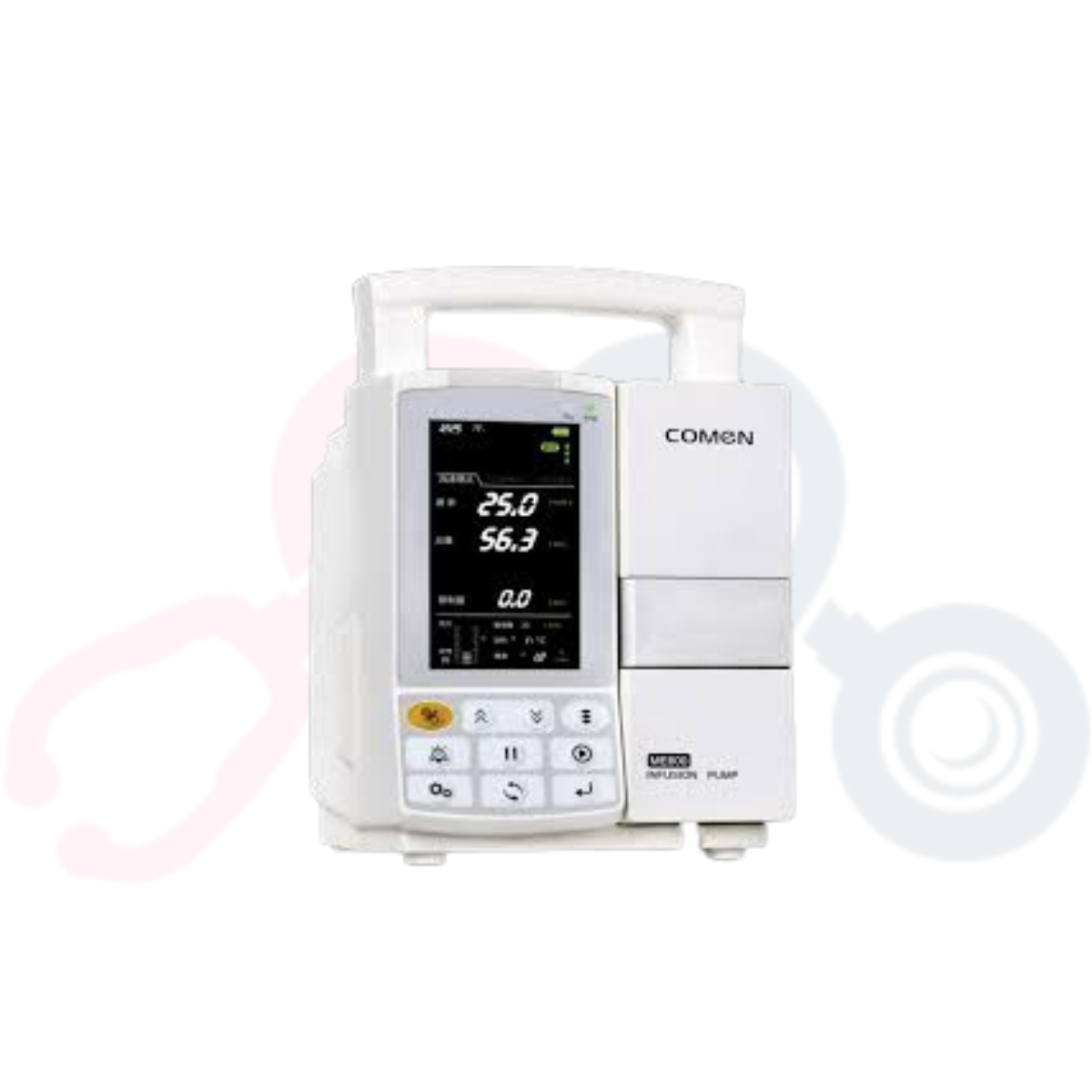
Volumetric Infusion Pump
Ensures highly accurate and continuous delivery of IV fluids and medications to patients safely at home.
Why a pump rather than an ordinary drip
A drip stand and a roller clamp deliver fluid at whatever rate gravity and a nurse's estimate produce. A pump delivers it at exactly the prescribed rate and keeps delivering it, hour after hour, and alarms when something interferes.
For plain hydration that difference rarely matters. For a medicine where the rate is part of the treatment, it matters entirely.
Four courses that bring a pump home in the Twin Cities
1. Finishing a course of IV antibiotics
This is the most common reason we see in Islamabad and Rawalpindi. A patient is stable, the infection is responding, but the antibiotic still has two or three weeks to run and it cannot be taken as a tablet.
NHS guidance from Cambridge University Hospitals describes this arrangement — outpatient IV antibiotic therapy — as a recognised way of completing treatment outside hospital. The antibiotic goes into a vein through a venous access device: a thin, flexible tube placed into the vein and secured with a dressing, which stays in place for the course.
NHS trusts running these services also note something worth knowing: completing IV antibiotics at home rather than as an inpatient improves quality of life and reduces the risk of picking up a hospital-acquired infection. Going home early is not a compromise — for the right patient it is the better option.
2. Support between chemotherapy cycles
Hydration, anti-sickness medicine and supportive fluids given at a controlled rate at home, so the patient recovers in their own bed between hospital visits.
3. Pain and symptom management
Where a steady level of medication has to be maintained rather than given in peaks. Common in palliative care, and the situation where a pump makes the most difference to how comfortable somebody is.
4. Fluids for patients who cannot drink enough
Elderly patients, patients after surgery, or anyone unable to maintain hydration by mouth — where the volume and rate need to be measured rather than guessed.
How long will you actually need it?
This is the question families ask second, after the price, and it decides whether renting makes sense.
Rental is charged monthly. So the practical question is not "how many days" but "how many months does this course cross".
| Situation | Typical duration | What that usually means |
|---|---|---|
| Short IV antibiotic course | 1 to 2 weeks | One month's rental normally covers it |
| Longer IV antibiotic course | 4 to 6 weeks | Plan for two months |
| Chemotherapy support | Across several cycles | Depends on the protocol — ask the oncologist |
| Palliative symptom control | Open-ended | Review monthly rather than assuming |
| Post-surgical hydration | Days to 2 weeks | One month, often returned early |
One caution before you plan around a date: NHS guidance notes that the length of IV treatment is decided by the doctor and can change depending on how the patient responds. Courses get extended. Ask us rather than assuming you must commit to a fixed period.
Who operates it — and why this is not negotiable
We supply equipment. We do not supply nursing staff, and an infusion pump is not a device for a family member to program.
Rates are prescribed by the treating doctor. Setting the pump, starting the infusion, responding to alarms and checking the line are the work of a trained nurse. Arrange that before the equipment arrives — families who order the machine first and then start looking lose several stressful days.
There is a second reason for having a nurse involved. Patients on longer IV courses usually need regular blood tests to check how the body is responding to treatment, and the line itself needs checking for signs of infection at the insertion site. Neither is something a family can assess.
Alarms: what they usually mean
Every pump alarms, and most alarms at home are mechanical rather than medical:
- Occlusion — tubing kinked, clamped, trapped under the patient, or a blocked cannula
- Air in line — a bubble detected in the tubing
- Infusion complete — the prescribed volume has finished
- Low battery — the pump needs mains power
- Set error — the giving set is not loaded correctly
Whoever is caring for the patient should be able to say which alarm is sounding and what to do. Never silence one without knowing why it went off, and never adjust the rate to stop a pump complaining.
Included in the monthly rent: cleaning, inspection and testing before delivery, installation at the bedside, a working demonstration, the mains adapter and standard accessories, and servicing or replacement if the unit develops a fault.
Not included: giving sets, IV lines, cannulas, dressings and the medication itself. These are consumables and are usually prescribed or supplied through the treating team.
The trap: not every giving set works with every pump. Confirm which sets are compatible with the pump you are renting before somebody buys a month's supply from a pharmacy in Blue Area or Saddar. This catches families out regularly, and the sets are not returnable.
Power planning in Islamabad and Rawalpindi
An infusion pump has an internal battery, but it is a bridge, not a plan.
- Ask us the battery run time on the specific unit and test it once with the nurse present
- Keep the pump on mains power whenever possible so the battery stays charged for outages
- Give the pump its own socket — not shared with a heater, air conditioner or fridge
- Agree what the nurse does if power fails mid-infusion, before it happens
Two local notes. In newer Islamabad sectors and societies this is usually straightforward. In older Rawalpindi houses — around Saddar, Tench Bhata and the lanes off Murree Road — the wiring often needs looking at before several devices run in one room, particularly if oxygen equipment is running alongside.
What usually goes with it
An infusion pump rarely arrives alone. Depending on the case, families in the Twin Cities commonly add:
- IV stand — PKR 1,500 per month, to hold the pump and fluid bag steady
- Syringe pump — PKR 12,000 per month, where a second drug runs in small measured doses
- Patient monitor — PKR 10,000 per month, where vitals need tracking too
- Electric hospital bed — PKR 22,000 per month, for patients mostly in bed
- Feeding pump — PKR 15,000 per month, for tube-fed patients
Send us the discharge summary or prescription and we will tell you which of these the paperwork actually calls for — including the ones you can leave out.
Delivery across Islamabad and Rawalpindi
Same-day delivery is standard where the unit is in stock. Because most infusion pump orders follow a discharge, tell us the discharge date and hour when you first message so we can plan backwards from it.
Islamabad: the F, G, E, I and H sectors, DHA, Bahria Town, Gulberg Greens and Residencia, Park View City, B-17, PWD, Soan Garden, Bani Gala and Chak Shahzad.
Rawalpindi: Saddar, Satellite Town, Westridge, Chaklala, Lalazar, Morgah, Askari, Bahria Town, DHA, Gulraiz, Media Town, Adiala Road and Chakri Road.
Two practical points. Apartment blocks in G-11, I-8 and E-11 are fine for a pump — it is a small unit — but tell us the floor if a bed is coming with it. And cantonment addresses in Rawalpindi need a gate pass arranged in advance, so mention that when you book rather than on the day.
Frequently asked questions
This page is general information about equipment rental and is not medical advice. Infusion therapy is prescribed by a doctor, and infusion rates are set and changed only by the treating medical team. A patient receiving infusions at home requires trained nursing care. For a suspected reaction, redness or pain at the line site, fever, or a pump failure during a critical infusion, seek medical advice immediately.