This guide walks families through oxygen concentrator backup power realities in Pakistan — how much power an oxygen concentrator actually needs, what UPS and generator options exist, when cylinder backup is essential, and how to build a setup that keeps the patient breathing safely through whatever the WAPDA schedule throws at you. Nothing here replaces the doctor's or pulmonologist's specific plan for the patient — but it will help families avoid the expensive mistakes that only become apparent during a power cut.
Understanding an Oxygen Concentrator's Power Demand
An oxygen concentrator is a moderately power-hungry piece of equipment. Understanding this helps size backup arrangements correctly.
Typical Power Draw
- 5 LPM home oxygen concentrator: approximately 300–450 watts continuous
- 10 LPM high-capacity concentrator: approximately 600–900 watts continuous
- Startup surge: momentarily higher than continuous draw
Compare this to a ceiling fan at 75 watts or a small LED bulb at 10 watts and it is clear why the concentrator is one of the bigger loads in a household.
Battery Backup Inside the Concentrator
Most home oxygen concentrators do not have internal batteries — they run only on mains power. Portable concentrators (POCs) have batteries but typically deliver much less oxygen for a much shorter time. Do not assume the concentrator will keep running for a while on its own when the power fails. Almost always, the moment mains power fails, the concentrator stops.
Voltage Sensitivity
Pakistani voltage fluctuates. Concentrators are sensitive to low voltage and to surges. Voltage stabilisers protect the equipment and keep it running through minor fluctuations that would otherwise trigger shutdown.
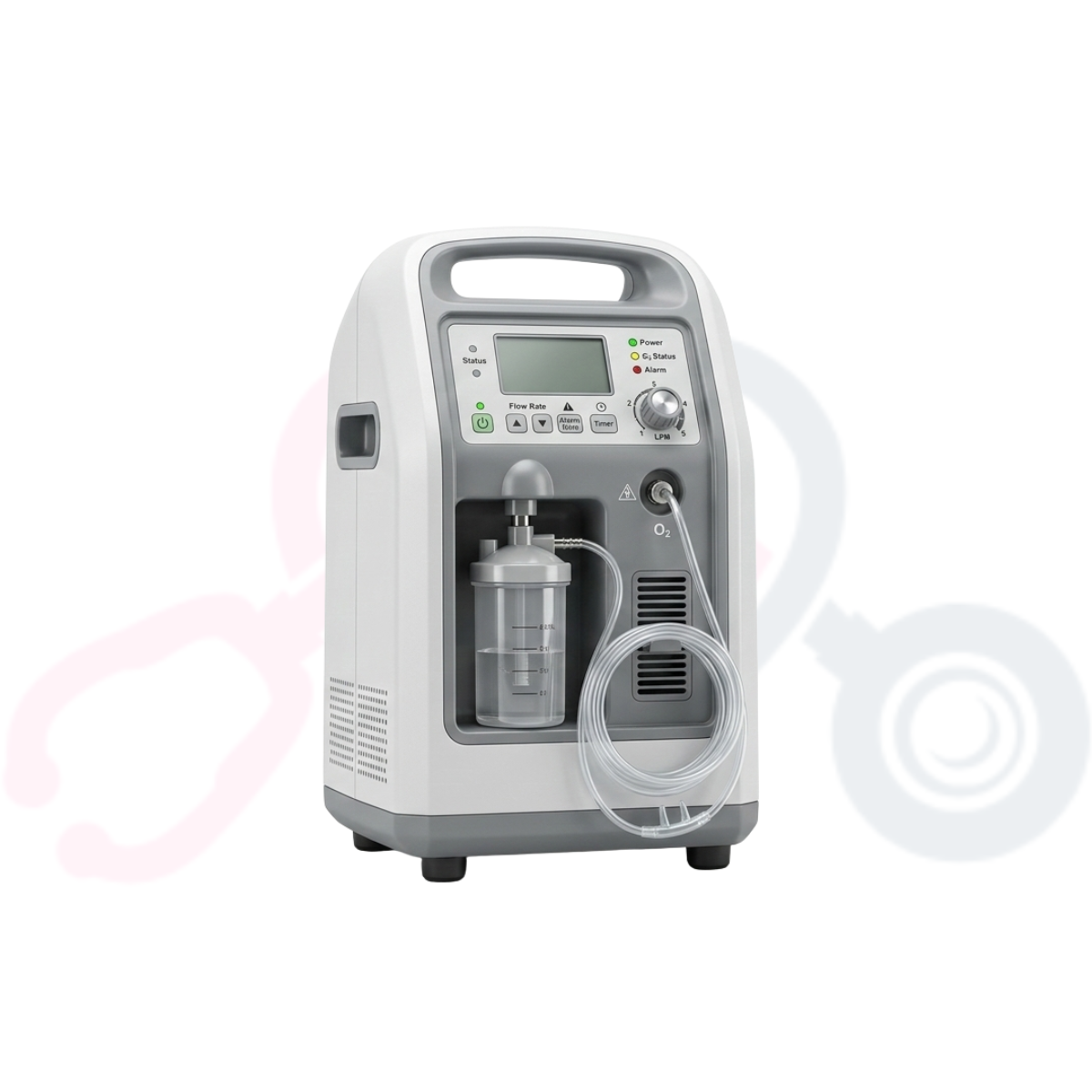
Oxygen Concentrator (5 Liters)
Reliable electric oxygen machine producing up to 5LPM continuous oxygen. Low noise operation.
Who Decides on Backup Requirements
- Doctor / Pulmonologist: Decides how critical continuous oxygen is for the patient and what interruption is acceptable. A patient whose saturation drops to 80% within minutes of oxygen loss needs a very different backup setup than a patient who can safely go 30 minutes without.
- Registered Nurse: Monitors the patient's response to any oxygen interruption and identifies deterioration early.
- Equipment Supplier: Provides the concentrator and can usually advise on compatible UPS, stabiliser, and cylinder backup. Not a clinical role.
- Family: Runs the practical backup arrangement — testing UPS regularly, keeping cylinders full, tracking WAPDA schedules.
Reputable home care providers coordinate the medical, equipment, and backup setup together rather than leaving the family to piece it together.
The Backup Options — From Simplest to Most Robust
Option 1: UPS Alone
An uninterruptible power supply (UPS) sits between mains power and the concentrator. When mains fails, the UPS switches to battery within milliseconds — usually so fast the concentrator does not even reset.
Option 2: UPS + Cylinder Backup
UPS handles short outages. An oxygen cylinder beside the bed handles longer outages when the UPS runs out. This is the most common practical arrangement for continuous-oxygen patients in Pakistan.
Option 3: Generator Backup
A household generator that kicks in during load-shedding. Big enough to run the concentrator, essential lights, and fan. Petrol, diesel, or gas-powered.
Option 4: Solar with Battery Bank
Increasingly common in Pakistan. Solar panels charge batteries during daytime; the concentrator runs off the battery bank during outages. Larger upfront cost but low running cost.
Option 5: Multiple Redundant Systems
For critically oxygen-dependent patients — UPS for instant switchover, generator for medium outages, cylinder backup for equipment failures, and sometimes solar as a third layer. Belt-and-braces for patients where oxygen interruption would be immediately dangerous.
Sizing the UPS Correctly
A common expensive mistake families make is buying a UPS too small for the concentrator.
Watts vs VA
UPS ratings are usually given in VA (volt-amperes) rather than watts. For a rough conversion, VA × 0.6 = usable watts. A 1000 VA UPS delivers roughly 600 watts of continuous load capacity.
Sizing Rule
Choose a UPS that can handle at least 1.5 to 2 times the concentrator's power draw. This handles startup surges and gives some headroom.
Runtime Calculation
UPS runtime = battery watt-hours ÷ load watts. A UPS with 720 Wh of battery, powering a 400-watt concentrator, gives about 1.8 hours. Larger battery banks (external batteries added to the UPS) extend runtime.
Practical Recommendation
For a 5 LPM home concentrator, a UPS of 1500–2000 VA with extended battery bank is a reasonable starting point. For 10 LPM concentrators, larger. Confirm sizing with a technical adviser or the equipment supplier.
Sine-Wave UPS
Oxygen concentrators contain sensitive electronics and motors. A pure sine-wave UPS is safer than a modified sine-wave one — the concentrator runs more smoothly and the motor lasts longer. Do not compromise on this for a critical medical device.
Cylinder Backup — Do Not Skip It
Even with the best UPS or generator, equipment can fail. A concentrator can develop a fault. A UPS battery can degrade. A generator can run out of fuel. For patients who genuinely need continuous oxygen, cylinder backup is not optional.
Sizing the Cylinder
- A standard portable oxygen cylinder holds enough oxygen for several hours at low flow rates, less at high flow rates
- Jumbo cylinders hold much more but are large and less portable
- For continuous-use patients, have a minimum of one cylinder always full at home, with a plan to refill or replace within hours if used
Regulator and Flowmeter
Cylinders need a regulator (reduces high tank pressure to safe delivery pressure) and a flowmeter (sets litres per minute). Match the flowmeter range to the patient's prescribed flow.
Storage Safety
- Store cylinders upright, secured against falling
- Away from heat sources — stoves, heaters, direct sunlight
- Well-ventilated area
- No smoking anywhere near cylinders
- No oil, grease, or flammable materials near valves
Switching From Concentrator to Cylinder
Every family member and caretaker in the household should know how to switch from concentrator to cylinder within a minute. Practice this before you need to do it under pressure.
Refill Arrangements
Have the supplier's phone number saved. Know their response time. In Karachi, Lahore, Islamabad, Rawalpindi, and other major cities, most suppliers deliver within a few hours. Rural areas may be much slower — plan accordingly.
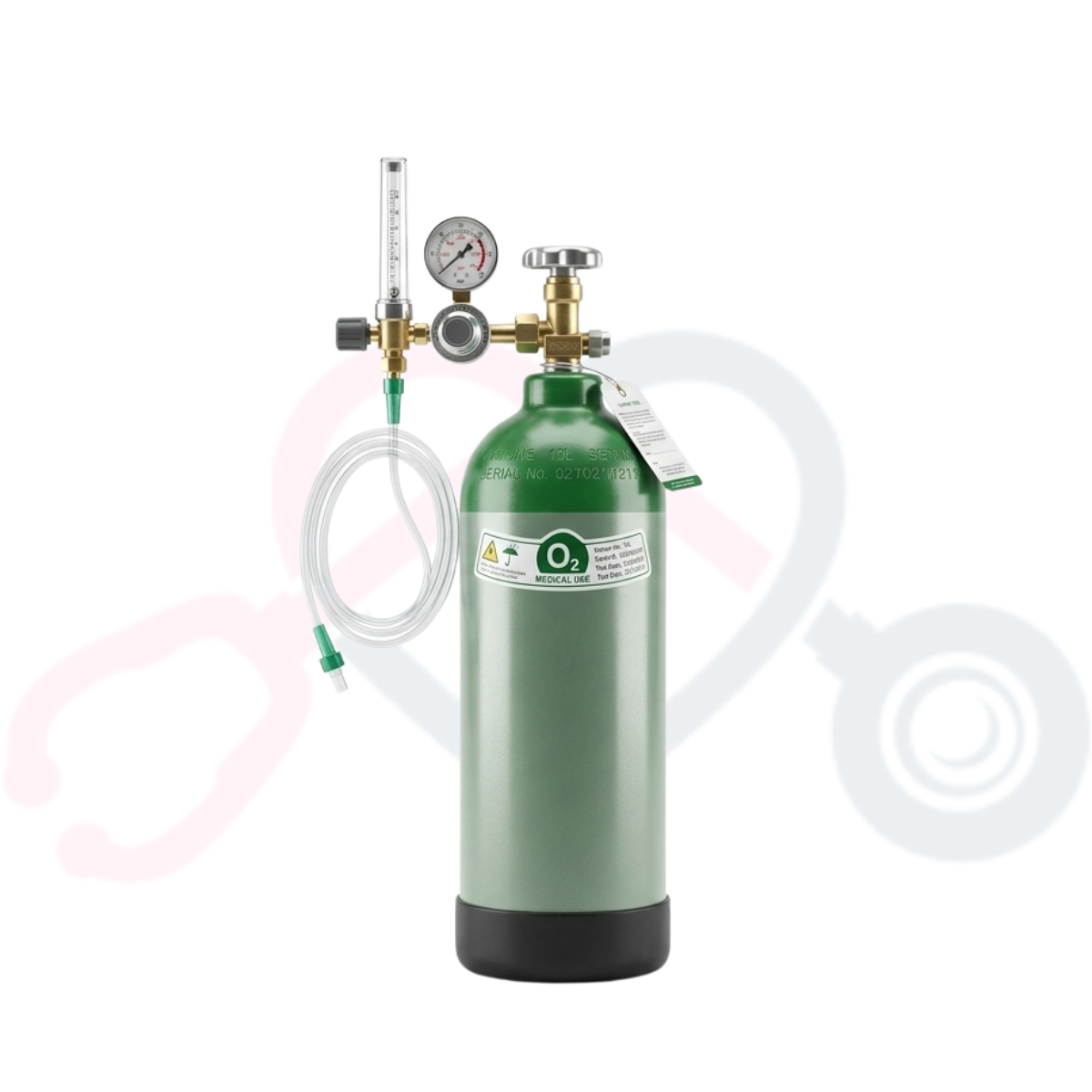
Oxygen Cylinder (10 Liters)
Essential portable 10L oxygen cylinder with flowmeter and mask. Crucial load-shedding and emergency backup for concentrator users.
Generator Setup
For families in Pakistan already running a generator for the household, powering the concentrator is usually feasible with attention to details.
Sizing
The generator needs to handle the concentrator plus other loads — fan, lights, other equipment. A 2 kVA generator handles a 5 LPM concentrator plus a fan and a few lights. Larger for more equipment.
Sine Wave Output
Cheap generators produce dirty power that damages sensitive electronics. An inverter generator or a good-quality voltage-regulated generator is worth the extra cost for medical use.
Fuel Reserves
Keep enough fuel to run through the longest expected outage plus a buffer. Do not rely on the corner petrol pump being open at 3 AM.
Autostart or Manual Start
An autostart generator kicks in seconds after a power cut. Manual-start generators need someone available to start them — not always practical at night or when family is asleep. For critical patients, autostart is worth the cost.
Ventilation
Never run a generator indoors or in an enclosed space. Carbon monoxide poisoning kills. Generators go in the courtyard, outside, or in a well-ventilated open shelter.
Transfer Switch
A proper transfer switch prevents the generator from back-feeding into the mains grid (which can kill utility workers) and simplifies switchover. Get this installed by a qualified electrician.
Solar Backup
Increasingly popular for households in Pakistan with medical equipment. Practical considerations:
- Solar panels charge batteries during daylight
- Battery bank powers the concentrator when mains fails
- Sizing depends on daily oxygen usage hours, panel capacity, and battery capacity
- Higher upfront cost, low running cost
- Requires roof space and installation
- Works well as one layer of a multi-layer backup arrangement
Not usually the only backup — most families use solar plus UPS plus cylinder for critical patients.
Room Setup Around the Concentrator
Ventilation
Concentrators generate heat. Do not push them against a wall. Ensure air can circulate around the intake and exhaust vents. Overheating causes shutdown.
Location
In a room with good ventilation, near the patient but not so close that motor noise disturbs sleep. Some families position the concentrator in an adjacent room with tubing running through the wall.
Tubing Length
Longer tubing means the patient can move around but slightly reduces delivered oxygen concentration. Keep tubing as short as practical for the patient's mobility needs.
Humidifier
Distilled water only. Change and clean regularly to prevent bacterial growth.
Around the Bed
The concentrator is usually part of a larger setup that may include a hospital bed, patient monitor, and other equipment. An electric hospital bed alongside the concentrator makes positioning for optimal breathing (head-up posture) easy.
Monitoring During Power Interruptions
Pulse Oximeter
Essential for any patient on continuous oxygen. A fingertip pulse oximeter costs little and gives immediate feedback on whether the oxygen is reaching the patient's blood. Check saturation during and after any power interruption.
Watching the Patient
Signs that oxygen supply has been inadequate:
- Increased breathing rate
- Bluish colour around lips or fingertips
- Increasing restlessness or confusion
- Chest indrawing when breathing
- Falling oxygen saturation on the pulse oximeter
Concentrator Alarms
Modern concentrators alarm if oxygen concentration drops, flow is interrupted, or the unit malfunctions. Understand what each alarm sounds like and what to do.
Common Situations at Home
Elderly COPD Patient on Continuous Low-Flow Oxygen
The most common scenario. UPS for immediate switchover, plus one backup cylinder, plus reliable refill service. Regular assessment of saturation during load-shedding to confirm the setup is adequate.
Post-COVID Patient in Recovery
Often on oxygen for weeks or months during recovery. Setup as above. Gradual weaning as saturation improves — the doctor decides.
Pulmonary Fibrosis Patient
Higher flow rates often needed. May require multiple cylinders in reserve and a higher-capacity concentrator. Discuss with the pulmonologist and equipment supplier.
Home ICU Patient on Ventilator and Oxygen
Highest-risk setup. Multiple redundant backups — UPS plus generator plus cylinder plus solar in some cases. Continuous trained nursing presence to respond to any interruption. Coordinated home care with appropriate equipment including ventilator and patient monitor is essential.
Palliative Care Patient
Oxygen for comfort. Less intensive backup needed if oxygen is for symptom relief rather than physiological necessity — but discuss with the palliative team.
Pediatric Patient
Special considerations — smaller flowmeters, more careful monitoring, more sensitive to interruption. Paediatric specialist should be involved in setup.
Practical Tips for Load-Shedding Prone Areas
Know the Schedule
Most areas in Pakistan have predictable load-shedding hours. Plan around them — top up UPS during power-on hours, verify cylinder pressure, keep generator fuel ready.
Test Backup Weekly
Do not wait for a real power cut to discover the UPS battery is dead. Simulate an outage weekly by unplugging the concentrator from the wall (with UPS still in circuit) and confirming it continues running.
Battery Replacement
UPS batteries degrade over 2–4 years. When runtime shortens, replace batteries. Do not wait until the UPS fails completely.
Have a Written Emergency Plan
- What to do when concentrator stops
- How to switch to cylinder
- Phone numbers for supplier, doctor, ambulance
- Nearest hospital with oxygen capacity
Written down, posted where visible, everyone in the house knows it.
Multiple Backup Layers
Do not rely on one backup. UPS alone fails when battery dies. Cylinder alone fails if the family cannot switch quickly. Generator alone fails if it will not start. Layered redundancy — different types of backup — is what actually keeps patients safe.
Coordinated Equipment Around Oxygen Therapy
Oxygen concentrators rarely sit alone. Depending on the patient's needs, the setup often includes:
- A nebuliser for prescribed inhaled medications
- A suction machine for patients with weak cough
- A BiPAP or CPAP machine for specific patients
- A hospital bed for optimal positioning
- Pulse oximeter for monitoring
All of these have their own power requirements. Sizing the backup arrangement should account for the whole setup, not just the concentrator.
Common Mistakes Families Make
Buying a Small Household UPS
A 650 VA UPS meant for a computer will not run an oxygen concentrator. Size it properly.
Skipping the Sine-Wave UPS
Modified-sine or square-wave UPS damages the concentrator over time. Pure sine wave is the safe choice.
Not Having Cylinder Backup
Relying on a UPS or generator alone is one equipment failure away from a crisis.
Not Testing the Backup Regularly
A UPS battery that has quietly degraded to 2 minutes of runtime is discovered only during a real outage.
Running Generator Indoors or Under a Window
Carbon monoxide poisoning. Every year Pakistani households suffer preventable deaths from this.
Not Training Every Family Member
If only one person knows how to switch to cylinder, they will not be home when it happens.
Storing Cylinders Poorly
Beside a hot water heater, in direct sun, next to a gas stove — all real risks that families overlook.
Red Flags: When to Seek Emergency Help
Contact the doctor or take to the emergency room / call 1122 for any of the following:
- Patient's oxygen saturation dropping below the doctor's set threshold and not recovering with backup oxygen
- Bluish colour around lips or fingertips despite backup oxygen running
- Sudden severe shortness of breath
- Chest pain
- New confusion or drowsiness
- Cough with new coloured or bloody sputum
- Complete equipment failure with no cylinder backup available
- Concentrator alarm indicating low oxygen concentration output
- Fire, smoke, or unusual smell from any equipment
For patient-friendly background on home oxygen therapy, the US National Heart, Lung, and Blood Institute guide to oxygen therapy is a reliable reference. For your patient's specific setup, always follow the treating doctor's prescription.
Frequently Asked Questions
This page is general information about equipment rental and is not medical advice. Oxygen therapy is prescribed by a doctor, and oxygen flow rates are set and changed only by the treating medical team. Always ensure safe storage and use of oxygen cylinders and equipment.