
This guide explains the difference in plain language, walks through when each is the right choice, and covers the practical realities of running either device safely at home. Nothing here replaces the doctor's prescription — the treating team decides what pump is needed. This guide helps families understand the reasoning and get the equipment side right.
Who Decides Which Pump Is Needed
The decision belongs to the treating team:
- ICU Consultant / Physician / Oncologist: Decides what medication needs to be delivered continuously and at what rate. The choice of pump follows from the drug and the rate, not the other way around.
- Registered Nurse: Sets up the pump, programmes it correctly, monitors delivery, and troubleshoots alarms. Home-based use of any infusion equipment requires trained nursing hands, at least initially.
- Equipment Supplier: Delivers, installs, demonstrates the device, and provides consumables. Not a clinical role.
- Family: Learns what alarms sound like, what to do when they trigger, and when to call the nurse or doctor.
Reputable home care agencies typically coordinate the pump and the nurse together — a pump delivered without someone trained to use it is a hazard, not help.
The Short Answer First
Before the detail:
- A syringe pump delivers small volumes of medication at very precise low rates from a standard syringe. Typically used for potent drugs where the dose has to be exactly right.
- An infusion pump (also called volumetric pump) delivers larger volumes from an IV bag or bottle at moderate rates. Typically used for IV fluids, antibiotics, and feeds.
Same broad job (continuous delivery of something into a patient), different scale and precision. A cardiologist's dose of a heart-support drug at 2 mL an hour is not the same problem as running a bag of IV antibiotic over 30 minutes. Different tools for different jobs.
What a Syringe Pump Does
A syringe pump holds a standard 20, 30, or 50 mL syringe and pushes the plunger forward at a precisely controlled rate — sometimes as slow as 0.1 mL per hour. The medication travels through a short line into an IV or central line into the patient's bloodstream.
Key Features
- Very high precision — micro-dosing
- Small volumes — max around 50 mL per syringe
- Compact size, portable
- Battery backup for short periods
- Alarms for occlusion, syringe empty, battery low
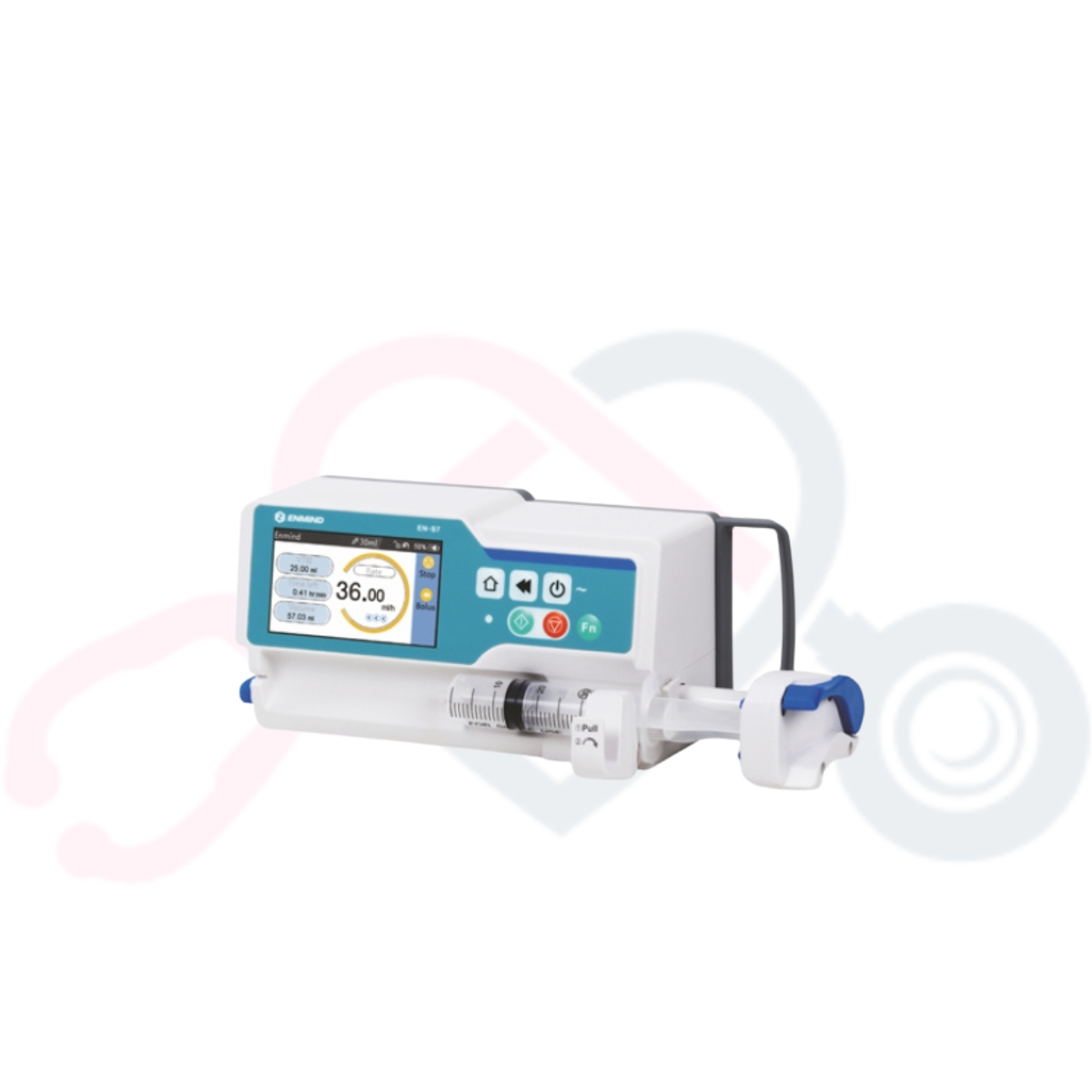
Syringe Pump
Micro-infusion device designed for precise, steady, and slow administration of critical drugs as prescribed by your doctor.
Who Typically Needs a Syringe Pump at Home
- Patients on continuous cardiac medications like dobutamine or milrinone (rare at home, usually palliative)
- Patients on continuous pain management with opioids in a palliative setting
- Some patients on continuous insulin for critical illness recovery
- Patients on continuous anti-nausea drugs (palliative)
- Some patients on prolonged infusions of specific antibiotics
- Paediatric patients where doses are very small and precision matters
The strength of a syringe pump is precision. When a wrong dose by even 10% would be dangerous, a syringe pump is the right tool. Renting a syringe pump on rent for a defined period is common for post-ICU discharges and palliative care setups.
What an Infusion Pump Does
An infusion pump (volumetric infusion pump, or IV pump) uses a set of tubing connected to an IV bag or bottle, and pumps fluid through at a rate set by the operator. It handles much larger volumes at higher rates than a syringe pump.
Key Features
- Larger volumes — from small bags to 1000 mL and beyond
- Rate range from a few mL per hour up to many hundreds
- Programmable delivery — total volume, rate, duration
- Battery backup
- Alarms for air-in-line, occlusion, empty, low battery
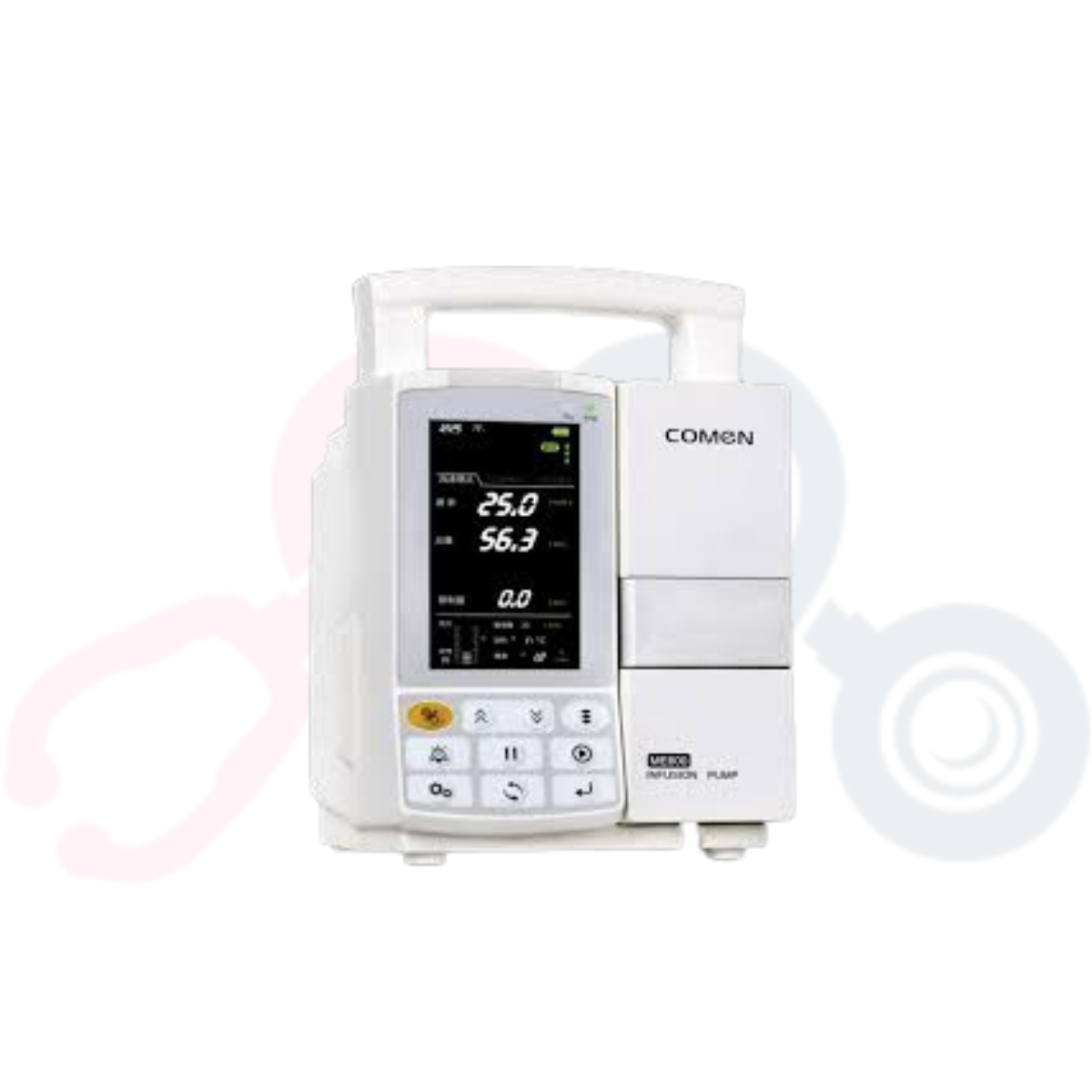
Volumetric Infusion Pump
Ensures highly accurate and continuous delivery of IV fluids and medications to patients safely at home.
Who Typically Needs an Infusion Pump at Home
- Patients on continuous IV fluids at home
- IV antibiotic infusions delivered over 30–60 minutes
- Patients on TPN (total parenteral nutrition) at home
- Chemotherapy patients receiving certain infusions at home (with specialist supervision)
- Post-surgical patients still needing IV medications for the first days at home
- Some palliative care patients on continuous larger-volume medications
The strength of an infusion pump is capacity and versatility. Larger volumes, higher rates, and a wider range of medications and fluids. Renting an infusion pump on rent is standard for extended IV therapy at home.
Head-to-Head: Syringe Pump vs Infusion Pump
| Feature | Syringe Pump | Infusion Pump |
|---|---|---|
| Container | Standard syringe (up to 50 mL) | IV bag or bottle (up to 1000+ mL) |
| Volume range | Small — max ~50 mL | Large — small to very large |
| Rate range | Very slow to moderate (0.1 to ~100 mL/hr) | Slow to fast (1 to 1000+ mL/hr) |
| Precision | Very high, for micro-dosing | High, but not micro-level |
| Typical use | Potent low-volume drugs | Fluids, antibiotics, TPN, feeds |
| Portability | Compact | Larger, but portable |
| Rental cost | Similar to infusion pump | Similar to syringe pump |
| Who typically uses it | Trained nurse | Trained nurse |
Which One Is Right for Your Patient?
Start with the medication and the prescribed rate. That decides the pump — not the price or the availability of one over the other. Some common scenarios:
Continuous Low-Dose Opioid Infusion (Palliative)
Syringe pump. The dose is small, precision matters, and portability helps.
IV Antibiotics Delivered Over 30–60 Minutes
Infusion pump. The volume (100–250 mL) is too large for a syringe pump, and rate precision matters less than reliable delivery.
Continuous IV Fluids for Rehydration
Infusion pump. Large volumes over hours.
Total Parenteral Nutrition (TPN)
Infusion pump. TPN bags are typically 1–3 litres delivered over 10–24 hours.
Chemotherapy at Home
Depends on the drug. Some agents run in a syringe pump, others in an infusion pump. The oncology team decides — this is not a family choice.
Insulin Infusion for Critical Recovery
Syringe pump usually. Insulin doses are small and precision matters.
Both Together
Some patients need both — a syringe pump for a continuous medication and an infusion pump for daily IV fluid or antibiotics. Common in complex post-ICU care.
What About Feeding Pumps?
Worth briefly clarifying, because families often conflate the three. A feeding pump is a different device again — designed specifically to deliver liquid feed through an NG or PEG tube into the stomach. It works at rates similar to infusion pumps but is designed for enteral (gut) feeding, not IV. Different tubing, different connection, different alarms. If your patient needs tube feeding, arrange a feeding pump on rent — not a syringe pump or IV infusion pump, which do a different job.
Setting Up Either Pump at Home
Room Setup
- IV stand near the bed to hang bags at the correct height
- Pump on a stable surface (side table or dedicated IV stand attachment)
- Wall socket with stabiliser and UPS backup
- Space for the nurse to work without stepping over cables
Consumables
Syringes (for syringe pumps), IV giving sets (for infusion pumps), IV bags or bottles, needleless connectors, skin cleaning wipes, sharps disposal container. Ask the supplier what is included in the rental and what you buy separately.
Power and Battery
Both pumps have battery backup, usually a few hours. For load-shedding, a UPS keeps the pump running through the cut. For patients on continuous medications where interruption would be harmful, a UPS is not optional.
Alarms
Understand the common alarms before the first infusion starts:
- Occlusion: The line is blocked. Check for kinks, closed clamps, or a tube caught under the patient.
- Air-in-line: Air bubble in the tubing. The pump stops for safety. The nurse clears it.
- Empty: The syringe or bag is finished. Change over to the next.
- Low battery: Plug in. If already plugged in, investigate the power.
- Dose limit: The programmed dose has been reached.
Silence the alarm only after identifying and dealing with the cause. Never mute an alarm just because it is annoying.
Practical Realities at Home
Trained Hands Matter Enormously
These are not plug-and-play devices. Programming a pump wrongly delivers the wrong dose — sometimes with lethal consequences. Home use requires trained nursing hands. Renting a pump without arranging the nursing simultaneously is renting a hazard. This is one place where paying for competent home help is not a luxury; it is safety.
Line Care
The IV or central line delivering the drug is a direct entry to the bloodstream. It must be kept scrupulously clean. Any redness at the insertion site, any fever, or any leaking around the line needs urgent nurse review — line infections cause sepsis fast.
Regular Flushing
IV lines need regular flushing with saline to keep them patent between medications. The nurse handles this on the prescribed schedule.
Medication Preparation
Drawing up a drug, calculating the concentration, and setting the pump rate is a technical task. Errors here are dangerous. Family members should never do this without specific training and supervision.
Documentation
What was given, when, and at what rate — recorded. The doctor reviewing the case needs this information. Families should keep a simple log even if the nurse maintains a formal chart.
Other Equipment That Often Goes With
Pumps rarely arrive alone. Depending on the patient's condition, the complete setup usually includes:
- An IV stand for hanging bags and holding the pump — often an IV stand on rent alongside the pump
- An adjustable electric hospital bed for positioning and comfort
- A patient monitor for vital sign tracking during and after infusions
- Oxygen concentrator if respiratory support is also needed
- Suction machine if airway secretions are an issue
Coordinated delivery of all equipment on the same day, followed by a proper demonstration with the nurse present, saves the family a week of confusion.
Common Mistakes Families Make
Renting the Wrong Pump
Ordering a syringe pump when the doctor prescribed an IV antibiotic infusion. The syringe pump cannot deliver 250 mL of antibiotic. Wasted money and delayed treatment.
Renting a Pump Without Nurse Support
Cheapest possible setup — until the alarm goes off at 2 AM and nobody knows what to do. Rent the pump and the nurse together, or do not rent the pump.
Ignoring Alarms
Silencing alarms without investigating them is how patients get under- or over-dosed. Every alarm has a reason; find the reason.
Skipping the UPS
Load-shedding interrupts continuous critical medications. A UPS costs less than a single hospital admission for a broken infusion.
Trying to DIY the Programming
Watching the nurse programme the pump three times and thinking you can do it yourself is how errors happen. Do not adjust settings without training and doctor approval.
Not Coordinating with the Care Team
Sourcing the pump from one provider, the nurse from another, and the pharmacy from a third makes coordination fragile. Bundled arrangements through a single home care provider or home care agencies are usually smoother — the nurse is familiar with the exact pump model, the pharmacy delivery schedule matches the infusion schedule, and problems get resolved by one team rather than shuffled between three.
Red Flags: When to Get Medical Help Urgently
If any of the following happen during a pump infusion at home, contact the doctor or nurse immediately, or go to the emergency room / call 1122:
- Sudden reaction to the medication — rash, difficulty breathing, swelling of the face or throat
- Chest pain or sudden shortness of breath
- The line insertion site becomes red, hot, painful, or leaks fluid
- Fever with an IV or central line in place — possible line infection
- Sudden change in mental state — confusion, drowsiness, unresponsiveness
- The pump has stopped and you cannot determine why
- Medication has infused too fast (rate accidentally increased) or too slowly (accidental interruption)
- Blood coming back up the line
- Air visible in the line and the pump has not stopped
These are medical situations that need immediate attention, not "wait until morning" situations.
For patient-friendly background on how infusion pumps are used safely, the US FDA guide to infusion pumps is a reliable reference. For your patient's specific setup, always follow the treating doctor's prescription and the nurse's technique.
Frequently Asked Questions
This page is for general information regarding infusion equipment and does not constitute medical advice. Always consult with the treating physician regarding diagnoses, prescriptions, and pump settings.