
Wheelchair sizing is not complicated once someone explains it. This guide walks through the four measurements that matter, the cushion choice that prevents skin damage, and the small mistakes that cause big problems for bedridden and mobility-limited patients across Lahore, Islamabad, and Rawalpindi.
Nothing here replaces a physiotherapist's assessment for a specific patient — always follow that first for a complex case.
The Four Measurements That Decide the Right Chair
| Measurement | How to Take It | Why It Matters |
|---|---|---|
| Seat width | Widest point of the hips + 2.5 cm (about one finger's width on each side) | Too narrow causes pressure on hips; too wide causes leaning and pressure sores |
| Seat depth | Back of buttocks to back of knee, minus 3–5 cm | Too shallow does not support the thigh; too deep presses behind the knee and cuts circulation |
| Seat height (floor to seat) | Match to lower leg length + about 5 cm for the cushion | Feet should rest flat on footrests, knees at 90 degrees |
| Backrest height | Depends on trunk control — full back for weak trunk, mid back for active users | Balance of support and freedom to move arms |
Take these measurements with the person seated in a firm chair, dressed the way they will be in the wheelchair (with trousers and shalwar, not just underwear). Write the numbers down and bring them when you visit the equipment provider.
Standard Wheelchair Sizes Available in Pakistan
| Seat Width | Fits Hip Width | Suits |
|---|---|---|
| 16 inches (40 cm) | Up to 37 cm | Small adults, teens |
| 18 inches (46 cm) — standard | Up to 43 cm | Average adult in Pakistan |
| 20 inches (51 cm) | Up to 48 cm | Larger adults |
| 22–24 inches (56–61 cm) — bariatric | Above 48 cm | Heavier or wider patients |
Most rental fleets stock 18-inch chairs by default. If the patient is smaller or larger, ask specifically — do not accept "standard size fits everyone." A wheelchair that is one size wrong is a wheelchair the patient will refuse to sit in by week three.
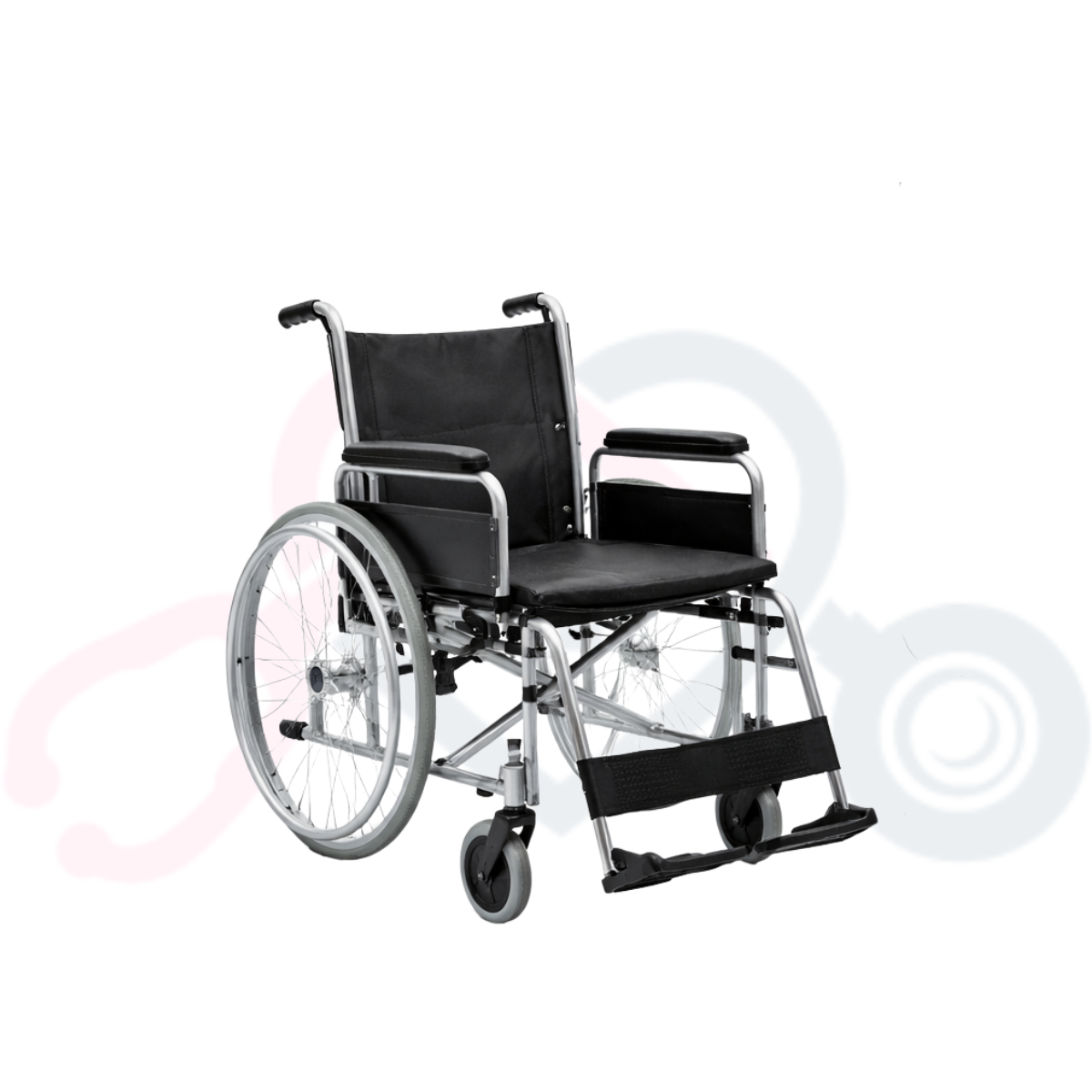
Standard Manual Wheelchair
Lightweight, foldable manual wheelchair available in standard sizes. Ideal for indoor and outdoor mobility support.
The Cushion: The Second-Most-Important Decision
A wheelchair without a proper cushion is a machine for producing pressure sores. Sitting concentrates most of the body's weight on the tailbone and the two "sit bones" (ischial tuberosities). Without a good cushion, the skin over these bones breaks down within weeks.
| Cushion Type | Cost | Best For | Downside |
|---|---|---|---|
| Foam cushion | Low | Occasional users, short sits | Loses shape in 2–3 months |
| Gel cushion | Moderate | Daily users, average sores risk | Heavy; can leak if punctured |
| Air (ROHO-style) cushion | Higher | High-risk patients (bedridden, previous sores, thin patients) | Needs adjustment; punctures need repair |
| Combination gel + memory foam | Moderate to high | Long-term daily users | Bulkier profile |
If the patient will sit in the chair more than four hours a day, do not accept the chair without a proper cushion. This is the single most cost-effective piece of home care help a family can invest in.
Foot Support Matters Almost as Much
If the footrests are the wrong height, the patient's thighs lift off the seat (feet too high) or slam pressure onto the back of the thighs and buttocks (feet too low). Both cause pressure sores.
Correct footrest position: soles flat, ankles at 90 degrees, knees at 90 degrees, thighs fully supported by the seat. Adjust the footrests when the chair is delivered. Most chairs have telescopic footrests you can extend or shorten with a single lever.
Head and Back Support for Weaker Patients
A patient with weak trunk control (post-stroke, advanced Parkinson's, muscular dystrophy) needs a chair with head support and a taller back. Standard chairs with a mid back do not hold these patients upright — they slump forward within minutes.
For these cases, a reclining wheelchair with a tall backrest and headrest is the right choice. Rent one first before buying, because needs change as the patient's condition changes.
Sizing Head-to-Head: Standard vs Reclining vs Bariatric
| Feature | Standard Folding | Reclining | Bariatric |
|---|---|---|---|
| Seat width available | 16–20 inches | 16–20 inches | 22–28 inches |
| Backrest | Mid to full back | Full back with reclining | Full back, reinforced |
| Headrest | Usually no | Usually yes | Optional |
| Weight capacity | Up to 100 kg | Up to 100 kg | 120–180 kg |
| Weight of chair itself | 15–18 kg | 20–25 kg | 25–35 kg |
| Folds for car | Yes, easily | Yes, but bulkier | Yes, but heavy |
| Best for | Most adult patients | Weak trunk, post-stroke, long sits | Heavier patients |
Use this table to talk with the physio or equipment provider. Naming the type of chair you need shortens the conversation and reduces the chance of getting the wrong one delivered.
Cushion Head-to-Head: Foam vs Gel vs Air
| Feature | Foam | Gel | Air (ROHO-style) |
|---|---|---|---|
| Pressure distribution | Basic | Good | Excellent |
| Life before replacement | 2–4 months daily use | 1–2 years | 3+ years with care |
| Maintenance | None | Wipe clean | Regular pressure adjustment |
| Weight | Very light | Heavy | Light |
| Suits | Short-term or occasional | Daily 4–8 hour use | Bedridden, thin, or previous sores |
The "right" cushion is the cheapest one that will not let a sore develop. For most families that is a gel cushion. For high-risk patients (previous sores, very thin patients, spinal injuries), invest in an air cushion — the price is much less than treating one deep pressure sore.
Wheelchair Accessories Worth the Money
- Cushion (non-negotiable, covered above)
- Waterproof cover for the cushion — protects against incontinence, extends cushion life
- Anti-tip bars — prevent the chair rolling backwards on a slope
- Larger rear wheels for outdoor use if the family will push it on rough streets
- Seat belt for patients with poor trunk control — prevents forward slide
- Cup holder or small pouch — small quality-of-life upgrades that matter
Skip: chrome plating, colour customisation, and any accessory that does not solve a real problem for your patient.
Getting the Fit Right at Delivery
When the chair arrives, do a five-minute fit check before signing acceptance:
- Sit the patient in the chair with the intended cushion
- Check that fingers can fit between hips and side of chair — not more, not less
- Check that behind the knee there is a 3–5 cm gap to the seat edge
- Check feet flat on footrests with knees at 90 degrees
- Ask the patient to try shifting forward, sideways — see if the chair supports them
- Check the brakes lock firmly
If anything is wrong, do not accept the chair. A good rental provider will swap for a different size or model on the same day.
Combining the Wheelchair With the Rest of the Home Setup
A wheelchair on its own does not solve the mobility problem. The rest of the equipment matters:
- A well-adjusted electric hospital bed at the correct height for transfers
- An air mattress on the bed to prevent sores when the patient is out of the chair
- A commode chair beside the bed for bathroom needs
- A bedside table at the right height, so the patient can eat and manage medicines in the chair
- A walker for the transition period if the patient may recover some walking ability
Who Advises on Sizing
- Physiotherapist: Best person to advise on size, backrest type, and cushion for a specific patient. Ask for a fitting assessment.
- Doctor: Confirms weight-bearing limits and medical restrictions.
- Home nurse: Checks skin daily, alerts the family if a pressure area develops so the cushion or chair can be reviewed.
- Equipment provider: Should offer at least two chair options and demonstrate the fit before you sign.
Common Sizing Mistakes
- Ordering by patient weight alone — hip width matters more than weight
- Skipping the cushion to save money
- Buying a fixed-height chair when the patient's height needs adjustable footrests
- Getting a chair too tall for the family to lift into the car boot
- Buying an expensive chair before the physio has confirmed the patient will use it long term
- Ignoring the backrest height — a slumping patient gets neck pain and reflux
Red Flags: Signs the Chair or Cushion Is Wrong
- Redness or open skin on tailbone, hips, or heels developing within days
- Patient sliding forward out of the chair repeatedly
- New back or neck pain when sitting
- Feet dangling or thighs lifting off the seat
- Patient refusing to sit in the chair after a few days
- Numbness or pins-and-needles in the legs while sitting
Any of these means the fit is wrong. Fix it — change the chair or the cushion — do not push through. A pressure sore takes weeks to heal and can require hospital admission.
Measure hip width and thigh length. Order a standard 18-inch chair for an average adult, wider or narrower as needed. Insist on a gel cushion for daily use, an air cushion for high-risk skin. Adjust the footrests when the chair arrives. Do a five-minute fit check before signing. Get the size right and the chair supports the patient; get it wrong and it becomes another problem to manage.
Frequently Asked Questions
For more information on mobility aids, the NHS guide to wheelchair services is a reliable reference. Always follow your medical team's specific guidance.