Hospital Bed Mattress Types: Foam, Air or Gel?
A plain Lahore guide for families setting up a hospital bed at home — how foam, air, and gel mattresses actually differ, which one suits which patient, and how to avoid the common wrong choices.
Three Options, One Decision
Hospital bed rental companies quote three main mattress types — foam, air, and gel — and families often pick the cheapest or the most expensive without really understanding which one they actually need. A ninety-year-old post-stroke patient on a foam mattress will develop pressure sores in a week. A mobile post-surgical patient on an expensive alternating pressure mattress is paying for protection they do not need. Getting this choice right once saves real money and prevents real harm.
This page is for Lahore families setting up a hospital bed at home — understanding hospital bed mattress types, matching mattress to patient, and recognising the quiet differences between models within each category.
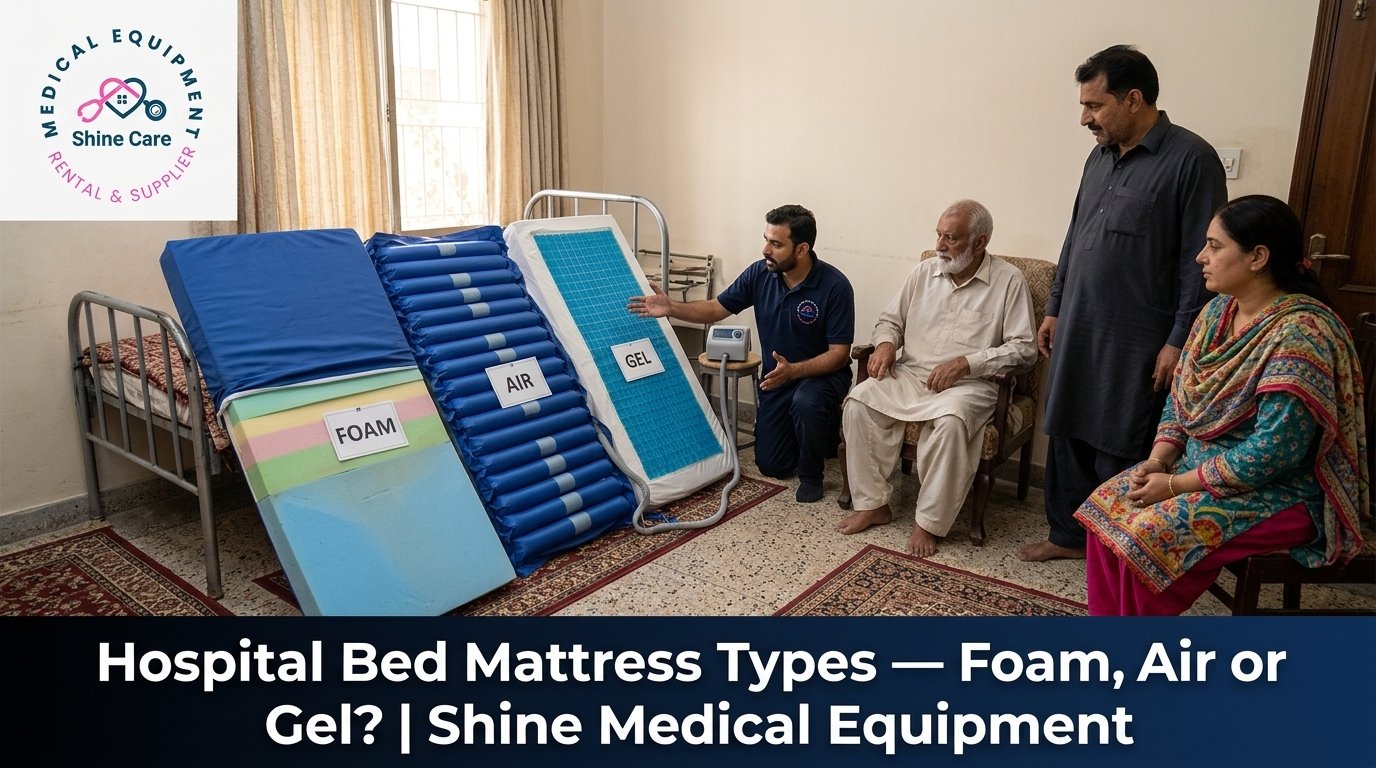
The Three Main Categories
Foam Mattress
Standard dense foam. No power needed. Good for mobile patients. Lowest cost. Not suitable for high-risk bedbound patients.
Air Mattress
Pump-driven cells that redistribute pressure. Static air or alternating pressure versions. Essential for bedbound and high-risk patients.
Gel Mattress
Gel pads integrated into a foam base. Distributes pressure without needing power. Useful for moderate-risk patients and specific comfort situations.
There are also hybrid mattresses combining categories (foam-gel, foam-air, gel-air) for specific situations.
Foam Mattresses in Depth
What They Are
Dense foam, usually 10-15 cm thick, cut to standard hospital bed size. Some have a single foam layer; better models have multi-density foam (firmer base, softer top layer).
Who They Suit
- Patients spending only short periods in bed each day.
- Patients who can reposition themselves regularly.
- Short-term recovery where the patient is mobile and will be on their feet within days.
- Light-duty hospital bed use — grandparents using a bed for comfort rather than medical necessity.
Who They Do Not Suit
- Bedbound patients.
- Patients with existing pressure sores.
- Patients with impaired consciousness or sensation.
- Long-term palliative, stroke, or advanced dementia patients.
Memory Foam
A specific type of foam that softens with body heat and moulds to the patient's shape. More comfortable than standard foam, distributes pressure better, and reduces pressure sore risk for moderate-risk patients. More expensive than standard foam, less protective than air for high-risk patients.
Pros and Cons
Pros: No power needed. Quiet. Low cost. No maintenance. Comfortable for most mobile patients.
Cons: Does not redistribute pressure dynamically. Inadequate for high-risk bedbound patients. Hot in summer (depending on foam type).
Air Mattresses in Depth
What They Are
Mattresses filled with air cells, powered by an electric pump. Two main mechanisms:
- Static air: All cells inflated evenly; the patient's weight distributes across the air volume.
- Alternating pressure: Rows of cells cycle — one row inflates while the adjacent row deflates, every 5-10 minutes. No single area of skin bears weight for long.
Who They Suit
- Bedbound patients.
- Patients who cannot reposition themselves.
- Patients with existing pressure sores (specific low air loss models).
- Long-term care — stroke, palliative, advanced dementia, post-ICU.
Who They Do Not Suit
- Mobile patients who can reposition themselves — unnecessary expense and the pump noise is for nothing.
- Short-term post-surgical recovery where the patient will be up and about within a week.
Entry Level — Bubble Pad
Thin plastic mattress with small bubble cells, sat on top of an existing mattress. Cheapest alternating pressure option. Good for moderate-risk patients expected to be in bed for weeks, not months.
Standard Alternating Pressure Mattress
Full-size mattress with larger air cells and reliable pump. The standard choice for most high-risk bedbound patients. Good for most home ICU setups.
Large-Cell / Low Air Loss
For patients at very high risk — bigger cells, continuous gentle air flow through the surface to keep skin dry. More expensive. For patients with existing pressure sores or heavy moisture issues.
Pros and Cons
Pros: Dynamic pressure redistribution. Dramatically reduces pressure sore risk in bedbound patients. Essential for home ICU care.
Cons: Needs continuous power (UPS backup important). Pump noise (newer models are quieter). Can puncture. More expensive than foam.
Gel Mattresses in Depth
What They Are
Gel pads built into a foam base. The gel distributes pressure across a larger area and helps dissipate body heat.
Who They Suit
- Moderate-risk patients who spend significant time in bed but can still reposition themselves.
- Patients who find air mattresses uncomfortable or who cannot tolerate the pump noise.
- Patients living in households without reliable electricity.
- Post-surgical patients during a longer-than-typical recovery.
Who They Do Not Suit
- Very high-risk bedbound patients who truly need dynamic pressure redistribution.
- Patients with existing deep pressure sores (need active pressure relief).
Pros and Cons
Pros: No power needed. Quiet. Comfortable. Better pressure distribution than plain foam. Durable.
Cons: Heavier. More expensive than foam. Less protective than air for high-risk patients. Limited availability in some models.
The Honest Decision Matrix
| Patient Type | Recommended Mattress |
|---|---|
| Mobile, short-term bed use | Foam or memory foam |
| Post-surgical recovery, up within days | Foam or memory foam |
| Semi-mobile, spends most of day in bed | Memory foam or gel |
| Bedbound but repositionable | Memory foam or static air |
| Bedbound, cannot reposition self | Alternating pressure air |
| Post-stroke recovery | Alternating pressure air |
| Advanced dementia bedbound | Alternating pressure air |
| Palliative care | Alternating pressure air or low air loss |
| Ventilated / ICU at home | Alternating pressure air (often large-cell) |
| Existing pressure sore | Low air loss or combination |
| Bariatric patient | Bariatric alternating pressure air |
Common Mistakes Families Make
- Choosing by price rather than by patient risk. The cheapest mattress for a high-risk patient costs more in the end — pressure sore treatment is significantly more expensive than the right mattress.
- Over-specifying for a mobile patient. An alternating pressure mattress with pump noise, UPS backup, and extra cost makes no sense for a patient who repositions themselves naturally.
- Assuming "hospital bed" includes the right mattress. Standard hospital beds often come with basic foam. The mattress is a separate decision.
- Ignoring the pump noise question for air mattresses. An older loud pump in a small bedroom keeps the household awake for weeks. Newer models are quieter — ask.
- Setting the air mattress pressure wrong for the patient's weight. Too soft, the patient bottoms out. Too firm, pressure points are not relieved. The pump has a dial — set it correctly.
- Over-layering the air mattress with blankets. Extra padding on top reduces the mattress's effect. One thin sheet is all that should separate the patient from the mattress surface.
- Forgetting the UPS for air mattresses. Pump needs continuous power. Load-shedding deflates the mattress and the patient is suddenly on a bare base. A small UPS is cheap insurance.
Indicative Rental Pricing
| Mattress Type | Approximate Monthly Rent |
|---|---|
| Standard foam (with hospital bed rental) | Often included |
| Memory foam | Rs. 4,000 – 7,000 |
| Gel mattress | Rs. 5,000 – 9,000 |
| Bubble pad (entry-level alternating air) | Rs. 4,000 – 6,500 |
| Standard alternating pressure air mattress | Rs. 6,000 – 10,000 |
| Large-cell alternating pressure | Rs. 9,000 – 14,000 |
| Low air loss mattress | Rs. 15,000 – 22,000 |
| Combination alternating + low air loss | Rs. 20,000 – 30,000 |
| Bariatric alternating pressure | Rs. 15,000 – 25,000 |
Rates indicative. Refundable security deposit applies. Package rates available with hospital bed rental.
Beyond the Mattress — What Else Matters
The mattress is one layer of pressure sore prevention. The others matter equally:
- Two-hourly repositioning by a trained attendant or nurse.
- Skin inspection at every reposition.
- Barrier cream at every incontinence change.
- Pressure-relieving cushion for chair time.
- Heel floating under a pillow (the mattress helps but heels are particularly vulnerable).
- Adequate nutrition and hydration for skin integrity.
- Prompt management of incontinence.
Honest care in the home for bedridden patients combines the right mattress with trained daily care. Among Lahore home care agencies and medical equipment vendors, this coordinated approach prevents the pressure sores that would otherwise make the mattress alone look inadequate.
For a broader view of what we deliver across Lahore, see our medical equipment rental service. For general background reading on pressure sore prevention, the NHS prevention guide is a useful family resource.
FAQs
Do I need an air mattress or will foam do?
Depends on the patient. Mobile patients who can reposition themselves — foam is fine. Bedbound or cannot-reposition patients — air mattress is strongly recommended. A short call about the patient settles which.
Which brand of air mattress is best?
Fit of mattress to patient risk matters more than brand. Current-generation pumps from reputable medical suppliers are reliable. We stock several models and recommend based on the case.
How quickly can you deliver a hospital bed and mattress to Lahore?
Same-day across most Lahore addresses when the request comes in before afternoon. Next-morning for later confirmations.
Does the mattress fit any hospital bed?
Standard air and foam mattresses fit standard hospital beds (usually 90-100 cm wide, 200 cm long). We confirm bed dimensions at booking.
What is included in rental?
Delivery, installation, demonstration, monthly service, and swap of faulty units at no extra charge. Refundable security deposit at the start.
Can I purchase instead of renting?
Yes for most mattress types. For long-term predictable needs, purchase may be more economical.
Which Lahore areas do you cover?
All major Lahore residential areas — DHA, Gulberg, Model Town, Garden Town, Johar Town, Wapda Town, Bahria Town, Lahore Cantt, Askari, Faisal Town, and surrounding belts.
Can you also arrange trained nursing?
Yes, through our partner nursing teams. Single point of contact for equipment and nursing. Honest home care help for bedridden patients is equipment plus trained hands.
Right Mattress for Your Patient in Lahore
Call Shine Medical Equipment for a short honest conversation about the patient. We will recommend the right mattress type, deliver with the hospital bed, and set up the room — usually within hours.