A family member is being discharged from the hospital next week, and suddenly there’s a hospital bed to arrange, maybe a wheelchair, possibly an oxygen concentrator too. The doctor has given instructions, but nobody has told you whether it makes more sense to rent this equipment or simply buy it outright. If this sounds familiar, you’re not alone — it’s one of the most common questions families across Pakistan face when a loved one needs care at home.
There isn’t a single right answer for everyone. Choosing between medical equipment rental in Lahore, Islamabad and Rawalpindi and buying equipment outright depends on several practical factors: how long the equipment will actually be needed, what the patient’s condition requires, your budget, the type of device involved, whether needs might change down the road, and even how much storage space you have at home.
This guide walks through both options honestly, so you can make a decision that actually fits your situation rather than guessing.
Understanding Medical Equipment Rental and Purchase Options
Renting medical equipment means you pay for the use of a device for a set period — a few weeks, a couple of months, or longer — without taking on ownership. Once the need passes, the equipment goes back, and you’re not left storing or maintaining something you no longer use.
Buying, on the other hand, means the equipment becomes yours. There’s no return date, no rental term to track, and you can use the device whenever it’s needed without checking availability each time.
Neither approach is inherently better. Renting suits situations that are temporary or uncertain in duration. Buying suits situations where the need is long-term or recurring. The right call really comes down to your specific circumstances — not a general rule that applies to every family.
When Renting Medical Equipment May Be a Practical Choice
Renting tends to make sense in situations like these:
- Short-term recovery. Someone recovering from surgery or an injury may only need a hospital bed or walker for a matter of weeks.
- Temporary mobility support. A patient regaining strength after a fall or fracture might need a wheelchair for a limited period, not permanently.
- Post-discharge care. Many patients need equipment immediately after leaving the hospital, but the exact recovery timeline isn’t always clear at the outset.
- Uncertain recovery duration. When a doctor can’t say precisely how long a device will be needed, renting avoids committing to a purchase that may turn out to be unnecessary later.
- Temporary home-care arrangements. Families sometimes set up care at home for a defined stretch of time, such as while awaiting a further procedure or transfer to another care setting.
- Changing equipment needs. As a patient’s condition evolves, the type of equipment required can change too. Renting makes it easier to switch devices without the financial commitment of ownership.
Before finalising a rental, it’s worth confirming the exact terms — duration, deposit requirements, and what happens if the equipment is needed for longer than planned. Availability may depend on the equipment type, current stock, exact delivery location, and schedule, so these details are best confirmed directly rather than assumed.
When Buying Medical Equipment May Be More Suitable
There are situations where purchasing outright is the more sensible route:
- Long-term use. If a patient will need a device for months or years, ownership often works out more practical than repeated rental arrangements.
- Recurring or regular use. Some equipment, like a nebulizer for a patient with a chronic respiratory condition, gets used often enough that owning it removes the hassle of arranging rentals again and again.
- Permanent care needs. For patients with lasting mobility or care requirements, having equipment on hand at all times — without needing to coordinate a rental — can be more convenient.
- Preference for ownership. Some families simply prefer having their own equipment, available whenever it’s needed, without any return timeline to manage.
That said, buying does come with its own responsibilities. You’ll need a place to store the equipment when it’s not in use, and devices with moving or electronic parts — hospital beds, oxygen concentrators, patient monitors — require occasional maintenance and servicing over time. These are worth factoring into the decision, not just the upfront cost.
Renting vs Buying Medical Equipment: Side-by-Side Comparison
| Factor | Renting | Buying |
|---|---|---|
| Initial payment | Generally lower upfront cost | Higher upfront investment |
| Short-term use | Well suited | May lead to unused equipment later |
| Long-term use | Can become costly over extended periods | Often more practical over time |
| Flexibility | Easy to return or switch equipment | Fixed once purchased |
| Equipment replacement | Handled as part of rental terms | Owner’s responsibility |
| Storage | Not required after return | Space needed at home |
| Maintenance | Typically covered within rental terms | Owner is responsible for upkeep |
| Ownership | No ownership | Full ownership |
| Changing patient needs | Easier to adjust | Less flexible once bought |
| Availability | Subject to stock and location at time of request | Equipment is on hand once purchased |
This comparison isn’t meant to push you toward one option. It’s meant to help you weigh what matters most for your particular situation — whether that’s flexibility, long-term cost, or simply having equipment ready at home without needing to coordinate anything.
Medical Equipment Commonly Available for Rent or Sale
Hospital Beds and Patient Positioning
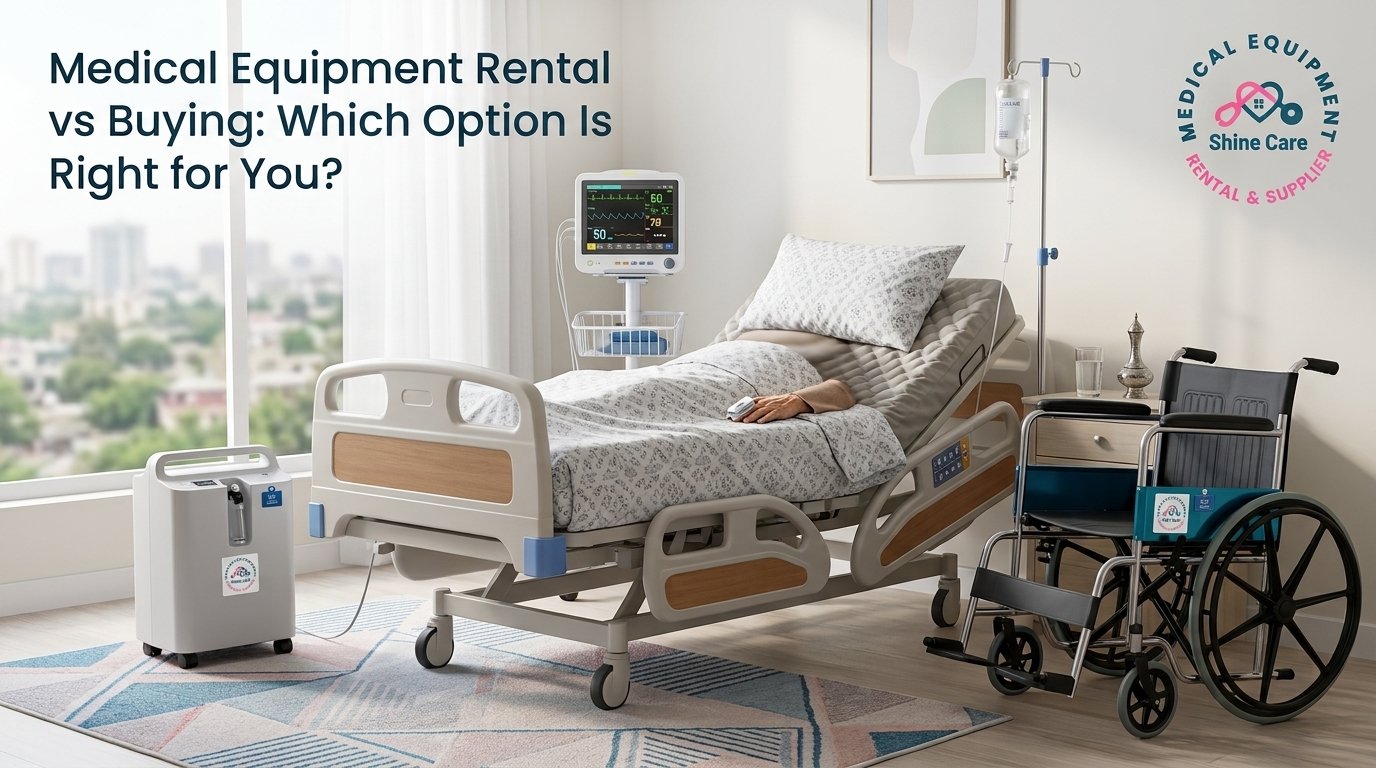
Electric, manual, and hospital beds each offer different levels of adjustability, which matters for patients who need to change position frequently or who require head and leg elevation. Bedside tables often go alongside these beds, giving patients easy access to essentials without leaving the bed. Families managing short recovery periods often lean toward renting a bed, while those caring for a bedridden family member long-term sometimes choose to purchase one.
Patient Comfort and Pressure Support
Anti-bedsore air mattresses help reduce the risk of pressure sores in patients who spend extended periods lying down. These are commonly rented alongside a hospital bed, particularly during recovery phases, though patients with ongoing mobility limitations sometimes opt to buy one for continuous use.
Mobility and Daily-Care Equipment
Wheelchairs, walkers, and commode chairs support day-to-day independence and safety. A patient recovering from a hip surgery might only need a walker for a few weeks, making rental the more sensible route, whereas someone with a permanent mobility condition may find ownership more convenient in the long run.
Oxygen and Respiratory Equipment
Oxygen concentrators, oxygen cylinders, BiPAP machines, ventilators, nebulizer machines, and suction machines fall under critical-care equipment. These devices should always be selected and used based on the guidance of a treating doctor, since respiratory support needs vary significantly from one patient to another. Some families rent oxygen concentrators for a defined recovery period, while others with ongoing respiratory conditions choose to purchase.
Patient Monitoring Equipment
Patient monitors and cardiac monitors allow caregivers and healthcare professionals to keep track of vital signs at home. These are typically recommended by a doctor based on the patient’s specific condition, and the decision to rent or buy often depends on how long monitoring will be required.
Medical Pumps and IV Support
Feeding pumps, infusion pumps, syringe pumps, and IV stands support patients who need precise, ongoing medical intervention. As with respiratory equipment, these devices should only be used under the guidance of a qualified healthcare professional, who will determine the appropriate setup for the patient’s condition.
Questions to Ask Before Choosing Rent or Buy
Before making a decision, it helps to work through a short checklist:
- How long will the equipment actually be required?
- Has a doctor or qualified healthcare professional recommended this specific equipment?
- Is the patient’s condition likely to change in the coming weeks or months?
- Is there enough space at home to store the equipment if purchased?
- Is the equipment genuinely suitable for the patient’s needs?
- What accessories or add-ons are required alongside the main device?
- What are the exact rental or purchase terms, including any deposits or conditions?
- Is delivery available to your area?
- Will there be guidance on setting up the equipment correctly?
- What support is available if a technical issue comes up later?
Working through these questions before committing to either option can save both money and inconvenience later.
Medical Equipment Availability in Lahore, Islamabad and Rawalpindi
Shine Medical Equipment offers medical equipment rental and sales for customers across Lahore, Islamabad, and Rawalpindi. Whether you’re arranging a hospital bed for a patient in Lahore, an oxygen concentrator for a home in Islamabad, or a wheelchair for someone in Rawalpindi, both rental and purchase routes are available depending on the equipment and your specific requirements.
That said, availability may depend on the equipment type, current stock, exact delivery location, and schedule. It’s always best to confirm these details directly before finalising any arrangement, rather than assuming a particular device is available on a given date. Delivery timing and rental terms can also vary depending on where you’re located within these cities, so a quick confirmation call goes a long way toward avoiding last-minute surprises.
How to Request Medical Equipment
Getting started is a straightforward process:
Step 1: Share the equipment requirement, including the type of device needed.
Step 2: Confirm the specific equipment model and how long it will be required.
Step 3: Check current availability for that equipment.
Step 4: Decide between the rental or purchase option based on your needs.
Step 5: Confirm the delivery location and any applicable terms.
Step 6: Arrange delivery or collection at a convenient time.
This process helps avoid confusion later and ensures the right equipment reaches the right place, at a time that works for your family.
Why Choose Shine Medical Equipment?
Shine Medical Equipment provides both rental and sales options, giving families the flexibility to choose whichever route suits their situation. The equipment range covers different patient-care needs, from mobility support to respiratory and monitoring devices, and the team helps confirm availability and guide customers through the selection process based on what the patient actually requires.
Delivery coordination is available where feasible, and service coverage extends across Lahore, Islamabad, and Rawalpindi, with exact terms confirmed at the time of request. The goal is straightforward: help families access the right equipment, through the option — rental or purchase — that genuinely fits their circumstances.
This article is for general information only and does not replace medical advice. Medical equipment should be selected and used according to the guidance of a doctor or qualified healthcare professional.
Frequently Asked Questions
Is medical equipment available for rent in Lahore?
Yes, medical equipment rental is offered in Lahore, though availability depends on the specific device, current stock, and delivery location.
Can I rent medical equipment in Islamabad?
Yes, rental options are available for customers in Islamabad. It’s best to confirm equipment type and delivery details in advance.
Is medical equipment available in Rawalpindi?
Yes, both rental and purchase options are available for customers in Rawalpindi, subject to availability at the time of request.
Can I buy medical equipment from Shine Medical Equipment?
Yes, medical equipment is also available for purchase, alongside the rental option, depending on the device and your requirements.
Is renting better than buying medical equipment?
Neither option is universally better. Renting tends to suit short-term or uncertain needs, while buying often suits long-term or recurring use. The right choice depends on your specific situation.
How long can medical equipment be rented?
Rental durations vary depending on the equipment and the patient’s needs. It’s best to confirm the available rental terms directly.
Can I rent a hospital bed for home use?
Yes, hospital beds are commonly available for rent for home patient care, alongside the option to purchase.
Are oxygen concentrators available for rent or sale?
Yes, oxygen concentrators are available through both rental and purchase, though use should always follow a doctor’s guidance.
What should I check before renting medical equipment?
It’s worth confirming the rental duration, terms, delivery timing, and whether the equipment matches the patient’s specific requirements.
How can I confirm equipment availability?
Availability can be confirmed by sharing your equipment requirement and location directly, so current stock and delivery options can be checked.
Conclusion
Choosing between medical equipment rental in Lahore, Islamabad and Rawalpindi and buying outright isn’t about picking the “correct” option — it’s about matching the choice to your patient’s needs, the expected duration of use, the type of equipment involved, your budget, and what the future might look like. A short-term recovery calls for a different approach than a long-term care situation, and there’s no shame in reassessing your decision as circumstances change.
Families across Lahore, Islamabad, and Rawalpindi face this same decision regularly, and working through it with clear information — rather than guesswork — makes the process far less stressful.
Contact Shine Medical Equipment to discuss your requirements, check current availability, and explore suitable rental or purchase options.