
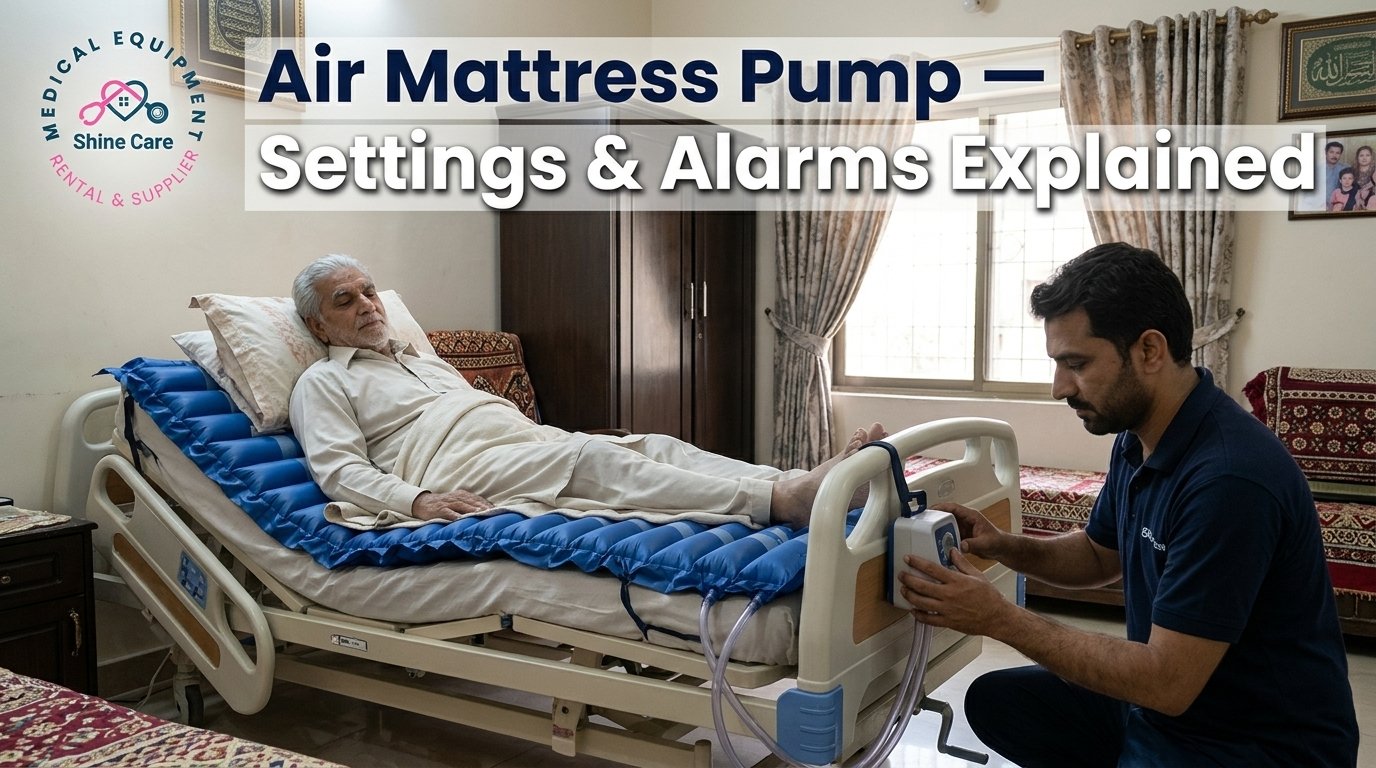
Air Mattress Pump — Settings and Alarms Explained
Air mattresses prevent pressure sores only when the pump is set correctly for the patient. Here is a plain guide to settings, alarms and troubleshooting, plus what Shine Medical Equipment supplies on rental and purchase across Lahore, Islamabad and Rawalpindi.
The family bought an air mattress for their stroke-recovery father three weeks ago. It is on his hospital-style bed in the drawing room. The pump has been running continuously. The mattress feels firm — maybe too firm. The patient has started to develop a pressure area on his sacrum anyway. The family is confused. "We bought the mattress to prevent this." The mattress is doing nothing of the sort because the pump pressure is set wrong for the patient's weight, and nobody has told the family that the setting matters. This pattern — expensive equipment, wrong setting, poor result — is one of the common failures of home medical equipment use in Pakistani households.
This article explains how an alternating air pressure mattress works, how to set the pump for your patient, what each alarm means, and when to call Shine Medical Equipment for service or a replacement unit.
What an Alternating Air Mattress Does
An alternating pressure air mattress uses a pump to inflate and deflate separate air cells in cycles. At any one moment some cells are up and some are down, so the pressure under any given body part keeps shifting. The result:
- No one area is under constant pressure
- Blood flow to the skin and tissue is preserved
- Pressure sores are prevented or allowed to heal
- Patient is comfortable for long bed-bound periods
These mattresses are standard for patients bed-bound for days or longer, patients with existing pressure sores, patients post-stroke, post-major surgery, in late-stage disease, or with any condition that significantly limits movement.
Static air cushions or foam mattresses alone do not do this cycling — they still redistribute pressure better than a plain mattress but do not alternate.
Why Settings Matter
The pump needs to be set so that:
- Cells inflate enough to lift the patient's weight — if too soft the patient "bottoms out" and lies on the hard base
- Cells do not inflate so hard that the patient is on a rigid surface
- Cycle time is suitable
- Any patient-specific features (CPR deflate, static mode) are configured correctly
Over-inflation = pressure is still high, just distributed differently. Under-inflation = patient bottoms out, no benefit. Both allow pressure sores. The correct setting is the lightest inflation that still supports the patient off the base.
The Hand Check — Simple Test for Correct Pressure
To check if the setting is right for your patient:
- Place the patient lying flat on the mattress
- Slide your flat hand, palm up, between the patient's sacrum (lower back) and the base of the mattress
- You should feel the patient's body supported above the base — about 2 to 3 cm clearance
- If your hand is immediately pressed hard — the mattress is too soft, patient is bottoming out — increase pressure
- If you can slide your hand through loosely — the mattress is too hard — reduce pressure
- Check again if the patient is heavier or on an inclined bed position
The hand check is the single most useful setting adjustment. Many Pakistani families never do it; the pump is set to the middle on day one and never changed.
Common Pump Controls
Most alternating pressure pumps have:
- Pressure dial — low to high, adjusted by patient weight and the hand check. Lower setting for lighter patients, higher for heavier.
- Static / float mode — stops the alternating cycle, maintains an even inflation. Used for a few minutes during repositioning, dressing changes, bed-pan use, or patient transfers. Should not be left on static long-term for sore-prevention cases.
- CPR deflate — quickly empties the mattress for CPR. Located prominently on most pumps. Family should know where this is in case of emergency.
- Cycle time — on some models adjustable. Standard is typically 10 to 12 minutes per full cycle.
- Alarm mute — temporarily silences alarms while you investigate.
- Power switch — simple on/off.
Not all models have all these controls. Simpler pumps may just have power and pressure. Fancier models may have memory, patient profiles and heater options.
Setting by Patient Weight — Rough Guide
| Patient Weight | Typical Pressure Setting | Hand Check Priority |
|---|---|---|
| Below 50 kg | Lowest third of dial | Confirm patient not bottoming out |
| 50–70 kg | Lower-middle | Standard check |
| 70–90 kg | Middle | Standard check |
| 90–110 kg | Upper-middle | Confirm sufficient inflation |
| Above 110 kg | Higher setting; check mattress weight rating | May need bariatric mattress |
This is a rough guide. The hand check overrides it. If your mattress has a specific weight-based setting chart from the manufacturer, follow that first.
What the Common Alarms Mean
Low Pressure Alarm
Sound: Continuous or intermittent beep.
Display: Pressure icon or specific indicator.
What it means: Mattress pressure has dropped below the set point.
Possible causes:
- Air leak — check tubing connections, inspect mattress for punctures
- Tubing disconnected from the pump
- Tubing kinked under the bed frame
- Patient has recently been added to a static-mode mattress (temporary dip while cells adjust)
- Pump failing
Action: Check tubing connection at both ends. Check tubing path for kinks. Visually and by feel check the mattress for leaks. If no obvious cause, call for service.
Power Failure Alarm
Sound: Continuous beep.
What it means: Mains power to pump lost.
Action: Check plug and socket. If load-shedding, the pump will restart when power returns. The mattress deflates slowly — if the patient will be without power for an extended period, consider repositioning them manually every 1 to 2 hours in the meantime.
High Pressure Alarm
Sound: Beep with pressure indicator.
What it means: Pressure exceeds safe limit.
Possible causes:
- Pressure dial accidentally turned too high
- Internal valve stuck
Action: Reduce pressure setting, check for pump malfunction. If alarm continues at correct setting, service needed.
Service / Fault Alarm
Sound: Specific tone, often with error code.
What it means: Internal diagnostic detected a fault.
Action: Note the code, call Shine Medical Equipment for service or replacement.
Battery Alarm
Some pumps have a small internal battery for brief power outages. Low battery alarm means the pump will shortly stop if mains does not return. Transition to manual repositioning until power is restored.
Troubleshooting Checklist
- Pump plugged in and switch on?
- Mains power present (not load-shedding)?
- Tubing connected at both ends — pump and mattress?
- Tubing not kinked under the bed or frame?
- Pressure dial at an appropriate setting for patient weight?
- Static mode not accidentally engaged?
- Mattress free of visible punctures or tears?
- Mattress correctly oriented (some have head and foot ends)?
- Within the manufacturer's weight limit?
- Pump air filter clean (where present)?
Many "faulty mattress" calls turn out to be a loose tubing connection, a kink, or a wrong setting.
When to Use Static Mode
- Short periods during repositioning
- During dressing changes on the back
- Bed-pan placement and use
- Patient transfers in and out of bed
- Short CPR or clinical procedures
Return to alternating mode immediately afterward. Leaving the mattress in static mode defeats its purpose for pressure sore prevention.
Daily and Weekly Maintenance
- Daily — pressure check (hand under sacrum)
- Daily — visual check of tubing and connections
- Weekly — wipe mattress cover with warm water and mild detergent
- Weekly — check for leaks or wear
- Weekly — check pump air filter if accessible (clean per manufacturer)
- Monthly — professional service for high-use rental mattresses
- Replace cover if torn — torn cover allows body fluid into the cells
- Replace mattress when cells are visibly damaged, lose pressure repeatedly, or at manufacturer-specified end of life
What Air Mattresses Do Not Do
- They do not substitute for repositioning. Patients still need turning every 2 hours — the mattress reduces risk but does not eliminate it, especially for severely bed-bound or high-risk patients.
- They do not treat existing deep pressure sores alone — these need specific wound care.
- They do not fix a wet or soiled mattress problem — incontinence care remains essential.
- They do not fix poor nutrition — bone-prominent patients still need protein and calories.
- They are not a replacement for trained nursing care in high-risk patients.
Common Family Mistakes
- Set the pump once and never check again
- Static mode left on because patient complains of movement
- Over-inflation to make the surface feel firm — defeats the whole purpose
- Under-inflation leading to bottoming out
- Tubing kinked under bed frame — unnoticed until mattress fails
- Puncture from an object left on the bed — scissors, keys, needles
- Buying a very cheap mattress with poor-quality cells that fail within weeks
- Using an air mattress on a hospital bed with sides that catch and pinch the mattress
- Skipping repositioning because "the mattress does it"
About Shine Medical Equipment
Shine Medical Equipment supplies and rents air mattresses, hospital beds, oxygen concentrators, suction machines, BiPAPs, CPAPs, wheelchairs, nebulisers, cardiac monitors and other home medical equipment across Lahore, Islamabad and Rawalpindi. For families setting up care in the home around a bed-bound patient — stroke recovery, late-stage dementia, post-ICU, cancer, long-term palliative — an air mattress plus a hospital bed plus the right nursing routine prevents the pressure sores that too often become the final crisis.
Rental is often more practical than purchase, especially where the need is for weeks to months rather than years. Rental includes service and replacement if the pump develops a fault during the rental period.
For related equipment and services, see our main air mattress rent page, hospital bed rent, suction machine rent, wheelchair rental, and medical equipment rental. For families needing home care agencies to supply the trained attendants and nurses to use this equipment correctly — turning, pressure checks, hygiene — our group's home nursing arm serves the same cities. The right home nurse alongside the right equipment produces the best outcome.
Call or WhatsApp 0312-7648307 for air mattress rental, service, replacement units, or new purchase.
Frequently Asked Questions
Does my grandfather still need turning if we have an air mattress?
Yes. Air mattresses reduce pressure sore risk but do not eliminate it. For most bed-bound patients, 2-hourly repositioning should continue alongside the mattress for best protection.
Can I switch the pump off at night to reduce noise?
No. The pump needs to run continuously for the mattress to function. Modern pumps are generally quiet. If noise is a problem, placement away from the patient's head reduces disturbance.
Why does the mattress feel soft even when the pressure is on high?
Alternating mattresses are intentionally softer than a firm mattress — the patient should sink slightly into the cells. If the patient is bottoming out (hand under sacrum touches the base), increase pressure or consider a higher-capacity mattress for the patient's weight.
How long does a rental mattress typically last?
With good care, a quality mattress can last several years. In continuous heavy use, pumps often need service after 1 to 2 years, mattress covers may need replacement earlier if soiled. Rental cycles usually cover this.
Can an air mattress be used on an ordinary bed?
Yes — many families use it on an ordinary bed, placed on top of the regular mattress. A hospital bed is preferable for most bed-bound patients because of adjustability and side-rail safety, but an air mattress on a regular bed is better than no air mattress.
What is bariatric mattress?
Reinforced mattress for heavier patients (typically above 120 kg). Higher weight capacity, often wider surface, stronger pump. Required when the patient exceeds the standard mattress rating.
How soon can you deliver across Lahore / Islamabad?
Same-day delivery usually possible in central areas, subject to availability. Call 0312-7648307.
Air Mattress Issue? Call for Same-Day Help
Shine Medical Equipment supplies, rents and services air mattresses across Lahore, Islamabad and Rawalpindi. Replacement units available for rental customers. Call us for any pressure, pump, or setup issue.
This article is a general equipment guide. For patients with existing deep pressure sores or complex positioning needs, direct nursing or wound-care assessment is essential. External reference: NHS — Pressure Sores.