
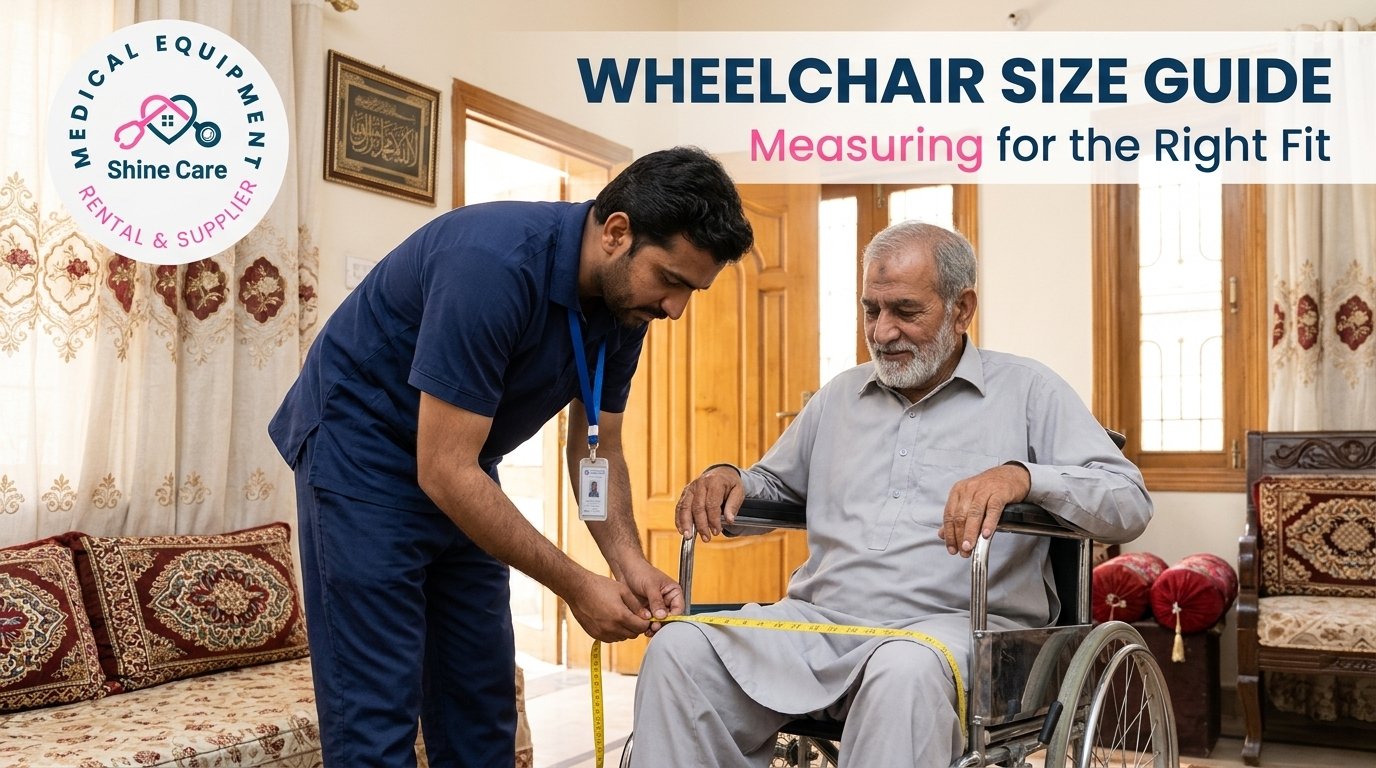
Wheelchair Size Guide — Measuring for the Right Fit
A wrong-size wheelchair causes pressure sores, back pain and falls. A right-size wheelchair keeps a patient comfortable, mobile and safe. Here is a simple measuring guide and what Shine Medical Equipment offers across Lahore, Islamabad and Rawalpindi.
Your 80-year-old grandmother can no longer walk long distances. The family bought a wheelchair from the first supplier they found. It is too wide for her — she slides sideways. The seat is too deep — the edge presses behind her knees. The footrests are at the wrong height — her feet hang. Within three weeks she has a pressure area on her tailbone and chronic back pain. She refuses to use the chair any more. The family blames the chair, then her, then themselves. The problem was never the chair — it was that no one measured her for it. A wheelchair fitted to the patient makes the difference between mobility and misery.
This guide walks Lahore, Islamabad and Rawalpindi families through the simple measurements that determine the right wheelchair size, the different wheelchair types available, and what Shine Medical Equipment supplies on rental and purchase. Nothing here replaces hands-on fitting — our team can visit the home for assessment where that helps.
Why Wheelchair Fit Matters
- A chair too narrow pinches the hips and causes pressure injuries
- A chair too wide allows sliding, poor posture, trunk collapse
- Seat too deep presses behind the knees, reducing blood flow
- Seat too shallow concentrates weight on the tailbone
- Back too low gives no support
- Back too high prevents arm movement
- Footrests too high raise knees above hip level, increasing pressure on sitting bones
- Footrests too low let feet dangle and cause circulation problems
- Armrests at wrong height cause shoulder and neck pain
- Wheels in wrong position affect propulsion and tipping risk
Patients in correctly fitted wheelchairs sit for hours comfortably. Patients in wrong-fit chairs usually ask to get out within 30 minutes. The chair ends up in a corner, and mobility shrinks.
The Five Essential Measurements
1. Seat Width
Measure the widest part of the patient's hips while they are seated — from one outer thigh to the other. Add about 2.5 to 5 cm (1 to 2 inches) for comfort and clothing. Too tight and the hips press against the sides; too wide and the patient slides sideways.
Standard adult seat widths range from 16 inches (narrow) to 22 inches (wide). The commonest standard adult chair is 18 inches. Bariatric chairs go wider.
2. Seat Depth
Measure from the back of the seated patient's buttocks to the back of their knees. Subtract about 2.5 to 5 cm so the front edge of the seat does not press behind the knees. Common depths 16 to 18 inches for standard adults.
Too deep — the patient slides forward trying not to press the knee crease. Too shallow — thighs unsupported, pressure concentrated.
3. Seat Height from the Floor
Measure from the back of the knee down to the heel while the patient is seated on a firm surface, with feet flat. Add shoe height. The resulting measurement is the ideal distance from the top of the seat cushion to the footrest surface — meaning the thigh is horizontal, knee at 90 degrees, foot flat.
If the chair's seat height from floor plus footrest cannot be matched to the patient, consider a hemi-height chair (lower seat so the patient can propel with their feet) or elevating the whole chair.
4. Back Height
- Standard back — up to the lower border of the shoulder blade. Good for active self-propelling users with trunk control.
- Tall back — up to or past the shoulder. For patients with poor trunk control, elderly needing full support, patients being transported in the chair.
- Reclining back — adjustable, for patients needing position changes.
- Headrest — for patients with poor neck control.
5. Armrest Height
Measure from the seat surface to the bottom of the elbow when the patient is seated with elbow at 90 degrees. Armrest should match or be slightly below. Too high and shoulders hunch; too low and the patient leans forward.
Fixed armrests, flip-back for easier transfers, or removable armrests — each suits different patients.
Additional Fit Considerations
- Weight capacity — standard chairs typically rated to 100 to 120 kg; bariatric chairs for heavier patients
- Elevating leg rests — for patients with swelling, post-fracture, DVT history
- Removable or swing-away leg rests — easier transfers in and out
- Push handles — for family-pushed chairs
- Brake quality — essential, often overlooked in cheap chairs
- Anti-tip bars — for less experienced users and ramp use
- Tyre type — solid tyres for indoor use, pneumatic for rough outdoor use
- Folding mechanism — for transport in cars
- Weight of the chair itself — matters for family handling
- Cushion — a correctly chosen cushion matters as much as the chair for pressure prevention
Wheelchair Types We Supply
Standard Manual Wheelchair
- For patients who need basic mobility — indoor and short outdoor use
- Family or attendant pushes, or the patient self-propels
- Steel or aluminium frame
- Fixed or flip-back armrests
- Standard widths 16 to 20 inches
- Weight limit typically 100 to 120 kg
Lightweight Folding Wheelchair
- Aluminium frame — easier to lift into a car boot
- Easy fold for storage and transport
- Suitable for families who need portability
Reclining Wheelchair
- Back reclines for position changes
- Important for patients with pressure sore risk
- Elevating leg rests often included
- Suited to patients spending many hours in the chair
High-Back / Tilt-in-Space Wheelchair
- Full back with headrest
- Tilts the entire seated position
- For patients with poor trunk control, severe disability, late-stage neurological conditions
Bariatric Wheelchair
- Reinforced frame for heavier patients
- Wider seat
- Higher weight capacity
Transport Wheelchair
- Small rear wheels — pushed by attendant only
- Lightest option
- Good for occasional outings
- Not for self-propulsion
Commode Wheelchair
- Opening in the seat for toileting
- Can be rolled into a bathroom
- Combined mobility and toilet assist
Electric / Power Wheelchair
- Battery-powered
- For patients unable to self-propel but with cognitive ability to control
- Available on special order
Quick Fit Reference
| Measurement | How to Check | Problem If Wrong |
|---|---|---|
| Seat width | Palm's width space between hip and side | Too narrow — pressure; too wide — slide |
| Seat depth | 2–5 cm gap behind knees | Too deep — knee press; too shallow — tailbone pressure |
| Seat height | Thigh horizontal, knee at 90, foot flat | Too high — feet dangle; too low — knees high |
| Back height | Below shoulder blade (active) or at shoulder (full support) | Too low — no support; too high — restricts arm |
| Armrest height | Match elbow at 90 degrees | Too high — shoulder hunch; too low — lean forward |
The Cushion Matters
A good wheelchair with a poor cushion still causes pressure sores. For any patient sitting more than 2 hours a day in the chair:
- Foam cushion — basic, adequate for low-risk short use
- Gel cushion — better pressure distribution, suitable for medium risk
- Air cushion — adjustable, best for high-risk patients (previous pressure sores, bony prominences, limited sensation)
- Combined gel-and-foam
- Avoid donut-shaped cushions — they concentrate pressure around the sore
Cushions wear out — replace per manufacturer schedule.
Current Shine Medical Equipment Options
| Equipment | Rental | Purchase |
|---|---|---|
| Standard manual wheelchair | Contact for monthly rate | Contact for current price |
| Reclining wheelchair | Contact for monthly rate | Contact for current price |
| Commode wheelchair | Contact for monthly rate | Contact for current price |
| High-back / tilt-in-space | Contact for monthly rate | Contact for current price |
Current prices and model availability on request — call 0312-7648307.
For families providing care in the home around a mobility-limited patient, our team can assess the home environment and the patient to recommend the right wheelchair plus any additional equipment (ramp, grab rails, hospital bed) that work together as a mobility set-up.
Where Patients Go Wrong
- Buying the first chair without measuring the patient
- Buying the cheapest option without checking brake quality
- Choosing a chair without seeing it against the home — doorway widths, bathroom size, lift access
- Buying when rental would be more sensible for a short-term need
- Not thinking about the pusher — can your 65-year-old mother actually push a 25 kg chair with her 85 kg husband in it?
- Ignoring the cushion entirely
- Not checking how the chair will fit in the family car boot
- No anti-tip features on a chair that will go on ramps
- Buying bariatric capacity for a patient who doesn't need it (heavier, harder to push)
- Buying standard capacity for a patient who exceeds the weight rating
Rental vs Purchase
- Rental — ideal for post-surgery recovery, short-term disability, temporary need. Service included for most of our rental customers. Lower upfront cost.
- Purchase — ideal for long-term users, patients likely to use the chair for years. Economics work out over 12–24 months for long-term users.
Our team helps families choose based on expected duration of need.
About Shine Medical Equipment
Shine Medical Equipment supplies and rents wheelchairs, hospital beds, oxygen concentrators, suction machines, BiPAPs, CPAPs, nebulisers, cardiac monitors, infusion pumps and other home medical equipment across Lahore, Islamabad and Rawalpindi. Our team assesses the patient and the home where that helps — a correctly sized chair matters more than any specific brand.
For related equipment and services, see our main wheelchair rental page, hospital bed rent, air mattress rent, commode chair rent, walker rent, and medical equipment rental. For families needing home care help alongside the equipment — trained attendants and nurses who know how to transfer safely in and out of a wheelchair — our group's home nursing arm serves the same cities.
Call or WhatsApp 0312-7648307 for wheelchair fitting, rental, purchase, or home assessment.
Frequently Asked Questions
What is the most common wheelchair size for a Pakistani adult?
18-inch seat width is the commonest standard. Narrower (16 inch) suits smaller patients; wider (20, 22 inch) suits larger. Always measure rather than assume.
Can I rent for a month to see if the chair suits?
Yes — many families start with rental for exactly this reason. We can swap if the fit is not right in the first days.
How often should the cushion be replaced?
Foam cushions usually 1 to 2 years; gel and air cushions longer with inspection. Replace if visibly flattened, torn, or if the patient is developing pressure areas.
Do you deliver and set up across Lahore and the Twin Cities?
Yes — delivery, setup and basic familiarisation for family across main residential areas of Lahore, Islamabad and Rawalpindi.
Can my mother self-propel a wheelchair?
Depends on upper body strength and cognition. For patients with one-sided weakness or weak arms, self-propulsion is limited. A hemi-height chair (lower, foot-propelled) may work. Our team advises based on the patient.
What about electric wheelchairs?
Available on special order. Suitable for patients unable to self-propel manually but able to control a joystick safely. Discuss specifications when you call.
Need the Right Wheelchair, Fitted Correctly?
Shine Medical Equipment delivers across Lahore, Islamabad and Rawalpindi. Rental, purchase and home assessment. Call us for the correct size and type for your patient.
This article is a general equipment guide. For patients with complex positioning needs — spinal injury, severe cerebral palsy, late-stage neurological disease — a physiotherapist or occupational therapist should assess for a custom seating system. External reference: NHS — Wheelchairs.