
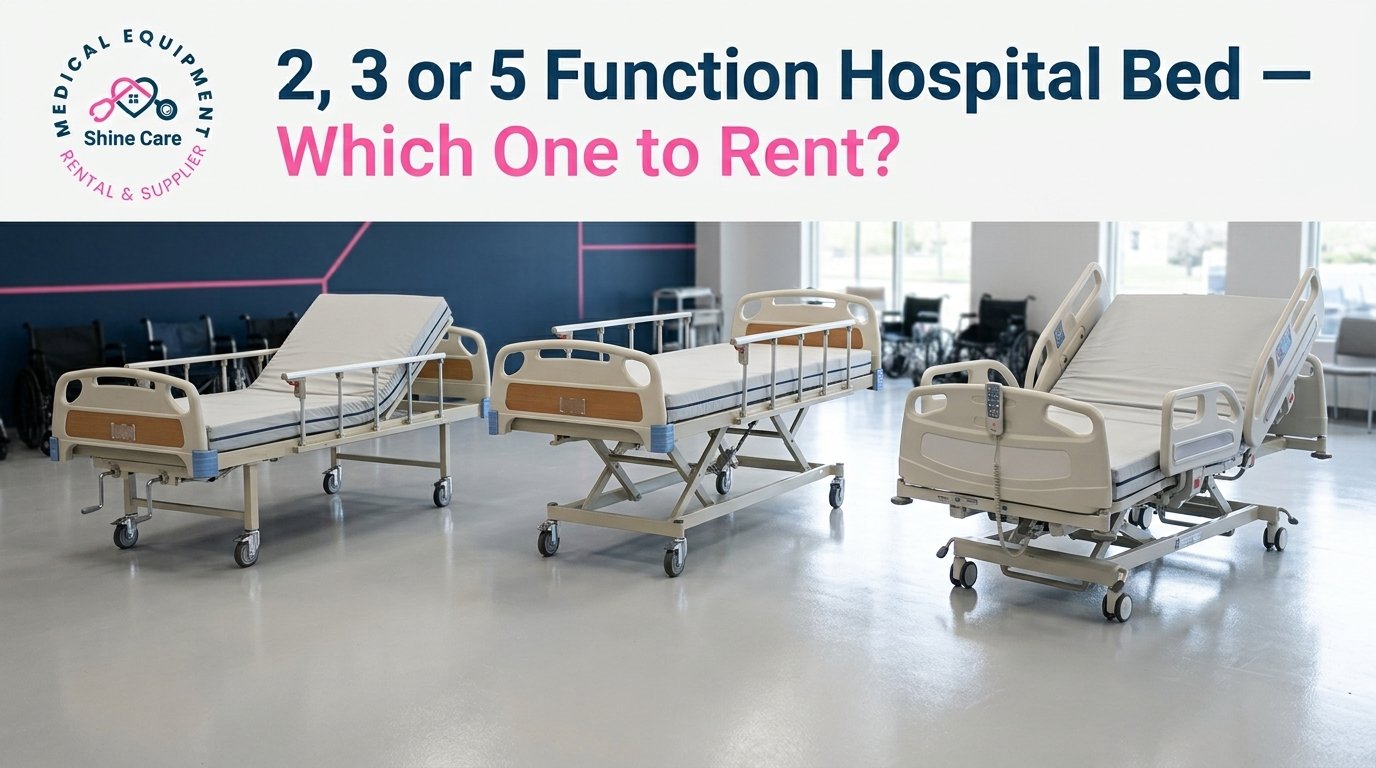
5 Function Hospital Bed vs 2 or 3: Which Should You Rent?
The best rental bed is not automatically the model with the most buttons. It is the one that supports the patient’s prescribed positions, allows safe transfers and fits the room and care routine. Before asking about the monthly price, ask which movements the person actually needs.
Compare the movements rather than the sales label
| Bed type | Common adjustments | Main question before renting |
|---|---|---|
| 2 function | Backrest and knee/leg section | Is a fixed overall height suitable for transfers and daily care? |
| 3 function | Backrest, knee/leg section and overall height | Will adjustable working and transfer height meet the care plan? |
| 5 function | The above plus Trendelenburg and reverse Trendelenburg tilt | Has the clinical team identified a reason for whole-bed tilt? |
Function count describes movements, not necessarily the power source. A bed may use electric controls, manual cranks or a combination. Ask for a demonstration and the manufacturer’s specification rather than assuming that “five function” always means fully electric.
When a simpler model may be enough
A two-function bed may suit a stable person who needs back and leg adjustment but whose transfer and care needs can be met safely at its fixed height. Check that height with the actual mattress fitted. A bed that looks comfortable can still be difficult to stand from or awkward for someone assisting with washing.
A three-function model may be a more practical choice when the bed must be lowered for access and raised for care tasks. The extra height adjustment can matter more to the daily routine than additional tilt options.
When the additional tilt needs a clinical reason
Trendelenburg tilts the whole mattress platform so the head is below the feet. Reverse Trendelenburg does the opposite. Neither movement is the same as simply raising the backrest.
Choose these positions only under an individual clinical plan. Do not use head-down tilt as a home treatment for fainting, low blood pressure or breathing difficulty. A bed is not a substitute for emergency assessment, and more functions do not make an unsuitable patient safe for home treatment.
The doctor or treating clinical team sets positioning requirements. A nurse provides assessment and prescribed clinical care within their competence. A physiotherapist can advise on transfers and movement. A caregiver or patient attendant helps with daily routines after training; an equipment technician demonstrates the controls and checks the installation, but does not prescribe treatment.
Check the whole bed system before delivery
- Confirm the safe working load and what the stated limit includes.
- Measure bed width, length, doorways, lift access and space around the bed.
- Check minimum and maximum height with the intended mattress.
- Ask which mattress is supplied and whether a pressure-redistribution assessment is needed.
- Have the supplier demonstrate brakes, controls, emergency lowering and any control lock.
- For an electric model, ask what works during a power cut and how backup power is maintained.
- Inspect the mattress fit and rail compatibility, including when sections move.
Rails can help some people reposition, but they can also cause entrapment or more serious falls if someone climbs over them. The FDA’s bed-safety guide recommends individual assessment, appropriate mattress fit and regular review of rail use. Do not treat raised rails as a replacement for supervision.
Ask for one complete rental quote
Get the rental period, deposit, delivery, installation, collection, mattress and accessory charges in writing. Ask who handles a failed motor, how faults are reported and what replacement arrangements apply. Do not assume a battery, pressure-relieving mattress or overbed table is included.
If home care help or nursing services are being arranged separately, tell that team the model and mattress before delivery. A bed does not remove the need for assisted transfers, skin checks or a personalised repositioning plan.
Make the final decision around the care plan
Start with prescribed positioning, then transfer height, mattress needs, power arrangements and room fit. Only then compare rental costs. Seek emergency help for a fall with serious injury, breathing difficulty or a person trapped in the bed; do not keep operating the controls in an attempt to solve a dangerous entrapment.
Contact Shine Medical Equipment to ask about current models, and request a written specification through the equipment rental enquiry before paying. Availability, prices and service coverage must be confirmed directly.
Frequently asked questions
Is a five-function model always better for an older adult?
No. Match the movements to the person’s needs. A suitable height range, mattress and safe transfers may matter more than extra tilt functions.
Does five function mean fully electric?
Not necessarily. Ask how every movement is operated and inspect the actual model’s specification.
Does a rental bed prevent pressure injuries?
No bed can guarantee prevention. The person still needs an individual skin-care, repositioning and support-surface plan.
Can we rent before the patient is discharged?
Yes, planning early is sensible, but obtain the clinical positioning and transfer requirements first. Arrange installation and caregiver instruction before the patient arrives.
General information only; not an individual clinical assessment. Follow the treating team’s instructions and seek emergency care for serious symptoms.