
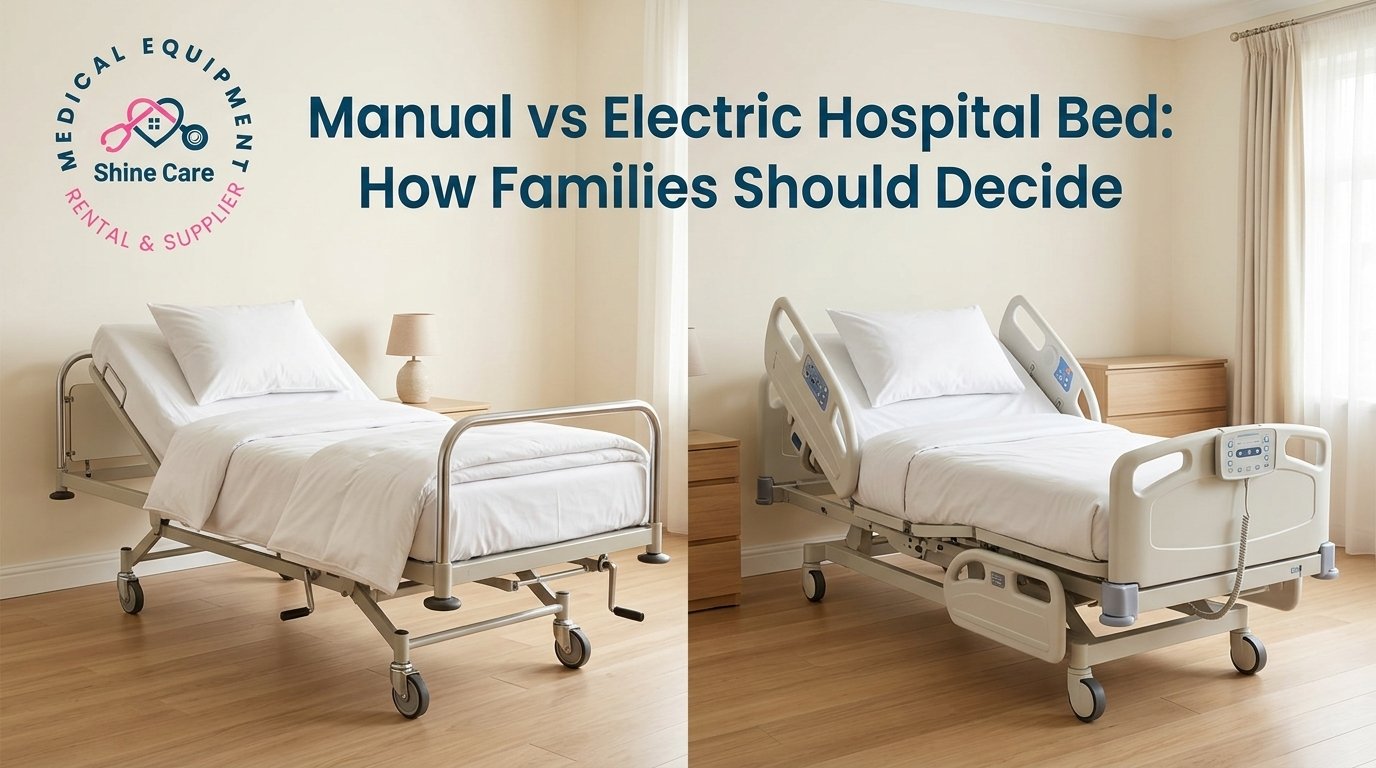
Manual or Electric Hospital Bed: How to Decide — A Practical Guide
When a family member is about to be discharged from hospital and cannot get out of bed easily, one of the first questions the doctor or discharge nurse raises is: "You will need a hospital bed at home." Simple sentence. Long list of follow-up questions. Manual or electric? Rent or buy? What kind of mattress? This guide walks families in Lahore, Islamabad, and Rawalpindi through the decision.
This guide walks families through the manual vs electric hospital bed decision — the practical differences, what each type actually costs to run and to use, which kind of patient each is really suited for, and the small mistakes that make families regret their choice within a week. Nothing here replaces your doctor's or physiotherapist's recommendation, but it will help you make the choice with your eyes open.
Who Decides What Bed Is Needed
The bed is one of the few home care items where the family really does drive the decision — the doctor rarely specifies a brand or model. But the people who help clarify what the patient actually needs are:
- Doctor / Physiotherapist: Advises whether the patient will be spending most of the day in bed, whether they need to sit up frequently for feeding or breathing, and whether they will regain mobility over weeks or months.
- Home Nurse / Attendant: Knows how many times a day the patient's position needs changing — a critical input, because it decides whether a manual bed will be practical.
- Equipment Supplier: Explains the differences between models, delivery, setup, and rental versus purchase terms. Not a clinical role — take the technical explanation from the supplier, but the decision on what fits your situation is yours.
- Family: Has to live with the bed. Their opinion on how many hands are available to operate a manual bed, whether the electricity supply is stable, and what the budget looks like matters as much as anything.
Reputable home care agencies also often help with equipment recommendations as part of setting up a nursing plan — bundled arrangements can be more practical than sourcing the bed, the mattress, and the care team from three different places.
What Both Beds Actually Do
Before the differences, understand what a hospital bed is compared to a normal home bed. A hospital bed has three key features:
- Adjustable backrest — lets the patient sit up for eating, drinking, watching TV, praying, or coughing without needing to pile up ten pillows.
- Adjustable knee bend — reduces slipping down the bed and takes pressure off the lower back.
- Adjustable height (in most models) — lets a caregiver or nurse work at a comfortable height instead of bending over, which prevents caregiver back injury over months of care.
Some models also have side rails to prevent falling out of bed, a mattress platform designed for medical mattresses, and locking wheels so the bed can be moved and then stabilised.
The difference between manual and electric is simply how these adjustments are made — by hand-cranks or by push-button.
The Manual Hospital Bed — Honest Overview
How It Works
Two or three hand-cranks at the foot of the bed. Turn the crank to raise or lower the backrest, the knee section, or (in some models) the whole bed height. Each adjustment takes 30 to 60 seconds of steady cranking. A manual hospital bed on rent is the more common choice for families on a tight budget or short-term needs.
The Advantages
- Much lower cost — both rental and purchase price
- Works during load-shedding — no electricity needed, ever
- Fewer things to go wrong — no motors, no wiring, no control panel
- Easier to move between rooms — usually a bit lighter than motorised versions
- Long service life with basic maintenance
The Trade-Offs
- The patient cannot adjust it themselves — every position change needs someone to come and crank it
- Slow to adjust — during a coughing fit or shortness of breath, 30 seconds of cranking feels like a long time
- Physically tiring for the caregiver if the patient needs many adjustments per day
- Cranks stick out from the foot of the bed — can catch a toe or hit a leg if you walk past too fast
- Height adjustment (if available) is the slowest and most tiring crank — most families end up leaving the bed at one height
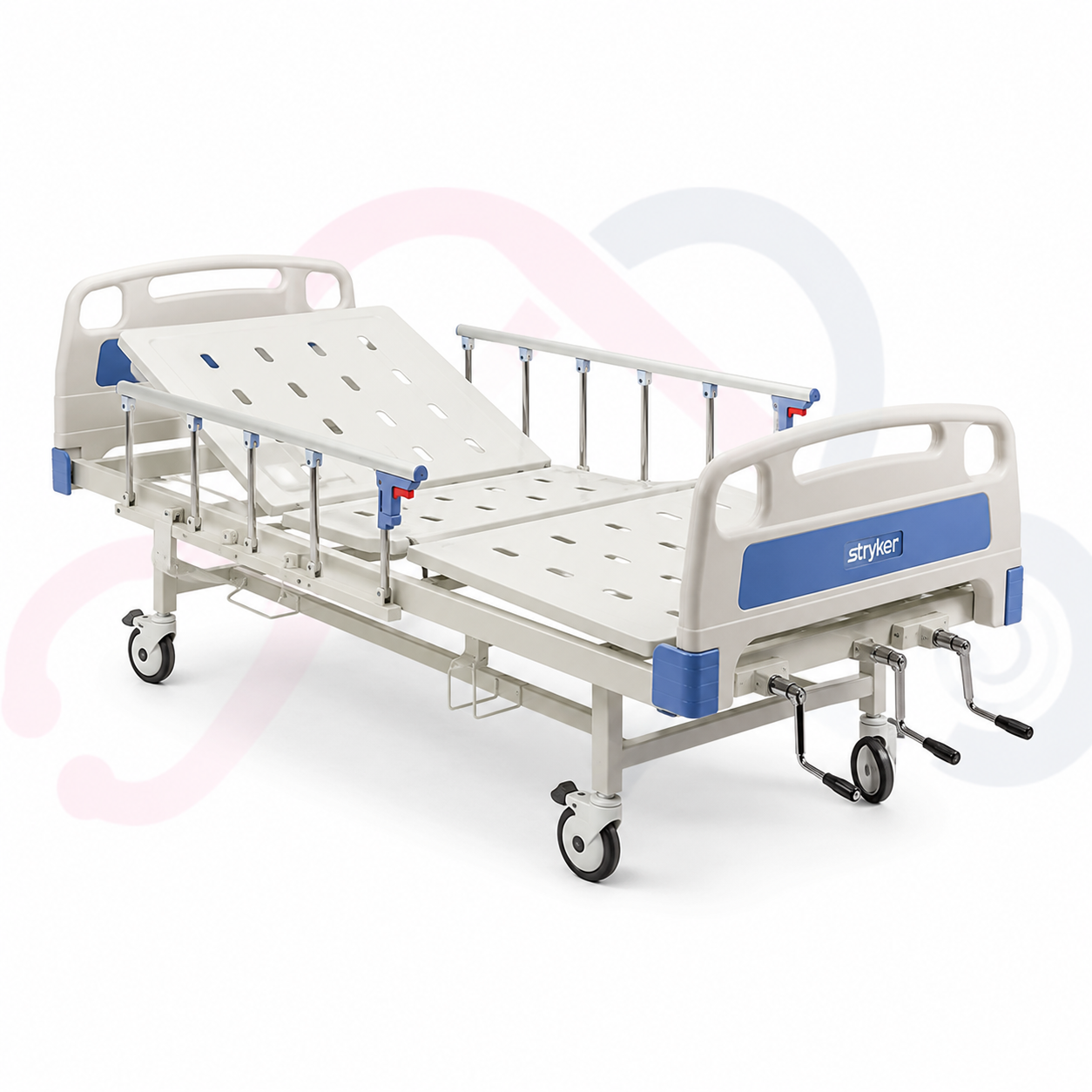
Manual Hospital Bed
Sturdy manual bed featuring adjustable backrest, knee rest, and height adjustments via mechanical hand cranks. Includes safety rails.
The Electric Hospital Bed — Honest Overview
How It Works
Push-button control (usually a handset the patient can hold). Motors do the work of raising the backrest, bending the knees, adjusting the height, or sometimes tilting the whole bed. Some models offer a chair position where the patient can sit up almost fully upright, and a CPR-flat button that drops everything instantly if resuscitation is needed. Families frequently choose an electric hospital bed on rent when the patient needs frequent adjustments or when the situation is expected to last months.
The Advantages
- The patient can adjust it themselves — a huge boost to dignity and independence for anyone who can press a button
- Fast adjustment — critical during breathing difficulty, coughing, or nausea
- Multiple positions possible — chair mode, Trendelenburg (feet up), reverse Trendelenburg (head up)
- Height adjustment used properly — nurses and attendants can raise the bed to work without bending, then lower it for the patient to feel less "up in the air"
- Less physical strain for family caregivers — especially important when the caregiver is elderly themselves (a spouse looking after a spouse)
The Trade-Offs
- Higher cost — both rental and purchase
- Stops working during load-shedding unless the bed is on a UPS — and if the bed is stuck in an awkward position when the power goes, the patient may be left uncomfortable
- More things to go wrong — motors, controllers, wires, switches. Servicing intervals matter.
- Slightly heavier — harder to move between rooms
- Sensitive to voltage fluctuations — a stabiliser is usually worth the extra outlay
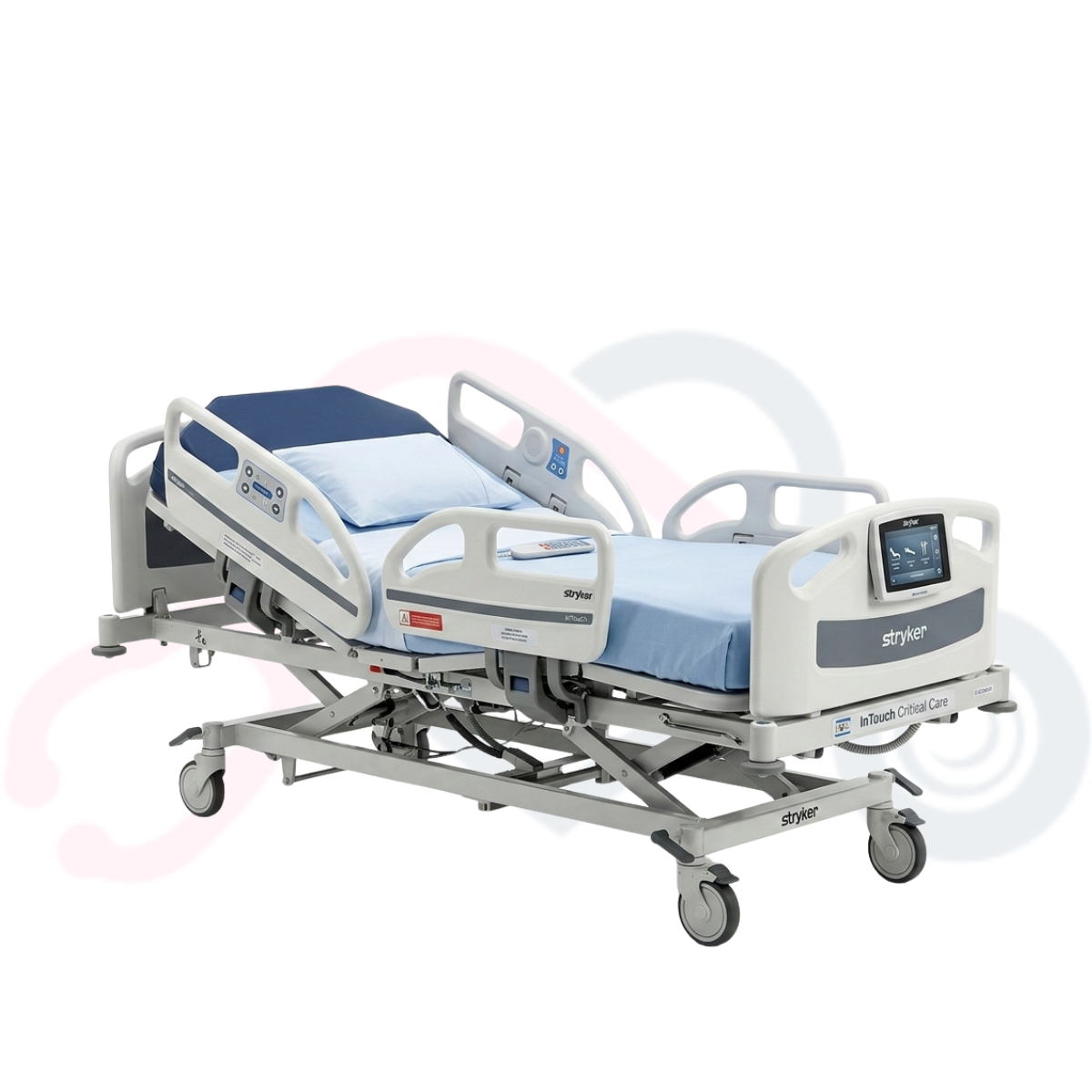
Electric Hospital Bed
Imported electric ICU bed providing automated positioning via remote control. Ideal for patients requiring frequent repositioning without physical strain.
Semi-Electric — The In-Between Option
Some hospital beds are semi-electric: the backrest and knee bend are motorised, but the height adjustment is still manual. This is often a sensible middle ground:
- The patient can adjust their sitting position independently (the most frequently used feature)
- Height gets set once at delivery and rarely changed
- Purchase and rental prices sit between manual and fully electric
- Fewer motors means fewer electrical faults
For many home care situations in Lahore where a fully electric bed feels like a stretch but a fully manual bed feels underpowered, semi-electric is genuinely the practical answer. Ask the supplier whether this option is available before committing.
Head-to-Head: Manual vs Electric Hospital Bed
| Feature | Manual | Electric |
|---|---|---|
| Adjustment mechanism | Hand cranks | Push-button motors |
| Who can operate it | Caregiver only | Patient or caregiver |
| Speed of position change | 30–60 seconds per adjustment | A few seconds |
| Works during load-shedding | Yes | Only with UPS backup |
| Physical effort for caregiver | High | Low |
| Servicing needs | Minimal — occasional lubrication of cranks | Regular electrical checks and motor servicing |
| Best suited for | Short-term use, simple needs, stable family support | Long-term use, frequent adjustments, independent patients |
The Mattress Question — Do Not Get Distracted by the Frame
Families spend hours comparing bed frames and often forget the mattress on top. For most bedridden patients, the mattress matters at least as much as the bed. The wrong mattress on the best electric bed still causes bedsores.
Standard Foam Mattress
Fine for short-term use, mobile patients, and patients who can shift their own weight. Not enough for anyone bedridden long-term.
Alternating Pressure Air Mattress (Ripple Mattress)
Small cells inflate and deflate in cycles, constantly changing the pressure points on the patient's body. Substantially reduces bedsore risk for bedridden patients. Runs off a small quiet pump that plugs into the wall. An air mattress on rent is one of the most cost-effective additions to any home care setup for a bedridden patient — the difference between what an air mattress costs monthly and what treating a Stage 3 bedsore costs is not close.
Standard Medical Mattress
Denser foam, sometimes with contoured layers. Better than a household mattress, not as effective as an air mattress for at-risk patients. Reasonable for semi-mobile patients.
Other Equipment That Goes With the Bed
A hospital bed sits inside a larger home care setup, and a few companions make daily life easier:
Bedside Table (Overbed Table)
The wheeled table that rolls over the bed at meal times. Adjustable in height. Makes eating in bed less of a spillage disaster. A simple bedside table on rent pays for itself in comfort and reduced mess within a week.
IV Stand
For hanging feeding bags at the right height, or any IV drips the doctor prescribes. Inexpensive to rent, worth having beside the bed even if you are not sure you will need it every day.
Wheelchair
For patients who will regain some mobility, or who need to be moved to the bathroom or the sitting room. A foldable wheelchair on rent is much easier than lifting the patient every time. Worth arranging alongside the bed rather than as an afterthought.
Commode Chair
For patients who cannot walk to the bathroom but are not fully bedridden. A bedside commode chair on rent preserves dignity and drastically reduces the workload of managing bedpans.
Cost Realities: Rent vs Buy
The single biggest question after "manual or electric" is "rent or buy". Here is how to think about it:
Rent Almost Always Makes Sense When...
- The situation is uncertain — new diagnosis, post-surgery recovery, post-ICU discharge
- Expected use is under 6 to 9 months
- You do not have space to store the bed after it is no longer needed
- Servicing and repair worry you
- You want the option to upgrade or downgrade the model as the patient's needs change
Buying Starts to Make Sense When...
- Long-term or permanent use is expected (advanced dementia, MND, permanent post-stroke immobility)
- Total rental cost over the expected duration would exceed the purchase price
- You have space to store the bed if needs change
- You are comfortable arranging servicing when needed
For most Lahore, Islamabad, and Rawalpindi families new to home care, renting for the first few months and reviewing at the three-month mark is the least regrettable approach. If the situation is clearly long-term by then, converting to a purchase or a longer-term rental contract becomes a rational decision.
Load-Shedding: The Pakistan-Specific Consideration
An electric hospital bed with the patient sitting halfway up when the electricity goes leaves the patient stuck in that position — not dangerous, but uncomfortable if the outage lasts hours. A simple UPS backup for the bed (usually a modest one, since the motors only draw power during the few seconds of movement) solves this cleanly. Alternatively, a semi-electric bed keeps the height fixed and only motorises the more critical backrest and knee adjustments.
For fully bedridden patients on multiple powered devices — feeding pump, oxygen concentrator, suction machine — the UPS setup for the room usually includes the bed anyway, and the extra load from the bed is small.
Setting the Bed Up Correctly
Once the bed arrives, spend a few minutes on setup — it prevents daily annoyances:
- Place the head of the bed away from a window in winter, away from a west wall in summer (heat)
- Leave at least 60 cm of clear space on both long sides — you will need it for daily care and for turning the patient
- Place the caregiver's chair on the patient's preferred side (usually the side of a working hand or ear)
- Position electrical sockets and UPS on the head-end side, out of the patient's kicking reach
- Lock the wheels once the bed is in position — a hospital bed on unlocked wheels drifts under the patient's own movements
A good supplier delivers, installs, demonstrates every function, and answers questions. Do not accept a drop-and-leave delivery.
Common Mistakes Families Make
Choosing the Cheapest Bed Because "It Is Only for a Month"
Post-surgery recovery that was supposed to take a month often stretches to three. Rent the right bed from the start rather than the cheapest bed and regret it in week three.
Not Testing the Height Adjustment During Demonstration
Whoever will be doing the daily care of the patient should try lifting/adjusting the patient at the delivered bed height. Adjust once, live with the setting for weeks.
Skipping the Air Mattress
Trying to save money by putting a household mattress on the hospital bed. Then dealing with a Stage 2 or Stage 3 bedsore six weeks later. The air mattress is not optional for a bedridden patient.
Buying an Electric Bed Without a UPS
Two hours into the first load-shedding, the patient is stuck at the wrong angle and the family is trying to work out how to lift them without breaking the bed. Buy the UPS at the same time as the bed.
Forgetting About the Attendant
The best bed in the world is only useful if someone competent is using it. Coordinating the bed delivery with the arrival of a trained attendant, or with a package of home help, saves the family a week of confusion.
Red Flags — When the Bed Alone Is Not Enough
A hospital bed helps positioning; it does not treat medical problems. If any of the following happen, contact the doctor immediately or take the patient to the nearest emergency room / call 1122:
- New bedsores forming despite the air mattress and correct positioning
- Sudden shortness of breath, especially when sitting up
- Chest pain
- Fever above 38°C (100.4°F) with new symptoms
- Patient becoming unresponsive or hard to wake
- Wound leakage or foul smell from any dressing
- Any electric shock or spark from the bed's motor or wiring — turn off, unplug, call the supplier
For patient-friendly background on preventing pressure sores in bedridden patients, the Mayo Clinic guide to bed sores is a reliable reference. For your patient's specific care plan, follow your treating doctor's instructions.
Frequently Asked Questions
This page is general information about equipment rental and is not medical advice. Medical equipment should be selected and used according to a doctor or physiotherapist's guidance to ensure patient safety and comfort.