
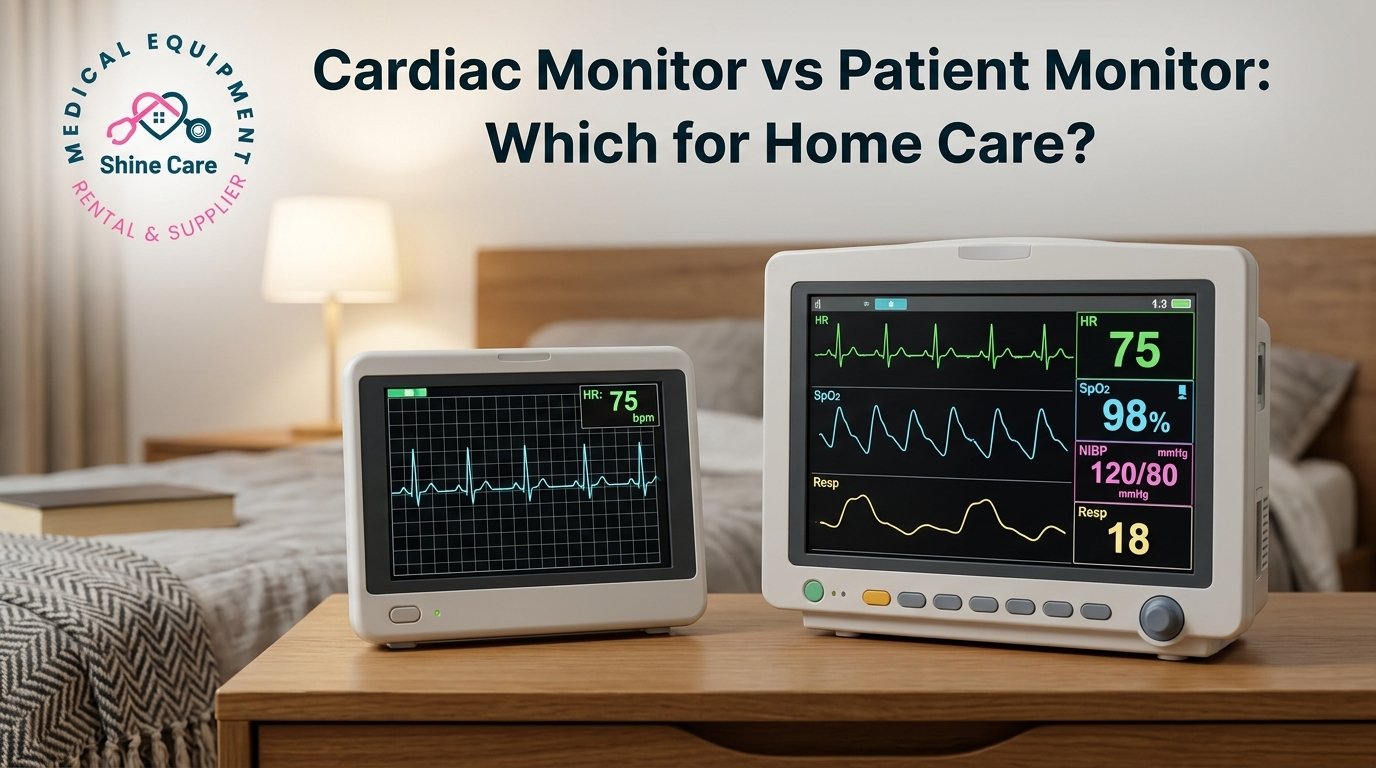
Cardiac Monitor or Patient Monitor: The Difference — A Practical Guide
When a family arranges home care for a critically ill or post-ICU patient, one item on the equipment list often causes real confusion: monitoring. The doctor says "we need a monitor." The equipment supplier lists "cardiac monitor" and "patient monitor" as two different products at two different prices. The family is left wondering — which one does the patient actually need?
Are they the same thing? What is the practical difference between a cardiac monitor vs patient monitor in a home setting?
This guide explains the difference in plain language, walks through when each one is the right choice, and covers the practical setup families need to know before renting either device. Nothing here replaces the doctor's prescription — the treating team decides what monitoring is required. This guide helps families understand the recommendation and make the equipment side of the decision correctly.
Who Decides Which Monitor Is Needed
As with all home medical equipment, the decision on monitoring comes from the treating team, not the supplier:
- Cardiologist / Physician / ICU Consultant: Decides what parameters need to be tracked continuously at home — heart rhythm alone, or heart rhythm plus oxygen, blood pressure, breathing rate, and temperature. This decision shapes which device you need.
- Home Nurse: Uses the monitor, interprets alarms, and coordinates with the doctor when readings change. Nursing input on setup is often more useful than the equipment technician's, because the nurse actually uses it every shift.
- Equipment Supplier: Delivers, installs, demonstrates the machine, and services it. Not a clinical role.
- Family: Learns what alarms sound like, what to do first if one goes off, and when to call the nurse or doctor.
Reputable home care agencies often provide bundled arrangements — the monitor delivered and set up on the same day as the nurse starts — which is much smoother than sourcing the two separately.
The Short Answer First
Before the detail, the plain summary:
- A cardiac monitor focuses primarily on the heart — it displays the ECG waveform (heart rhythm) and the heart rate. Some models also include SpO2 (oxygen saturation).
- A patient monitor is a broader, multi-parameter device — it displays ECG and heart rate, plus SpO2, non-invasive blood pressure (NIBP), respiration rate, and temperature. Some ICU-grade models include additional parameters.
Both machines look similar from a distance — a screen, cables running to the patient, some kind of clip on a finger. The difference is in what the screen actually shows and what alarms the machine can raise.
What a Cardiac Monitor Does
A cardiac monitor is a specialised device designed for continuous heart rhythm monitoring. The core parameters it shows are:
- ECG waveform — the continuous electrical trace of the heartbeat, from which the doctor or nurse can identify abnormal rhythms
- Heart rate — beats per minute
- Alarms for heart rate outside set limits, and for certain rhythm disturbances
Some cardiac monitors also include:
- SpO2 (oxygen saturation via fingertip probe)
- A basic single-lead ECG display (compared to the multi-lead ECG on more advanced patient monitors)
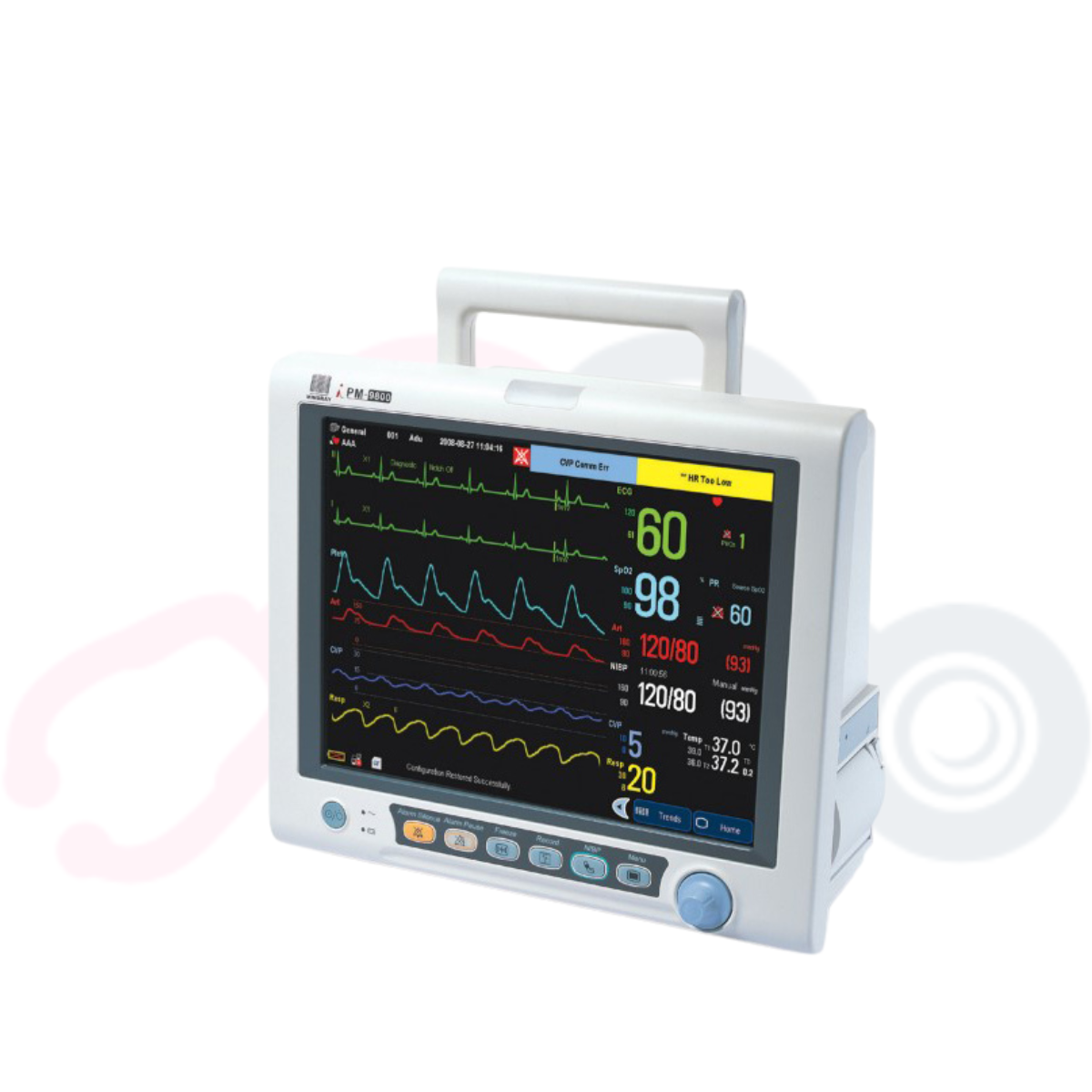
Cardiac Monitor
Reliable cardiac monitoring system focused on real-time tracking of ECG, heart rate, and basic oxygen saturation for targeted home observation.
Who Typically Needs a Cardiac Monitor at Home
- Post-cardiac surgery patients — bypass surgery, valve replacement, pacemaker implantation — for a defined period
- Patients with known dangerous heart rhythm disturbances (arrhythmias) needing ongoing observation
- Patients recovering from a heart attack in the early weeks at home
- Some patients with severe heart failure where rhythm monitoring guides medication adjustment
- Older stable ICU patients whose only ongoing monitoring need is the heart
The strength of a dedicated cardiac monitor is that it does one job very well — continuous rhythm surveillance — often at a lower rental cost than a full patient monitor. Renting a cardiac monitor on rent for a specific post-cardiac recovery period is a common and sensible arrangement.
What a Patient Monitor Does
A patient monitor is a broader, multi-parameter device — often the same category of monitor you would see beside a patient in a hospital ward or step-down unit. The parameters displayed usually include:
- ECG — heart rhythm waveform (often multi-lead)
- Heart rate
- SpO2 — oxygen saturation
- NIBP — non-invasive blood pressure, taken automatically at set intervals
- Respiration rate — breaths per minute
- Temperature — via a skin or oral probe
Some ICU-grade models add invasive blood pressure monitoring, end-tidal CO2, and other advanced parameters — but these are usually beyond what a home setup needs.
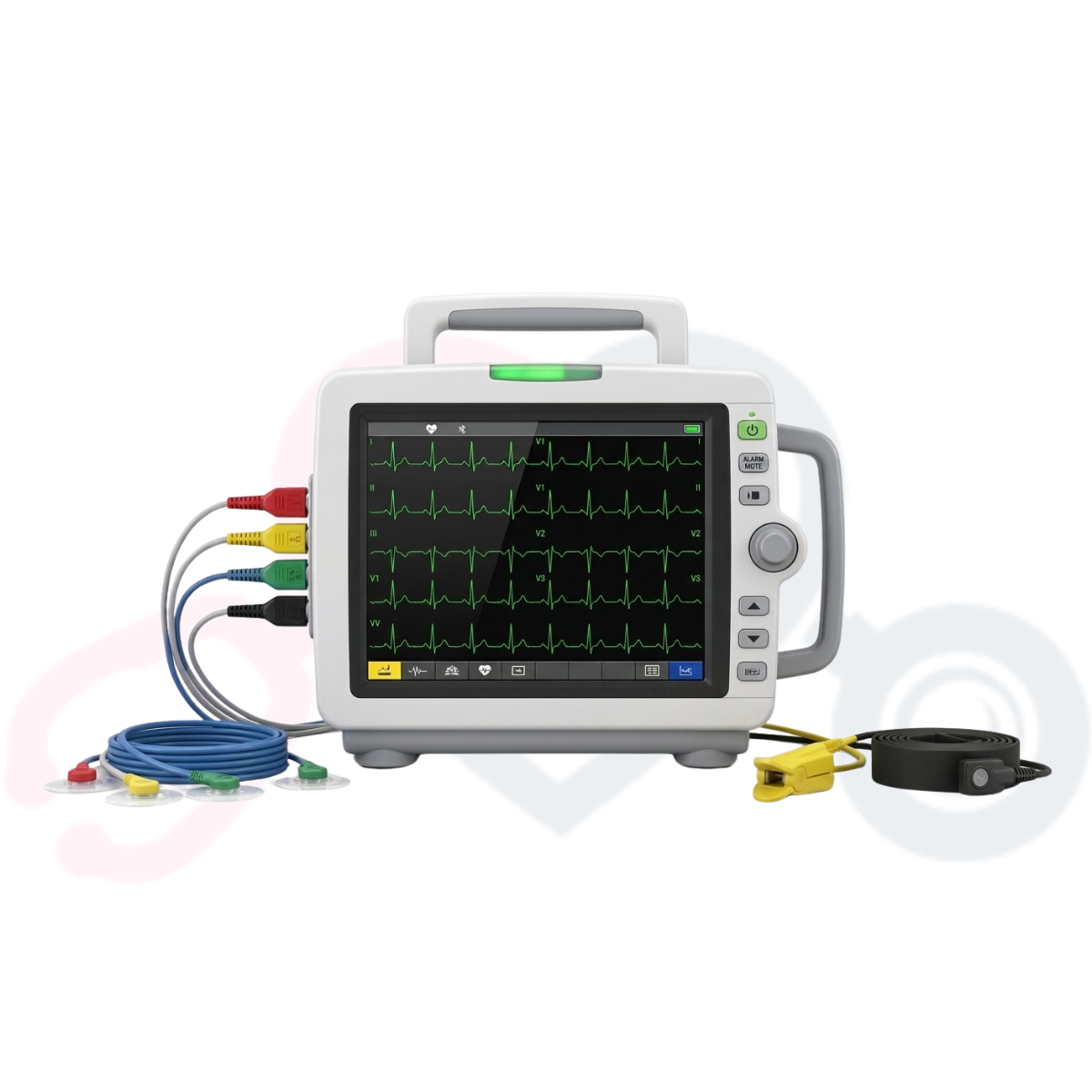
Patient Monitor
ICU-grade multi-parameter monitor for comprehensive tracking of ECG, SpO2, NIBP, Respiration, and Temperature simultaneously.
Who Typically Needs a Patient Monitor at Home
- Post-ICU discharges whose recovery still needs multi-parameter observation
- Patients on home ventilators, BiPAP with oxygen, or high-flow oxygen setups
- Post-major-surgery patients in the first days or weeks at home
- Advanced heart failure patients where BP, oxygen, and rhythm all matter
- Critically ill palliative care patients where changes in multiple parameters guide comfort measures
- Patients with tracheostomies where breathing rate needs continuous observation
The strength of a patient monitor is the complete clinical picture on one screen — the nurse or doctor can see rhythm, oxygen, blood pressure, and breathing together, which is often what is really needed for a genuinely critical patient. Renting a patient monitor on rent is standard for setting up ICU-level care at home.
Head-to-Head: Cardiac Monitor vs Patient Monitor
| Feature | Cardiac Monitor | Patient Monitor |
|---|---|---|
| Primary focus | Heart rhythm and rate | Multiple parameters together |
| ECG | Yes (usually simpler) | Yes (multi-lead in most models) |
| SpO2 (oxygen) | Often included | Yes, standard |
| Blood pressure (NIBP) | Rarely included | Yes, standard |
| Respiration rate | Rarely included | Yes, standard |
| Temperature | Rarely included | Yes, standard |
| Typical patient | Post-cardiac surgery, arrhythmia observation | Post-ICU, multi-organ instability, complex cases |
| Rental cost | Lower | Higher |
| Setup complexity | Simpler | More cables, more calibration |
| Who typically uses it | Trained caregiver or nurse | Registered nurse, especially at first |
Which One Is Right for Your Patient?
The honest answer: ask the doctor. But some common scenarios help frame the discussion:
Post-Pacemaker Implantation
Usually a cardiac monitor for the first days home, sometimes not needed at all if the patient is stable and the pacemaker interrogation showed everything is working. The doctor decides.
Post-CABG (Coronary Artery Bypass)
In the first weeks home, some patients benefit from cardiac monitoring for rhythm surveillance and to catch post-operative atrial fibrillation. Full patient monitor is usually not needed unless there are complications.
Post-ICU With Sepsis Recovery
Usually a full patient monitor for the first weeks — blood pressure trends, oxygen, and heart rate together tell the medical team whether the patient is truly recovering or slipping back.
Home Ventilator or BiPAP
Patient monitor is usually the choice — oxygen saturation, respiration, heart rate, and BP together tell the story of how well the respiratory support is working.
Advanced Heart Failure
Depending on stability, either can be appropriate. Ask about the trends the doctor wants to see — if it is mainly rhythm, a cardiac monitor works; if it is BP, weight, and multi-parameter trends, a patient monitor.
Palliative Care
Some palliative teams use monitoring sparingly — the goal is comfort, not intervention. Others use a patient monitor when medications are being adjusted for symptom control. Discuss with the palliative team before committing to rental.
Other Equipment That Goes With the Monitor
Neither type of monitor sits alone. The monitor is part of a bigger home setup:
- An adjustable hospital bed for positioning — either an electric hospital bed on rent or a manual one depending on need
- An oxygen concentrator for supplemental oxygen if the SpO2 target requires it
- A home ventilator or BiPAP machine for respiratory support in specific patients
- A suction machine for patients with airway issues
- IV stand, feeding pump, or infusion pump depending on the patient's needs
A good supplier should be able to arrange this equipment together and coordinate delivery so the room is set up in one visit, not four.
Setup and Practical Considerations at Home
Consumables
ECG electrodes, SpO2 probe covers, NIBP cuffs, and temperature probes are all consumables that need occasional replacement. Ask the supplier what is included in the rental and what you will need to buy separately. Running out of ECG electrodes at midnight is an annoyance that is easy to prevent.
Alarms — Set Them Correctly
A monitor with alarms set too tightly beeps constantly and stops being useful. Set too loosely, it misses genuine deterioration. The doctor and nurse should set alarm limits together — heart rate ranges, SpO2 threshold, BP limits. Do not silence alarms just because they are annoying — investigate why they are triggering.
Understand What the Alarms Mean
Whoever is with the patient should be able to recognise:
- A genuine emergency alarm (SpO2 dropping, dangerous heart rhythm, very low BP)
- A technical alarm (electrode came off, cable loose, low battery)
- A nuisance alarm (patient moved, cuff too tight, probe on the wrong finger)
This is what a trained nurse or a well-briefed attendant knows and a random family member does not.
Cleaning
Cables, probes, and cuffs need daily wipe-down. Reusable components need occasional deeper cleaning. Follow the supplier's instructions rather than using random household disinfectants.
Load-Shedding
Monitors are powered devices. Battery backup lasts one to several hours depending on the model. For patients on continuous monitoring, a UPS is a sensible investment. The bed, the monitor, and the oxygen concentrator can share a single UPS if sized correctly.
Common Mistakes Families Make
Renting a Cardiac Monitor Because It Is Cheaper
If the doctor wants blood pressure and oxygen trends too, a cardiac monitor alone is not enough. Making a cost decision that overrides the clinical need is where families get caught out — a monitor that misses the critical parameter is worse than no monitor at all.
Renting a Patient Monitor Without Someone Who Can Use It
An ICU-grade patient monitor is not a plug-and-play device. Family without training cannot make meaningful use of the readings, and alarms without response are just noise. Rent the monitor and the nurse together, or do not rent the monitor at all. (Consider engaging reliable home help to manage routine tasks so the nurse can focus on clinical monitoring).
Ignoring Trends in Favour of Snapshots
A single "normal" reading does not mean the patient is stable. What matters is the trend — how the numbers are changing over hours and days. The monitor stores this data; someone competent needs to review it.
Skipping the UPS
Load-shedding at 3 AM with a monitor that has run out of battery leaves the family blind to what is happening with a critical patient. Buy the UPS before you need it.
Not Coordinating with the Nurse Team
Some families source the monitor from one supplier and the home help team from a different agency. When the alarm goes off, the nurse is not familiar with this specific model, the settings are not what they usually work with, and time is lost. Coordinating both together — through the same provider or through matched providers — makes a real difference.
Red Flags: When to Escalate Beyond the Monitor
The monitor is a tool. It is not treatment. If any of the following happens while a patient is being monitored at home, contact the doctor immediately or take the patient to the nearest emergency room / call 1122:
- SpO2 dropping repeatedly below the doctor's target and not recovering
- Systolic BP below 90 or above 180 with symptoms
- New dangerous heart rhythm on the ECG (ask the nurse before setup — what rhythms trigger a call)
- Sudden increase in breathing rate above the alarm threshold
- New chest pain, confusion, or difficulty breathing
- Bluish lips or fingertips despite oxygen running
- Any equipment failure with no backup available
These are medical situations. Monitors help you see them earlier — they do not solve them.
For patient-friendly background on home monitoring and warning signs of heart problems, the American Heart Association guide to heart failure warning signs is a reliable reference. For your patient's specific parameters, always follow the treating doctor's plan.
Frequently Asked Questions
This page is for general information regarding patient monitoring equipment and does not constitute medical advice. Always consult with the treating physician regarding the appropriate level of monitoring for your patient's specific condition.