
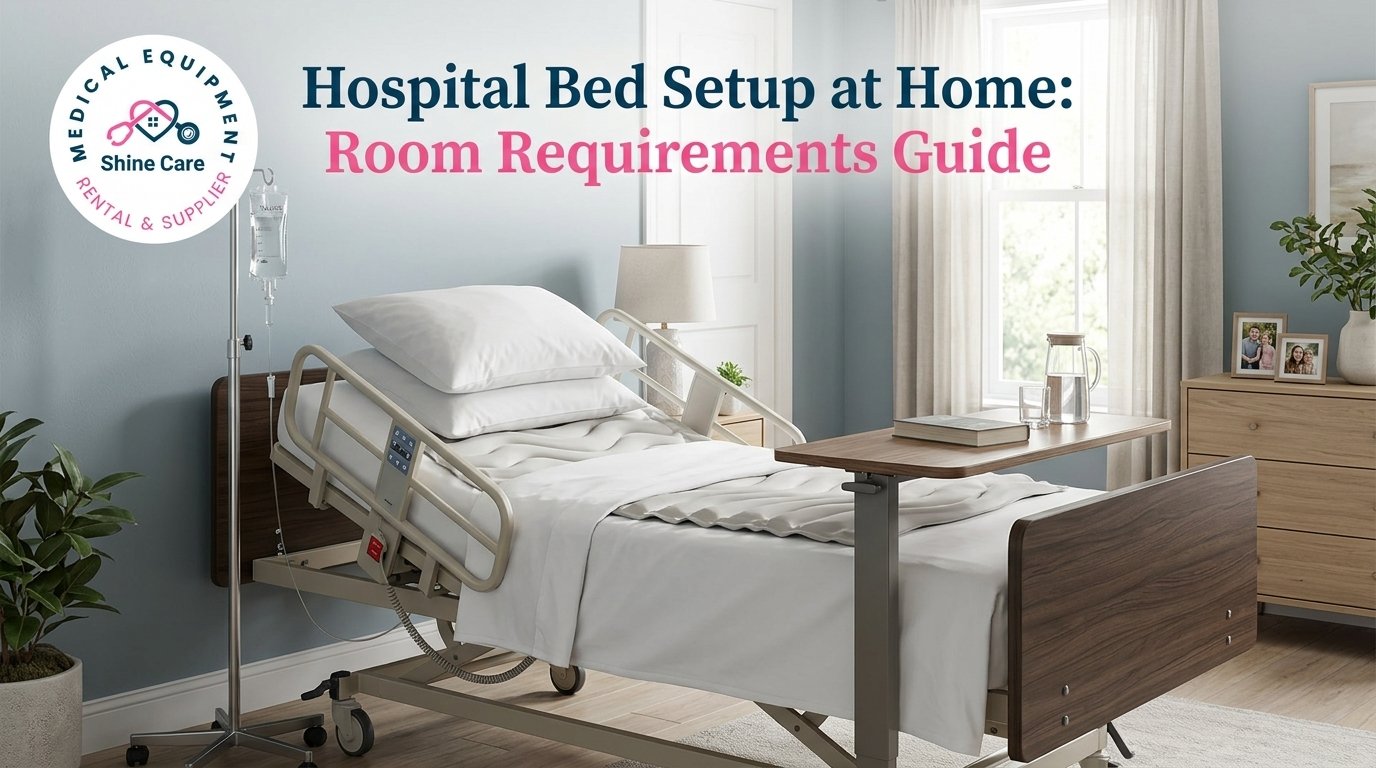
Setting Up a Hospital Bed at Home: Room Requirements — A Practical Guide
The moment a family in Pakistan realises they need a hospital bed at home is usually the moment reality hits. Someone in the family is coming home from hospital who cannot easily transfer to a normal bed, or an elderly parent has become bedridden and the ordinary charpai or divan is no longer safe. The family calls an equipment supplier, a bed is delivered, and only then does everyone realise — the doorway is too narrow. The room is too small. There is no wall socket where the head of the bed needs to sit. The mattress that came with it is not the pressure-relief kind. Suddenly what should have been a one-day setup becomes a week of scrambling.
This guide walks families through hospital bed setup at home realities — room measurements, doorway checks, power arrangements, mattress choices, and the practical items that need to sit alongside the bed. Nothing here replaces the doctor's or physiotherapist's specific recommendation for the patient — but it will help you avoid the expensive mistakes families commonly make in the first days.
Why a Hospital Bed at Home Matters
A proper hospital bed is not the same as an ordinary bed with rails added. Hospital beds provide:
- Adjustable head elevation — for eating, breathing, watching TV, and reducing risk of aspiration
- Adjustable knee elevation — reduces sliding down and improves circulation
- Adjustable overall height — protects caregivers' backs during care, and lowers to safe transfer height for the patient
- Side rails — prevent falls out of bed
- Solid frame for pressure-relief mattress — many pressure-relief mattresses only work on a proper hospital bed frame
- Attachment points — for IV stands, trapeze bars, and other accessories
Trying to substitute an ordinary bed for a genuine hospital bed leads to preventable pressure sores, worse aspiration risk, back injuries in caregivers, and unsafe transfers. For any patient who will be bedridden for more than a few weeks, a proper hospital bed is not a luxury — it is the safest option.
Who Decides Which Bed Is Needed
- Doctor / Physician / Physiatrist: Decides the medical need for a hospital bed and what features are essential based on the patient's condition — head elevation for reflux or breathing issues, height adjustment for transfers, side rails for safety.
- Physiotherapist: Advises on transfer needs and mobility considerations that shape which bed and which accessories fit.
- Occupational Therapist: Where available, does a room assessment.
- Registered Nurse: Sets up the room in coordination with the equipment supplier, teaches family safe use, and manages the daily care that happens on and around the bed.
- Equipment Supplier: Provides options, delivers, installs, demonstrates. Not clinical — do not accept a supplier telling you which bed is medically right for the patient.
- Family: Runs the practical setup and coordinates the team.
Reputable home care agencies usually coordinate the bed delivery with a nurse setup so the family is not left to figure it out alone.
Types of Hospital Beds
Manual Hospital Bed
Head, foot, and height adjustments controlled by hand cranks at the foot of the bed. Someone has to turn the crank each time an adjustment is needed. Cheaper to rent or buy, no electricity required, and reliable during load-shedding. But cumbersome — every position change is a physical task for the caretaker.
Suitable for: patients who do not need frequent position changes, load-shedding-prone areas, families on tight budgets, short-term needs. Renting a manual hospital bed on rent is common for short-term recovery periods.
Semi-Electric Hospital Bed
Head and foot adjustments are electric (controlled by a hand pendant), but height adjustment is manual. A middle-ground option.
Fully Electric Hospital Bed
All adjustments — head, foot, height — controlled electrically by a hand pendant. The patient can often adjust the bed themselves without needing a caretaker for every change. Transformative for patient independence and for caregiver back safety.
Suitable for: long-term bedridden patients, patients who need frequent adjustments, patients on ventilator or continuous care who cannot wait for someone to crank the bed. Renting an electric hospital bed on rent for long-term or critical care is standard.
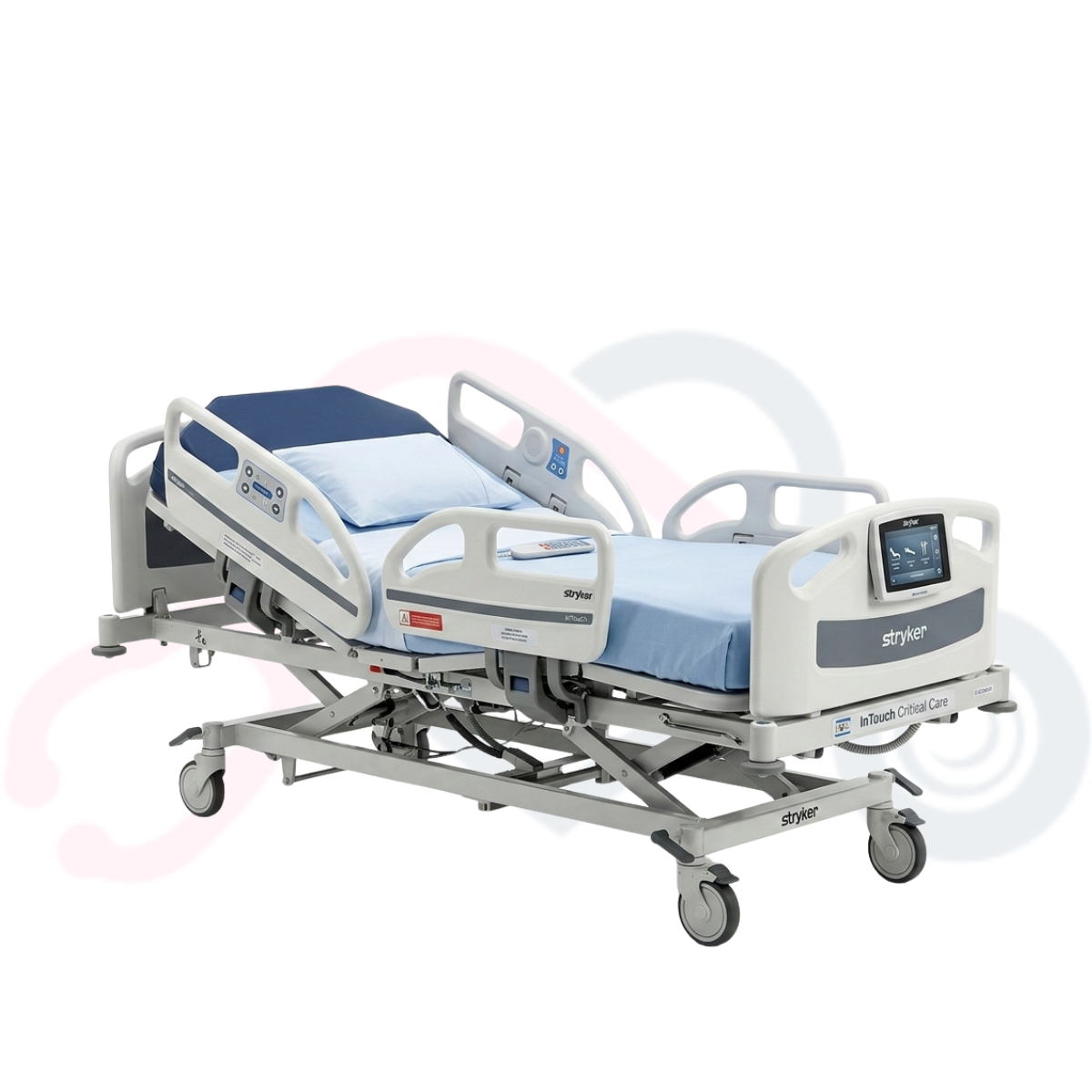
Electric Hospital Bed
Imported electric ICU bed providing automated positioning via remote control. Ideal for patients requiring frequent repositioning without physical strain on caregivers.
Bariatric Hospital Bed
Reinforced frames and wider mattresses for patients over the standard weight limit (usually about 135 kg). Essential for heavier patients — standard beds have safety limits.
ICU-Grade Beds
More advanced beds with features like tilt, CPR release, and integrated weighing. Usually for very complex home ICU setups.
Room Measurement Checklist
Before ordering any bed, measure the room carefully. Standard hospital beds are around 200–210 cm long and 90–110 cm wide. To fit and function properly, the room needs:
Bed Space Itself
- Length: bed length plus at least 15 cm at head and foot
- Width: bed width plus at least 90 cm clear on at least one side (better both) for transfers
- Ideally, a third side clear for equipment access
Doorway
Most hospital beds break down for delivery but need at least 75–80 cm doorway clearance to bring in. Measure your bedroom door, any hallway doors on the route, and any tight turns. A bed that will not fit through the door is a real and common problem.
Turn Radius
Consider the corridor and turn from the front door to the bedroom. If the corridor is narrow with a sharp turn, the bed may not physically get to the room.
Ceiling Height
Rarely a problem for standard beds. Matters for beds with trapeze attachments or lift systems.
Power and Electrical Setup
Power Socket
An electric hospital bed needs a wall socket within reach of where the bed will sit. Cables trailing across the room are trip hazards.
Stabiliser
Pakistani voltage fluctuates. A voltage stabiliser protects the bed's motor from damage during surges and drops.
UPS / Backup Power
For patients on continuous critical equipment (ventilator, feeding pump, oxygen concentrator) sharing the bed's room, a UPS is essential. For the bed alone, a UPS is nice but not essential — an electric bed can be operated manually or left in a comfortable position during load-shedding.
Additional Sockets
You will need power for other equipment near the bed — oxygen concentrator, suction machine, patient monitor, syringe or infusion pump, nebuliser. Plan for multiple sockets or a multi-outlet extension with surge protection.
Mattress — The Most Underestimated Decision
Many equipment suppliers include a basic foam mattress with the bed. For any long-term bedridden patient, this is not enough. Pressure sores develop quickly on inadequate mattresses.
Standard Foam Hospital Mattress
Basic. Suitable only for short-term use or patients who can shift position independently.
High-Density Foam Mattress
Better pressure distribution. Suitable for patients with limited mobility but who can shift some weight.
Alternating-Pressure Air Mattress
A powered mattress with air cells that inflate and deflate in a pattern, continuously shifting the pressure points on the patient's body. Essential for genuinely bedridden patients — dramatically reduces pressure sore risk. Renting an air mattress on rent alongside a hospital bed is the standard combination for long-term bedridden care in Pakistani households.
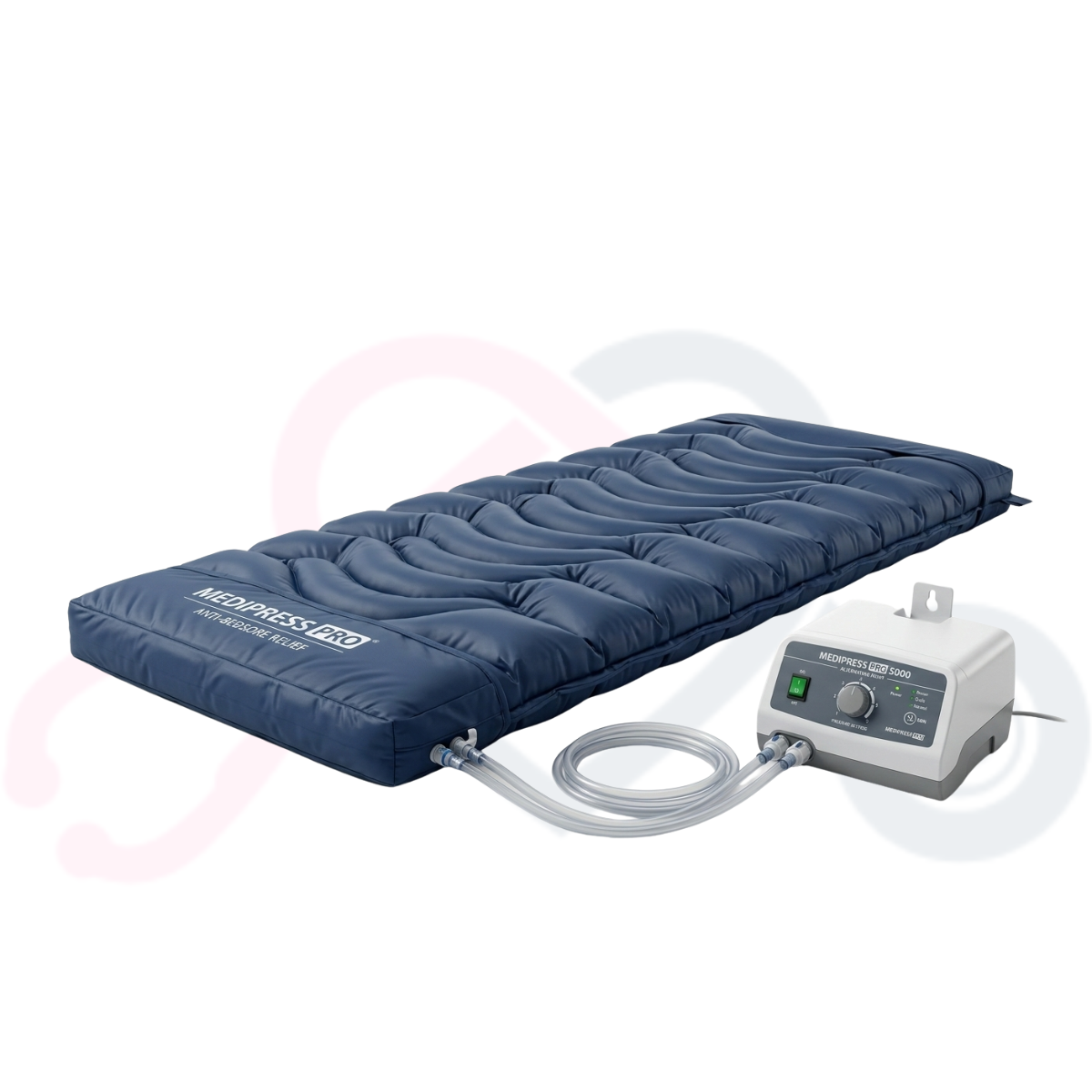
Medical Air Mattress
Alternating pressure pad and pump system designed to prevent and treat bedsores for bedridden patients.
Low Air Loss Mattress
More advanced — releases small amounts of air continuously to keep the skin dry as well as relieving pressure. For patients at highest pressure sore risk.
What to Consider
Do not accept "the mattress that came with the bed" for a long-term bedridden patient without asking whether pressure-relief upgrade is needed. Ask the doctor and the nurse.
Essential Bed Accessories
Side Rails
Full-length or half-length. Half-length allows the patient to enter and exit the bed more easily; full-length gives more protection against falls. Both have safety considerations — a confused patient can become trapped in badly designed rails.
Trapeze Bar
An overhead bar the patient can grip to reposition themselves. Useful for patients with strong arms recovering from lower body issues (post-hip surgery, spinal injury with arm function preserved).
Overbed Table
An adjustable table that fits over the bed for meals, activities, medications. An overbed table on rent transforms daily life for bedridden patients — meals stop being a struggle, and the patient can hold books, phones, or personal items easily.
IV Stand
For patients on IV fluids, medications, or feeds. A separate IV stand on rent beside the bed keeps the setup organised.
Pillows
Not the ordinary bedroom kind. Bedridden patients often need multiple pillows for positioning — one behind the back, one between the knees, one under the ankles to lift the heels, and so on.
Sheets and Bedding
Hospital beds are longer than standard beds. Regular household sheets often do not fit. Fitted sheets sized for hospital beds, waterproof mattress covers, and disposable bed pads for incontinent patients are all part of the setup.
Room Setup Around the Bed
Bedside Table Within Reach
Water, medications, phone, TV remote, call bell, tissues — all within arm's reach. A bedridden patient should not have to call for someone to hand them a glass of water.
Call Bell or Buzzer
Some way for the patient to summon help if left alone in the room. Simple bells work; battery-powered wireless buzzers are better; hospital-style pull cords are best.
Wheelchair Nearby
For any patient who transfers out of bed. Positioned where the transfer will happen, not across the room.
Commode Chair
Bedside commode for patients who cannot walk to the bathroom. Positioned within reach of the bed.
Adequate Lighting
Bedside lamp the patient can operate. Ceiling light with a switch near the bed. Night light for overnight visibility. Avoid harsh overhead lighting that shines directly in the patient's eyes.
Ventilation
Fresh air is important. Windows that open for daytime ventilation. Fan or AC as the season requires. Adequate airflow prevents smells building up and improves patient comfort.
Space for Equipment
If the patient needs oxygen, suction, feeding pump, or other equipment, plan the room layout so this equipment sits where it can be accessed and where its noise and heat are tolerable.
Space for Caretaker
Somewhere the caretaker or attendant can sit or rest during long shifts. A chair by the bed, not across the room.
Delivery and Installation Day
Clear the Route Before Delivery
Move furniture out of the way. Check the path from the front door to the room. Roll up rugs. Move fragile items.
Have Family or Caretaker Present
Someone who knows the layout should be there when delivery happens. The supplier's team will need direction.
Test Everything Before They Leave
- Bed raises and lowers
- Head and foot adjust
- Side rails go up and down
- All wheels lock properly
- Motor works quietly
- Pendant controls all functions
- Mattress is the type you ordered
If anything does not work, get it fixed before the delivery team leaves. Follow-up service calls are a hassle.
Get a Demonstration
Ask the delivery team or the nurse to show the family and caretaker how to operate the bed safely. Include how to reposition the patient using the bed's adjustments, how to lock the wheels, and what to do during power outages.
Save the Contact Information
Supplier's phone number, service contact, warranty details — write them down and put them by the bed. When something goes wrong at 10 PM you do not want to be searching for it.
Common Mistakes Families Make
Not Measuring Before Ordering
The bed arrives and does not fit through the door. Or fits but leaves no space for care around it. Always measure first.
Skipping the Pressure-Relief Mattress
The bed comes with a basic mattress. Family thinks that is enough. Pressure sores develop in 2 weeks. Ask about upgrading to alternating pressure for any bedridden patient before delivery, not after.
Placing the Bed Against a Wall on Both Sides
Care and transfers need access from both sides. A bed with only one accessible side means the caretaker cannot rotate the patient properly or provide care on the far side.
Not Setting Up Power Backup for Continuous Equipment
A patient on ventilator or continuous oxygen without UPS backup during load-shedding is a genuine emergency. Plan the power arrangements as carefully as the bed itself.
Renting a Manual Bed for a Long-Term Bedridden Patient
Cheaper up front but the caretaker's back suffers, and adjustments happen less often than they should. Electric usually pays off for long-term use.
Not Coordinating the Bed With a Wheelchair
The bed height and the wheelchair height should match for safe transfers. Renting a wheelchair on rent at the same time as the bed lets you match the heights before delivery.
Not Anticipating the Full Equipment Set
Some patients need an oxygen concentrator, some need a suction machine, some need a nebuliser. Coordinating the full setup — a suction machine on rent, an oxygen concentrator, an air mattress — with a single supplier avoids multiple delivery days and mismatched equipment.
Rent vs Buy
Rent
For short-term needs (weeks to a few months) — post-surgery recovery, post-fracture, temporary illness. Renting is almost always the sensible choice. No storage problem after use, no maintenance responsibility, service is usually included.
Buy
For confirmed long-term use (years) — chronic conditions, permanent bedridden status. Buying can work out cheaper over time. But consider that patient needs change; the bed you buy today may not suit the patient in two years.
Rent Then Buy
Some families rent initially to confirm the bed type suits, then purchase for long-term. Ask the supplier whether rental payments can be applied toward purchase.
Red Flags: When to Contact the Supplier or Doctor
Contact the supplier for any of the following:
- The bed's motor stops working, whirrs abnormally, or emits a burning smell — stop use, unplug, call supplier
- Any part of the frame becomes loose or damaged
- The mattress develops significant sagging or damage
- Side rails do not lock securely
- Wheels do not lock properly
Contact the doctor or nurse for any of the following:
- New pressure area, redness, or skin breakdown on the patient
- Bed sores worsening despite mattress and repositioning
- Patient falls from the bed
- Signs the current bed setup is not meeting the patient's evolving needs
For patient-friendly background on preventing bedsores and safe bed positioning, the NHS guide to pressure sores is a reliable reference. For your patient's specific setup, always follow the treating doctor's and nurse's advice.
Frequently Asked Questions
This page is general information about equipment rental and is not medical advice. Medical equipment should be selected and used according to a doctor or physiotherapist's guidance to ensure patient safety and comfort.