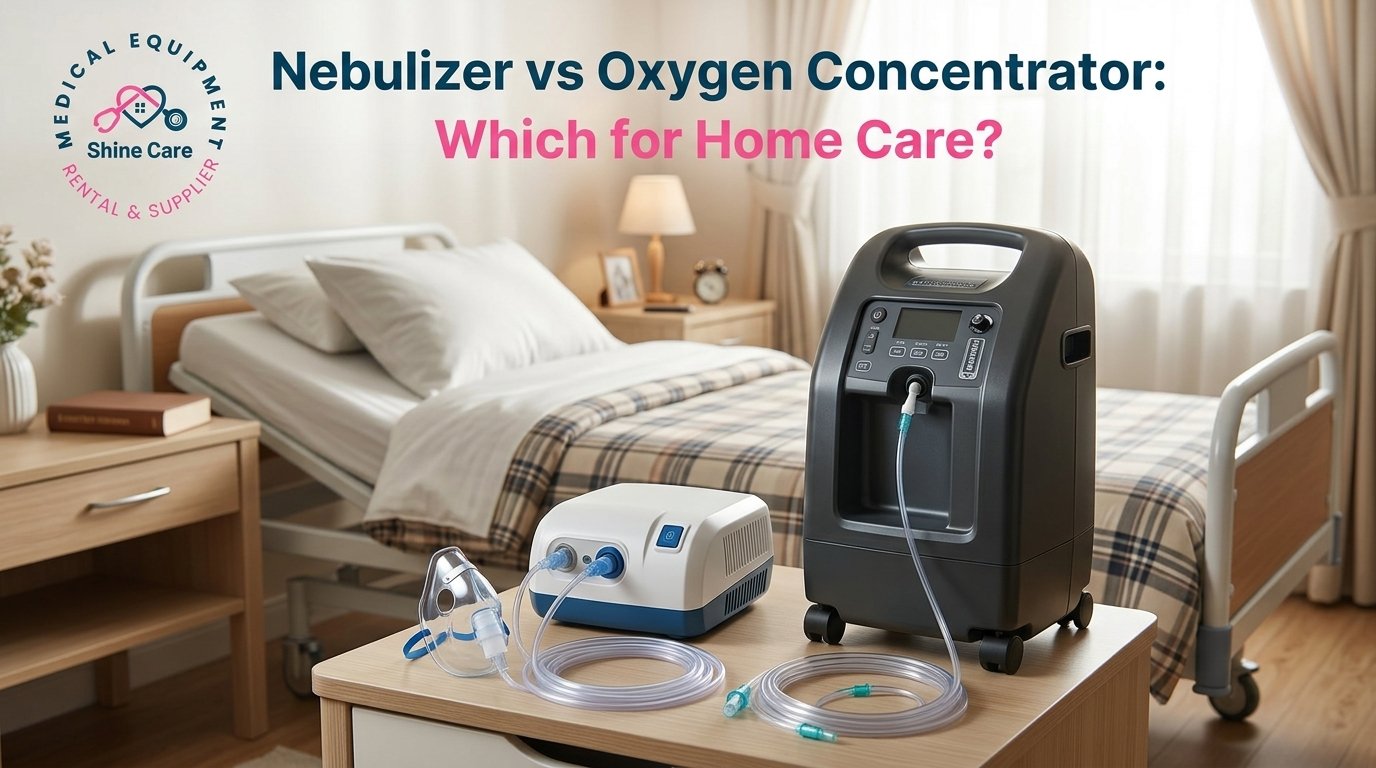
Nebulizer or Oxygen Concentrator: Which Is Needed? — A Practical Guide
Two of the most commonly rented pieces of respiratory equipment in Pakistani homes are also two of the most commonly confused. A grandmother has a bad chest, the doctor mentions "we need something for breathing", and the family goes to the equipment shop. There they see a nebulizer for one price and an oxygen concentrator for a much higher price, both connected to something with tubing and a mask. Which one does the doctor mean? Are they the same? Do we need both? And what happens if we rent the wrong one and only find out at 2 AM when the patient becomes short of breath?
This guide explains the difference in plain language, walks through when each is the right choice, and covers the practical side of running either at home. Nothing here replaces the doctor's prescription — the treating team decides what respiratory equipment is needed. This guide helps families understand the reasoning and make the right equipment decision.
Who Decides Which One Is Needed
The decision belongs to the treating team, not the equipment supplier:
- Doctor / Pulmonologist / Physician: Decides what the patient's respiratory problem actually is and what treatment they need. A patient with asthma needs a specific medication delivery — usually a nebulizer or inhaler. A patient with low blood oxygen needs supplemental oxygen. Different problems, different tools.
- Registered Nurse: Sets up the equipment correctly, teaches the family safe operation, and monitors for problems. Ongoing home use often benefits from periodic nursing review.
- Equipment Supplier: Delivers, installs, demonstrates the device, and provides consumables. Not a clinical role.
- Family: Learns how to use the equipment safely, watches for warning signs, and reports back to the doctor.
Reputable home care agencies typically coordinate the equipment and, where needed, the nursing input together. Renting complex respiratory equipment without any trained clinical support at least at setup is a risk families sometimes underestimate.
The Short Answer First
Before the detail:
- A nebulizer turns liquid medication into a fine mist that the patient breathes in through a mask or mouthpiece. It delivers medications to the airways.
- An oxygen concentrator pulls in room air, concentrates the oxygen, and delivers pure oxygen through a nasal cannula or mask. It delivers oxygen to the lungs.
Same broad category (respiratory support), completely different jobs. A patient with an asthma attack needs medication delivered by nebulizer. A patient with pneumonia and low oxygen levels needs supplemental oxygen. Some patients — for example a COPD patient in an exacerbation — need both.
What a Nebulizer Does
A nebulizer is a small compressor unit connected by a hose to a medication cup. The compressor forces air through the cup, breaking the medication into a fine aerosol that the patient inhales.
Key Features
- Compact — sits on a table
- Powered by mains electricity; some portable models run on battery
- Medication cup, tubing, mask or mouthpiece as accessories
- Typical session 5–15 minutes
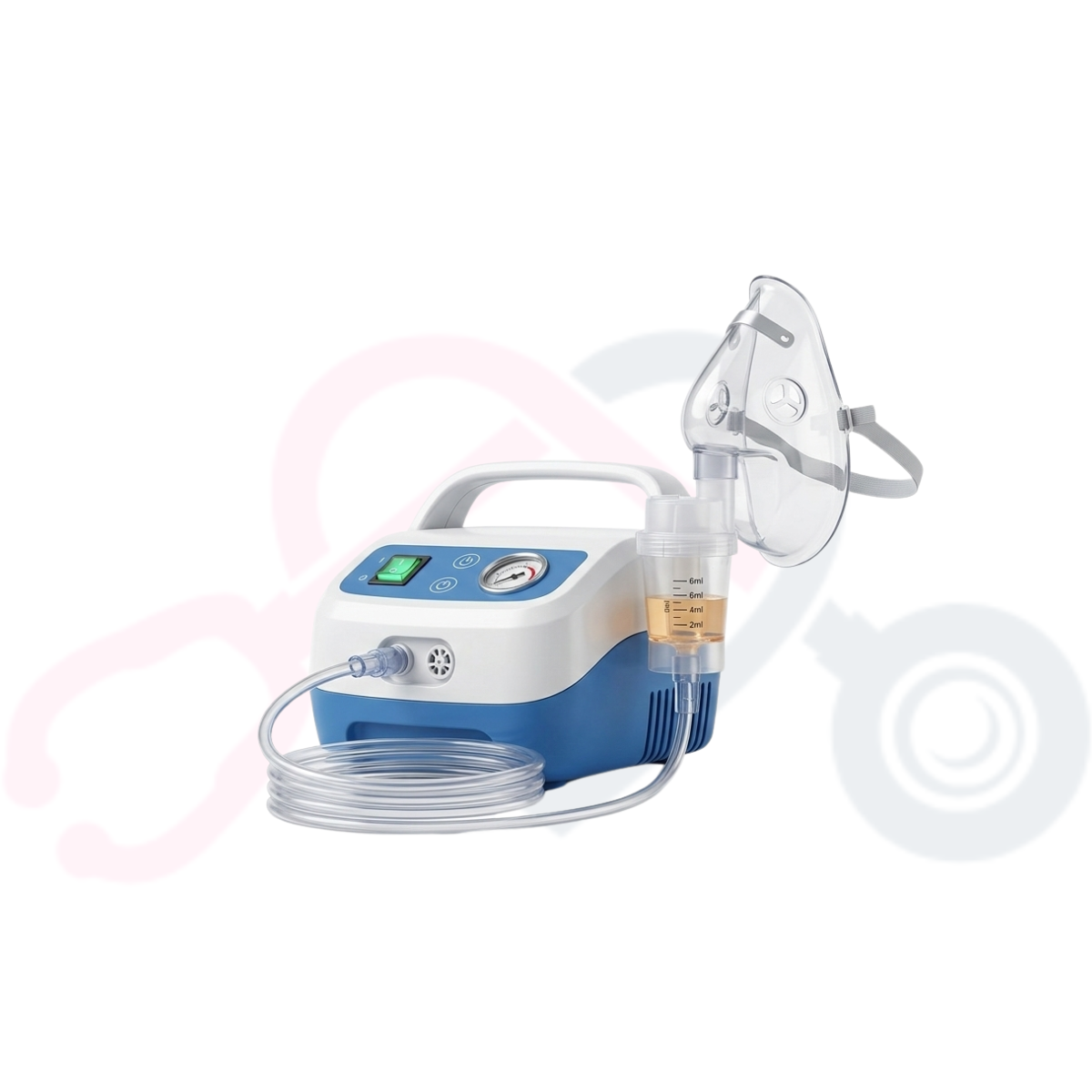
Nebulizer Machine
Compressor nebulizer machine designed to convert prescribed liquid medication into a breathable mist.
Common Medications Delivered
- Salbutamol (Ventolin) — for asthma, COPD, bronchospasm
- Ipratropium — for COPD and asthma
- Saline — for loosening thick secretions
- Steroids (budesonide, for example) — for anti-inflammatory effect
- Some antibiotics for specific conditions
Who Typically Needs a Nebulizer at Home
- Asthma patients, especially children and elderly, during attacks
- COPD patients on regular bronchodilator therapy
- Bronchiectasis and cystic fibrosis patients needing regular saline or antibiotic delivery
- Patients recovering from pneumonia with thick secretions
- Bedridden patients with chest problems where inhaler technique is not reliable
- Post-tracheostomy patients needing regular airway medications
The strength of a nebulizer is that it delivers medication reliably even when the patient's breathing technique is poor (young children, elderly with weak breath, patients too breathless to use an inhaler correctly). Renting a nebulizer on rent for a defined chest illness recovery is one of the most common medical equipment arrangements in Pakistani households.
What an Oxygen Concentrator Does
An oxygen concentrator takes in room air (which is about 21% oxygen), passes it through filters that remove nitrogen, and delivers concentrated oxygen (usually 90–95% pure) through tubing to a nasal cannula or mask.
Key Features
- Larger, floor-standing unit
- Runs on mains electricity — significant power draw
- Adjustable oxygen flow rate — typically 1 to 5 litres per minute
- Delivers oxygen continuously for as long as the machine is running
- No refilling required (unlike oxygen cylinders)
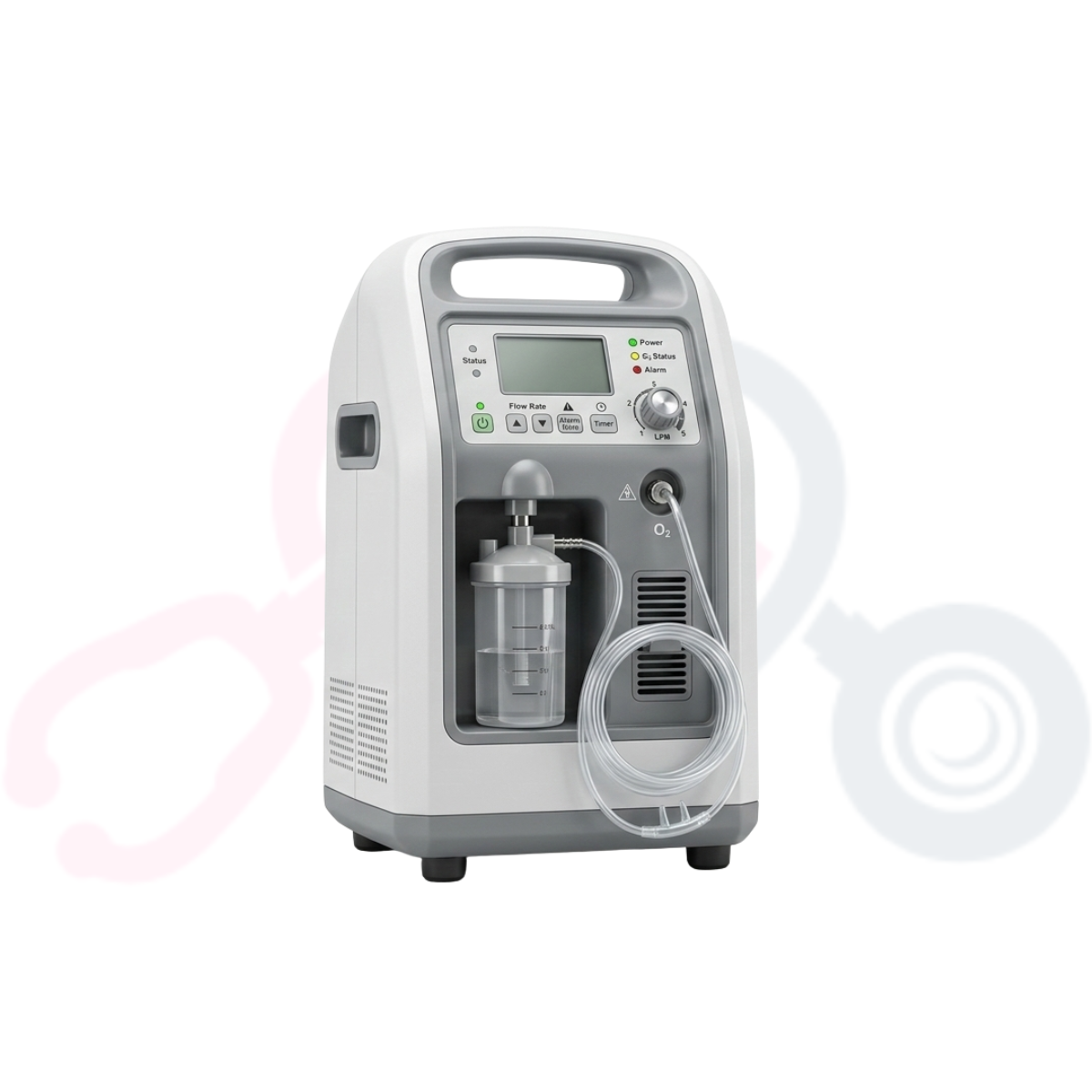
Oxygen Concentrator (5 Liters)
Reliable electric oxygen machine producing up to 5LPM continuous oxygen. Low noise operation.
Who Typically Needs an Oxygen Concentrator at Home
- COPD patients with chronic low oxygen levels needing long-term oxygen therapy
- Advanced heart failure patients with low oxygen
- Pulmonary fibrosis and other chronic lung diseases
- Post-COVID patients still needing supplemental oxygen during recovery
- Recovering pneumonia patients whose oxygen has not yet fully returned
- Some palliative care patients for symptom relief
- Post-ICU patients still weaning off oxygen
How Much Oxygen Is Needed?
Prescribed in litres per minute (LPM). Typical ranges:
- 1–2 LPM — mild need
- 2–4 LPM — moderate
- 4–5 LPM — high, at the top of what a home concentrator delivers
- Higher than 5 LPM — usually needs cylinder oxygen or high-flow systems
The doctor sets the specific target based on the patient's oxygen saturation (SpO2). Do not adjust the flow rate without medical instruction — too much oxygen in certain patients (some COPD) can be dangerous. Renting an oxygen concentrator on rent is standard for extended oxygen therapy at home.
Head-to-Head: Nebulizer vs Oxygen Concentrator
| Feature | Nebulizer | Oxygen Concentrator |
|---|---|---|
| Primary purpose | Deliver liquid medication as mist | Deliver concentrated oxygen |
| What it treats | Bronchospasm, thick secretions, airway inflammation | Low blood oxygen levels |
| Duration per session | 5–15 minutes per treatment | Continuous use — hours or 24/7 |
| Power draw | Modest | Significant — needs strong power supply |
| Rental cost | Lower | Significantly higher |
| Portability | Portable, easy to move | Larger, mostly stationary; portable models exist |
| Common conditions | Asthma, COPD flares, bronchiectasis | Chronic COPD, heart failure, post-COVID recovery |
| Needs medication prescription | Yes — for the medications used | Yes — for the flow rate and duration |
| Load-shedding concern | Session can be delayed briefly | Backup power essential for continuous users |
Which One Is Right for Your Patient?
Start with the doctor's diagnosis. Some common situations:
Acute Asthma Attack
Nebulizer with salbutamol. Not oxygen — the primary problem is bronchospasm, not low oxygen. Once the airways open, breathing improves. If oxygen levels are also low, both may be needed briefly.
COPD Exacerbation
Nebulizer for bronchodilators and often supplemental oxygen if saturation is low. Both together during the acute phase.
Chronic COPD With Low Baseline Oxygen
Long-term oxygen therapy from a concentrator. Nebulizer as needed for regular bronchodilator use. Often both, used differently.
Post-COVID Recovery With Low Oxygen
Oxygen concentrator during recovery until oxygen levels return to normal.
Advanced Heart Failure
Oxygen concentrator if oxygen levels are low. Nebulizer only if there is a coexisting airway problem.
Pneumonia Recovery
Depends on severity — mild cases may need neither at home; more severe recovery may need both.
Pulmonary Fibrosis
Oxygen concentrator, sometimes at high flow rates. Nebulizer may or may not be part of the plan.
Bedridden Patient With Chest Complications
Often both — nebulizer for regular airway medication delivery, and oxygen concentrator when saturation drops.
What About Oxygen Cylinders and BiPAP?
Worth briefly clarifying the wider category:
Oxygen Cylinder
A metal cylinder containing compressed oxygen. Deliver the same gas as a concentrator but through a pressure regulator. Needs periodic refilling. Useful as a backup, for portable use, and for very high flow rates that exceed concentrator capacity. Renting an oxygen cylinder alongside a concentrator is common — the concentrator for continuous use, the cylinder for load-shedding backup or emergencies.
BiPAP Machine
Provides pressure-supported breathing — not the same as oxygen. BiPAP is used for patients with sleep apnoea, certain COPD situations, and specific respiratory failure cases where the muscles cannot generate enough breathing on their own. A BiPAP machine may be used with or without added oxygen. Different problem, different tool.
Ventilator
Full respiratory support — usually for patients unable to breathe adequately on their own. Home use of a home ventilator requires specialised setup and continuous trained nursing presence.
Setting Up Either Machine at Home
Power Supply
Both machines run on electricity. For continuous oxygen concentrator use, load-shedding is a genuine risk — a UPS or generator backup is essential. For nebulizer sessions, planning around load-shedding is usually enough.
Room Setup
- Well-ventilated area — concentrators generate heat and need airflow
- Wall socket with stabiliser for voltage protection
- Space around the machine — do not push it against a wall
- Enough tubing length for the patient to move around the immediate area
- No smoking, no naked flames, no oil-based creams near oxygen equipment — fire hazard
Consumables
Nebulizer: medication cup, tubing, mask or mouthpiece — clean and replace as instructed. Oxygen concentrator: nasal cannulas, masks, humidifier bottles — replace on schedule.
Cleaning
Both machines need regular cleaning — especially nebulizer parts, which sit in medication and grow bacteria if not cleaned. Follow the supplier's instructions.
Monitoring
A fingertip pulse oximeter is essential for anyone using an oxygen concentrator. Regular spot checks confirm the therapy is working. For nebulizer use, watching whether wheeze reduces and breathing improves shows whether the medication is working.
Practical Realities at Home
When to Use a Mask vs Nasal Cannula
Nasal cannula — comfortable, allows eating and talking, for low-to-moderate flow rates. Mask — for higher flow rates, if the patient breathes mainly through the mouth, or if higher oxygen concentration is needed. The doctor or nurse advises.
Humidifier
Dry concentrator oxygen can irritate the nose. A small humidifier bottle attached to the concentrator adds moisture. Distilled water only — not tap water. Change and clean regularly.
Safety Around Oxygen
- No smoking near the equipment or the patient using it
- No open flames — candles, gas stoves close by, incense
- No oil-based creams or vaseline on the face while using nasal cannula
- Store cylinders upright and secured
- Turn off the concentrator when not in use if the patient does not need continuous oxygen
Nebulizer Timing
Follow the doctor's schedule — usually 3–4 times a day for regular use, or as needed for reliever medications. Do not exceed the prescribed frequency.
Home Help
For elderly patients or those with cognitive impairment, someone else needs to manage the equipment safely. Coordinated suction machine is often needed alongside for patients with weak cough — the whole respiratory setup requires trained daily attention rather than family guessing.
Common Mistakes Families Make
Buying a Nebulizer for a Patient Who Actually Needs Oxygen
The most common expensive mistake. A patient whose oxygen saturation is 88% will not improve with a nebulizer alone — they need supplemental oxygen. Always ask the doctor which one is needed.
Renting an Oxygen Concentrator Without a UPS
Load-shedding leaves a critical patient without oxygen. A UPS or generator backup is essential, not optional.
Increasing the Oxygen Flow When the Patient Feels Breathless
In some COPD patients, too much oxygen can worsen breathing and cause confusion. Only adjust flow rates on medical advice.
Not Cleaning Nebulizer Parts
Medication cups and tubing that are not cleaned regularly grow bacteria that can cause chest infections. Clean after every session, deep clean weekly.
Using an Oxygen Concentrator Near Open Flames
Genuine fire risk. Household kitchens using gas stoves, or patients who smoke, are situations to think through carefully.
Skipping Prescribed Nebulizer Doses "Because He Seems Fine"
Preventive medications work by continuous use. Skipping doses when symptoms are mild often causes flares later.
Using Household Water in the Humidifier
Tap water grows bacteria and mineral deposits. Distilled water only.
Red Flags: When to Get Medical Help Urgently
If any of the following happens while a patient is using respiratory equipment at home, contact the doctor or take to the emergency room / call 1122:
- Bluish colour around lips or fingertips despite oxygen running
- Severe shortness of breath not responding to prescribed nebulizer treatments
- Oxygen saturation dropping and not recovering
- New confusion or drowsiness
- Chest pain
- Very fast breathing not settling with treatment
- Wheeze getting worse instead of better with nebuliser
- Coughing up blood
- Equipment failure with no backup available
- Fire or smoke around any oxygen equipment
For patient-friendly background on oxygen therapy, the US National Heart, Lung, and Blood Institute guide to oxygen therapy is a reliable reference. For your patient's specific setup, always follow the treating doctor's prescription.
Frequently Asked Questions
This page is for general information regarding respiratory equipment and does not constitute medical advice. Always consult with a qualified pulmonologist or physician regarding diagnoses, prescriptions, and device settings.